
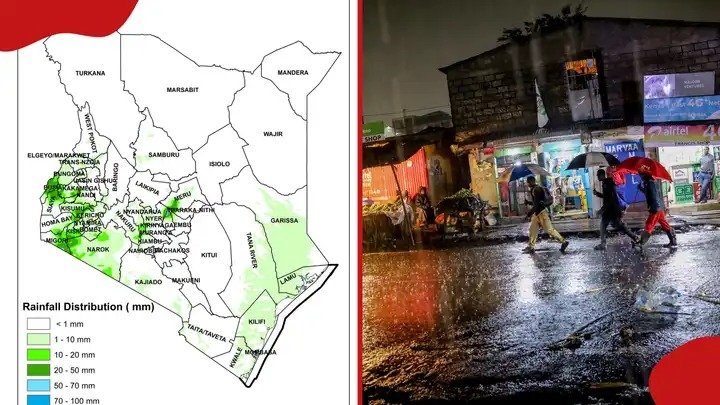

The Kenya Meteorological Department has released its weekly weather outlook for the period ending February 16, 2026, indicating that specific regions will receive rainfall even as the rest of the country experiences a significant dry spell. According to the department, while mostly sunny and dry conditions are expected to persist, isolated showers are likely in the Central Highlands, the Lake Victoria Basin, the Rift Valley, the South-eastern Lowlands, and parts of Western Kenya.
This forecast comes at a time when daytime temperatures are consistently exceeding 30°C in several parts of the country. The North-eastern and North-western regions, including counties such as Mandera, Wajir, and Garissa, are recording some of the highest temperatures, with maximums reaching up to 38°C. The Coast is also experiencing hot and humid conditions, adding to the general heat stress observed nationwide.
Meteorologists noted that the expected rainfall will likely be intermittent, occurring primarily in the afternoons and evenings. This pattern follows a review of the previous week, where isolated areas in the Lake Victoria Basin and Central Highlands recorded varying levels of precipitation. On February 7, the Suba Meteorological Station in Homa Bay County recorded the highest 24-hour rainfall total of 48.2 millimetres, demonstrating that localized heavy downpours can still occur during dry periods.
While the days are characterized by intense heat, the department warned of a sharp contrast with night-time temperatures. In higher altitude areas such as Nyahururu and parts of the Central Highlands, temperatures are expected to drop significantly during the night, leading to chilly conditions. This thermal range requires residents and workers in the construction and agricultural sectors to adapt to fluctuating environmentals throughout a single 24-hour cycle.
For the construction industry, these conditions present a dual challenge. High daytime temperatures require strict adherence to heat safety protocols for site workers to prevent dehydration and heatstroke. Conversely, the predicted rainfall in the five mentioned regions may necessitate short-term adjustments to site drainage and the scheduling of moisture-sensitive tasks.
The Met Department has emphasized that most of the country will continue to handle dry and dusty conditions until the onset of the long rains. Regional variations remain the primary feature of this week's outlook, with the Highlands West and East of the Rift Valley being the most likely to see the forecasted showers. Strong southeasterly winds exceeding 25 knots are also anticipated in parts of Marsabit and Turkana counties, which may impact logistics and high-elevation construction activities.
Comments (0)
Leave a Comment
No comments yet. Be the first to share your thoughts!