

The National Transport and Safety Authority, in coordination with the Office of the Government Spokesperson, has issued a public notice regarding hazardous road conditions following the onset of heavy rains.
Meteorological reports indicate sustained rainfall across various regions, prompting the Authority to caution the public against potentially life-threatening risks on the national road network.
Current weather patterns have significantly increased road risks, primarily due to reduced visibility and slippery road surfaces that compromise vehicle traction and braking distances.
The Authority emphasized that foggy conditions in certain areas are further complicating navigation for long-distance transporters and private motorists alike, necessitating a shift in driving behavior.
Motorists are urged to exercise extreme caution, remaining mindful of their own safety and that of other road users, particularly pedestrians who are vulnerable in wet weather.
Pedestrians have been advised to use only designated crossing points, as the risk of being struck increases when drivers face obstructed views and longer stopping times.
The safety alert also places responsibility on passengers, encouraging them to speak out or request drivers to stop if road conditions become demonstrably unsafe.
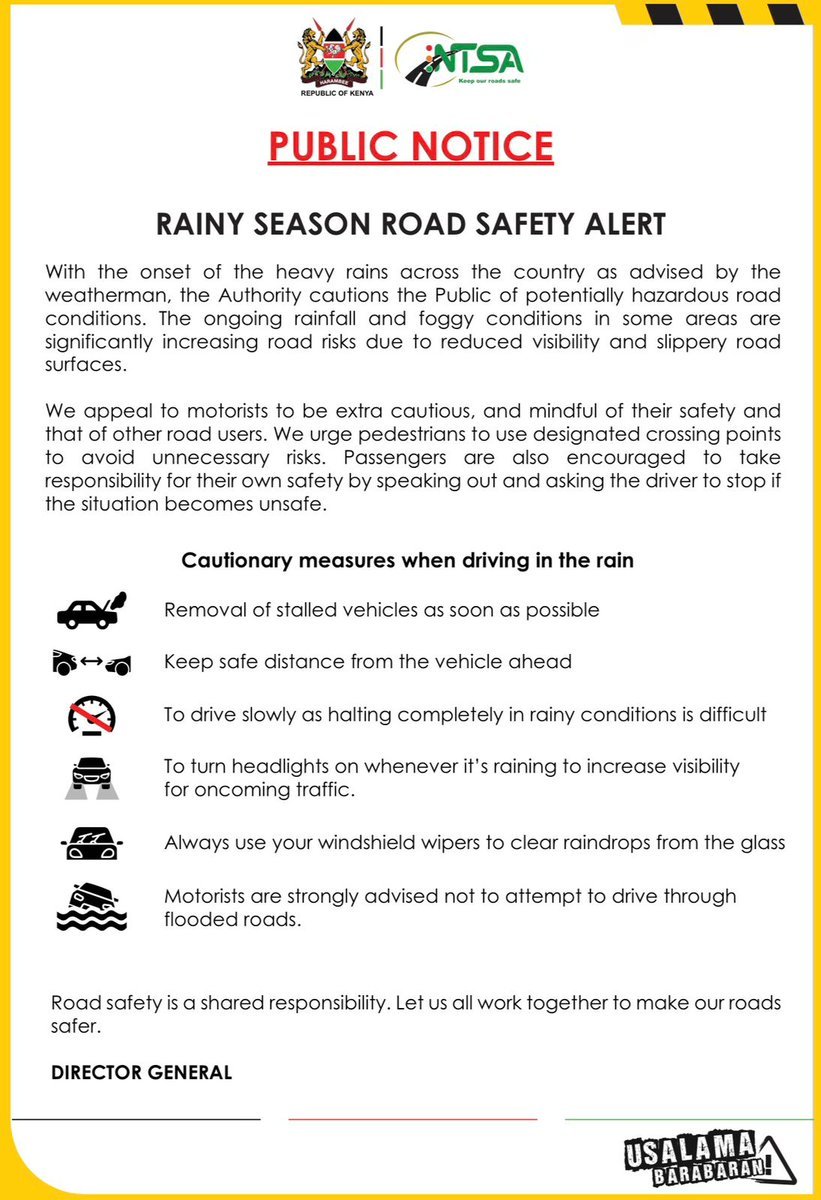
To mitigate the risk of collisions and mechanical failures, the NTSA has outlined several mandatory cautionary measures for those operating vehicles during the rainy season.
The prompt removal of stalled vehicles from the roadway is prioritized, as stationary obstacles on wet, low-visibility roads frequently lead to multi-vehicle pile-ups.
Drivers are instructed to maintain a safe following distance from the vehicle ahead, providing a necessary buffer for emergency braking on slick asphalt.
High-speed travel is discouraged, with the Authority noting that halting completely in rainy conditions is difficult when momentum is not properly managed.
Visibility remains a critical factor, and the notice mandates the use of headlights whenever it is raining to ensure oncoming traffic can identify approaching vehicles.
The continuous use of windshield wipers is essential to clear raindrops from the glass, ensuring the driver has an unobstructed field of vision.
Perhaps most critically, motorists are strongly advised not to attempt to drive through flooded roads, where water depth and current strength are often underestimated.
Flash floods can compromise road embankments and wash away sections of the pavement, creating hidden hazards that can trap or sweep away even heavy-duty vehicles.
Infrastructure integrity is often tested during these periods, with drainage systems in urban areas sometimes overwhelmed by the volume of runoff.
The NTSA reminded the public that road safety is a shared responsibility, requiring a collective effort to minimize fatalities and injuries during this seasonal peak.
By adhering to these guidelines, the government aims to reduce the strain on emergency services and prevent avoidable tragedies on the country's highways.
Ongoing monitoring of the weather and road conditions will continue, with further updates expected if the rainfall intensifies in the coming weeks.
Comments (0)
Leave a Comment
No comments yet. Be the first to share your thoughts!