
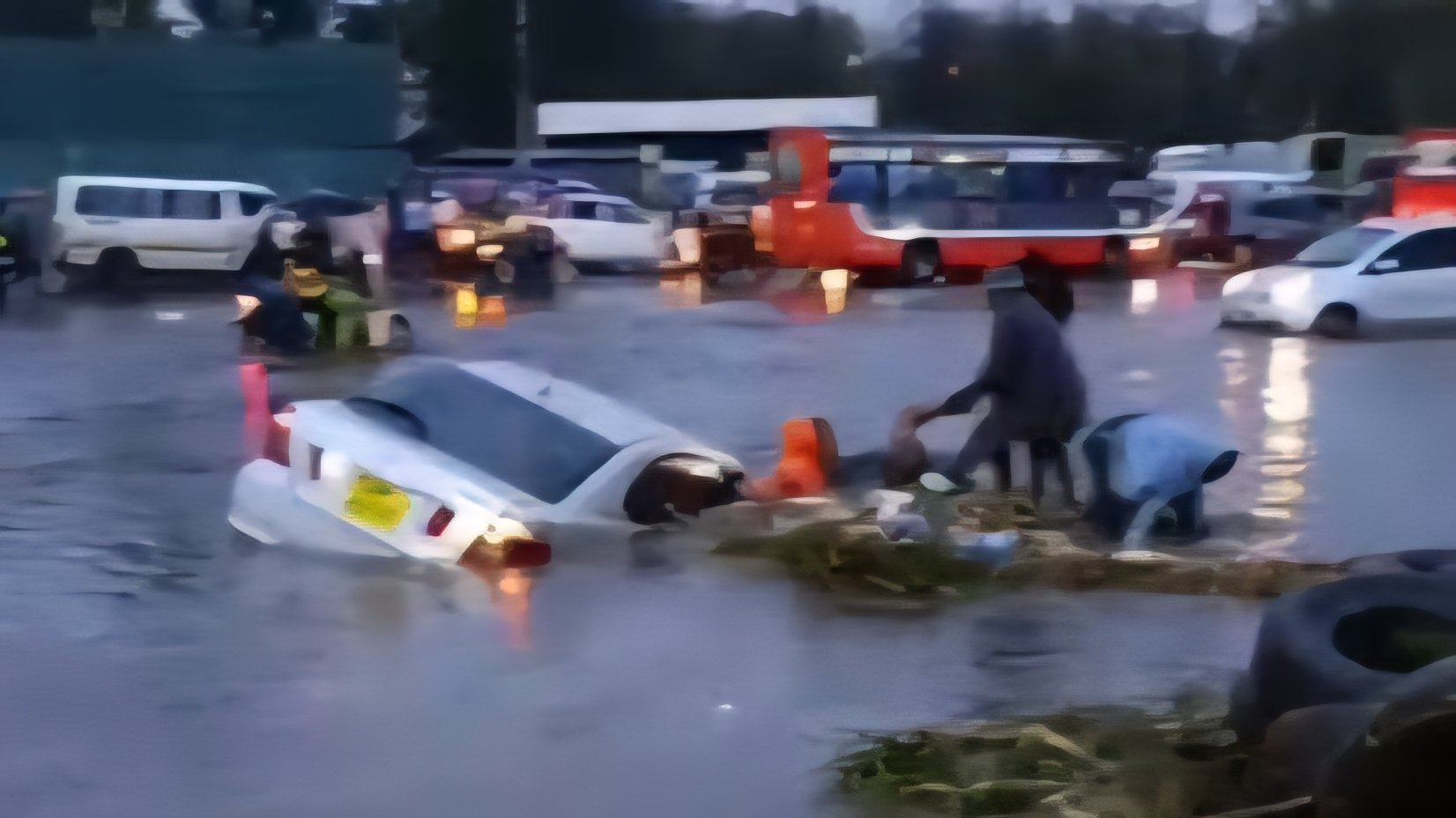

Flash floods triggered by torrential rainfall on the evening of February 17, 2026, have once again exposed significant vulnerabilities in the drainage design along the Ruai Bypass in Nairobi. The sudden deluge caused water levels to rise with enough velocity to sweep away at least two vehicles, including a saloon car that was nearly completely submerged. In a dramatic rescue captured on video, a group of residents formed a human chain to pull a man and a woman through the vehicle windows moments before the current overwhelmed the car.
The incident occurred at a notorious flashpoint near the Ruai underpass, where engineers and residents alike have noted a recurring failure in the local hydraulic capacity. As the bypass forms a critical artery for logistics and commuter traffic on the eastern outskirts of the capital, the disruption caused a total standstill, forcing many motorists to abandon their routes. Observations from the site on Wednesday morning revealed that sections of the underpass sustained structural damage, with debris and silt further clogging the already strained drainage culverts.
Local business owners and civil engineering observers have pointed to a combination of undersized drainage pipes and inadequate maintenance as the primary drivers of the crisis. While the bypass was designed to handle seasonal runoff, the increasing frequency of high-intensity rainfall events has rendered existing culverts insufficient. Residents reported that the water did not merely pool but moved with a force that suggests a lack of proper energy dissipation structures upstream.
Construction experts visiting the scene noted that the drainage channels along this section of the bypass appear to be frequently blocked by solid waste and sediment, a factor that reduces the effective area of the pipes. This reduction in capacity often leads to backwater effects, where the runoff overflows onto the road surface rather than flowing through the intended subterranean channels. The business community in Ruai is now calling for the government to initiate a comprehensive overhaul of the drainage system to include larger-diameter stormwater pipes and reinforced concrete channels.
The timing of this infrastructure failure is particularly sensitive, as it coincides with recent government announcements regarding multi-billion-shilling plans to address Nairobi’s chronic flooding issues. Governor Johnson Sakaja has previously acknowledged that the city’s drainage capacity is failing to keep pace with rapid urban development and changing weather patterns. However, for those using the Ruai Bypass, the need for immediate site-specific intervention is clear. Beyond the clearing of blocked culverts, there is a technical demand for redesigned catch basins and possibly the elevation of certain road sections that lie in low-lying riparian zones.
As the Kenya Meteorological Department warns of continued heavy rainfall through late February, the risk to commuters remains high. Emergency responders and local safety advocates have urged motorists to avoid the Ruai underpass during active downpours. The focus now shifts to the Kenya Urban Roads Authority and the county government to determine whether the current infrastructure will undergo a major retrofit or if temporary mitigation measures will be the only solution for the remainder of the rainy season.
Comments (0)
Leave a Comment
No comments yet. Be the first to share your thoughts!