
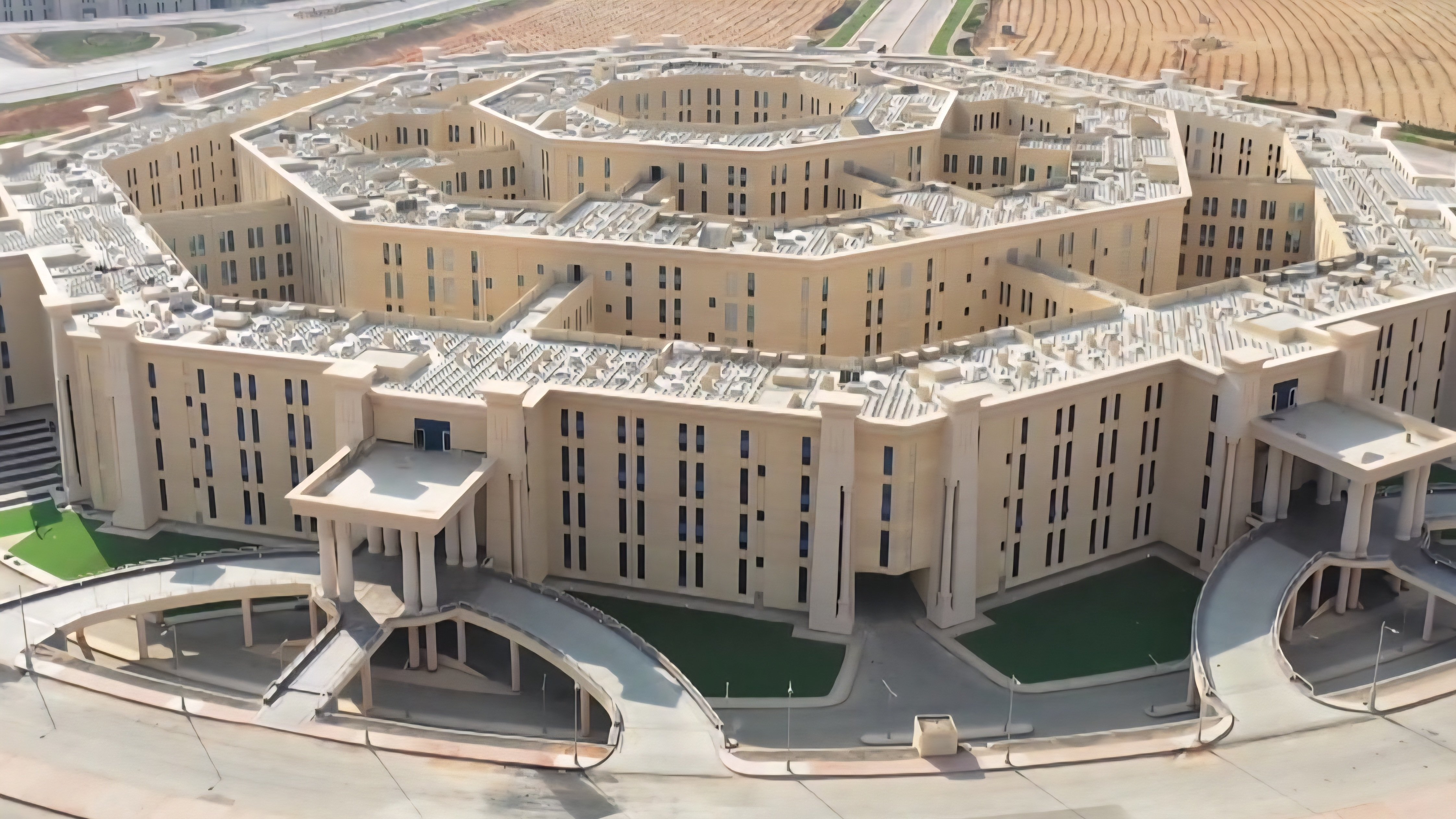

Egypt has unveiled its new military nerve center, a sprawling 22,000-acre facility called the Octagon. Located in the New Administrative Capital (NAC) east of Cairo, the site serves as the central base for the country's armed forces.
President Abdel Fattah El-Sisi officially inaugurated the massive complex during a formal ceremony. The facility replaces older installations, it centralizes national defense leadership. Officials from the State Information Service (SIS) stated that the complex handles national security.
The project incorporates eight outer octagonal buildings surrounding two central structures. This layout represents the individual branches of the Egyptian Armed Forces (EAF). The footprint is substantially larger than the United States (US) Pentagon complex located in Virginia.
Architects drew inspiration from ancient Egyptian architecture while integrating modern security infrastructure. The entire defense city contains thirteen strategic and logistical zones, it offers more than fifty million square feet of internal floor space across multiple buildings.
The development serves as a core component of the broader national relocation strategy. Egypt is currently moving its main sovereign institutions and government offices away from Cairo. The desert location provides enhanced security, it isolates leadership from urban vulnerabilities.
Beyond military functions, the hub operates as a unified state strategic data center. It houses a national emergency control facility to coordinate civilian and military responses. This integrated system allows different government agencies to share critical data during nationwide crises.
Advanced communications systems form the backbone of the new infrastructure. The complex relies on high-speed fiber-optic networks and secure satellite communications. Officials noted that artificial intelligence (AI) systems are utilized to process large amounts of operational data in real time.
The project was fully built and developed by domestic firms and engineering experts. President El-Sisi has supervised the construction progress since its inception, he made several site visits before the official launch.
The opening ceremony included a formal military inspection and a twenty-one gun salute. Overhead, Apache helicopters provided an aerial escort for the presidential motorcade. The president appeared in full military dress uniform for the first time in over a decade.
The event also featured drone displays, aerobatic shows, and the formal raising of the military flag. A documentary screening highlighted the construction process, honoring personnel, who have served the nation.
The total cost of the administrative capital infrastructure remains a subject of international economic discussion. Funding has reportedly involved regional partners alongside national resources. The facility represents a substantial change in how the state manages its defense operations.
With the opening of this hub, Egypt aims to project its institutional stability and power. Regional analysts view the development as an effort to secure state continuity. The fortified complex ensures that command functions remain operational during complex regional security challenges.
Security at the site is maintained by two elite units of the Republican Guard (RG). The surrounding area includes residential quarters, schools, and hospitals to support the personnel stationed within the compound.
Civilian administrative services are also integrated into the broader campus layout. This arrangement ensures that the defense hub can coordinate directly with ministries, if an exceptional emergency occurs.
Comments (0)
Leave a Comment
No comments yet. Be the first to share your thoughts!