

Steel remains one of the most widely used materials in construction, valued for its strength-to-weight ratio and resistance to weather and corrosion. According to the World Steel Association, cited via BlueScope's FY2025 Sustainability Report, the industry directly employs more than 6 million people and indirectly supports over 49 million jobs worldwide.
The scale of steel use is expected to grow rather than shrink. Total steel currently in use exceeds 215 kilograms per person globally, and global consumption is projected to rise by roughly 20 percent by 2050 as populations expand and infrastructure needs increase.
That growth has pushed manufacturers to focus on how steel is recovered and reused rather than only how it is produced. BlueScope has set a target of net zero Scope 1 and Scope 2 greenhouse gas emissions by 2050, alongside interim emissions intensity reduction goals for 2030, supported by five factors: technology, raw materials supply, renewable energy, green hydrogen and public policy.
Because steel can be recycled repeatedly without losing its structural properties, it fits naturally into circular economy models that favor repair, reuse and remanufacturing over disposal. Components can function as a kind of material bank, retaining value well beyond their original installation.
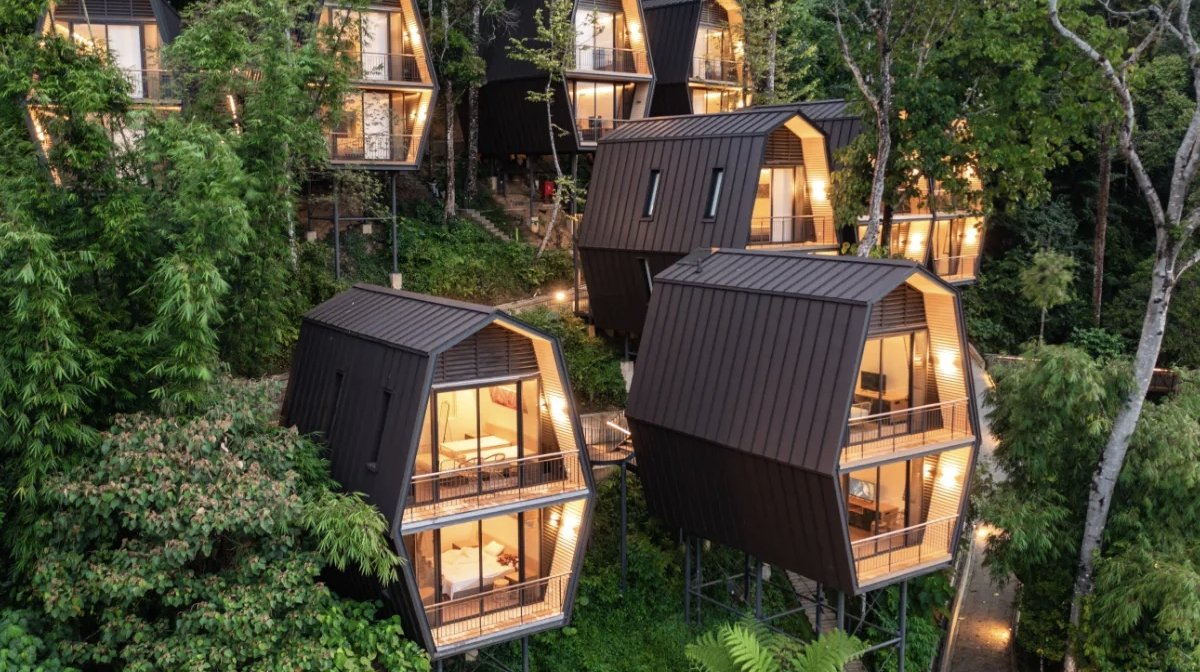
VanaVasa Resort in Malaysia illustrates the approach in practice. Winner of the 2024 BlueScope Steel Architectural Award and the 2024 Association of Southeast Asian Nations (ASEAN) BlueScope Steel Architectural Award, the resort sits on the hills of Tanarimba in Janda Baik.
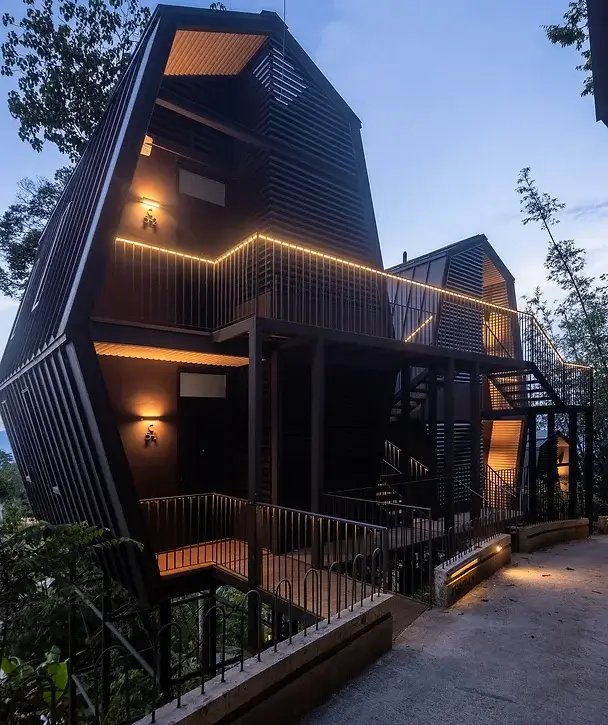
Champaka Chalet in Vana Vasa resort in Malaysia | Vanavasa
Designed by M J Kanny Architect, the complex includes 10 rooms with pool access and 20 chalet-style units spread across more than 32,000 square feet on a steeply sloping site. It was built in two phases, with construction of the chalet zone beginning a year after the first phase was completed.
Completed in 2023, the resort earned a GreenRE Gold certification and operates without air conditioning, relying instead on natural ventilation through roof openings and bamboo screens. While concrete, exposed brick and bamboo composite feature throughout, the chalets themselves were built using prefabricated steel structures.
That choice allowed the chalets to be assembled on site without concrete or wet masonry work, which in turn eliminated the need for temporary access roads that would have disturbed the sloping terrain. The staggered layout of the glamping-inspired chalets fits narrow floor plans between existing trees rather than clearing them.
Several practices are driving similar projects toward circularity more broadly. These include designing components for easier recovery, tracking materials through environmental product declarations and digital material passports, and expanding modular or prefabricated construction methods that reduce on-site waste.
BlueScope's own manufacturing reflects that shift. The company reported that 52 percent of its crude steel production in 2025 came from recovered and recycled scrap, consistent with prior years. Products such as COLORBOND steel are manufactured to precise specifications using dedicated software, which minimizes on-site cutting, while leftover scrap is returned to the steelmaking process rather than discarded.
Beyond material recovery, coatings such as COLORBOND steel with THERMATACH technology are designed to reduce roof surface temperatures, helping counter the urban heat island effect in denser developments. Combined with rainwater harvesting and orientation choices that limit western sun exposure, VanaVasa Resort's design points to how material selection and site planning can work together toward longer building lifespans.
Comments (0)
Leave a Comment
No comments yet. Be the first to share your thoughts!