
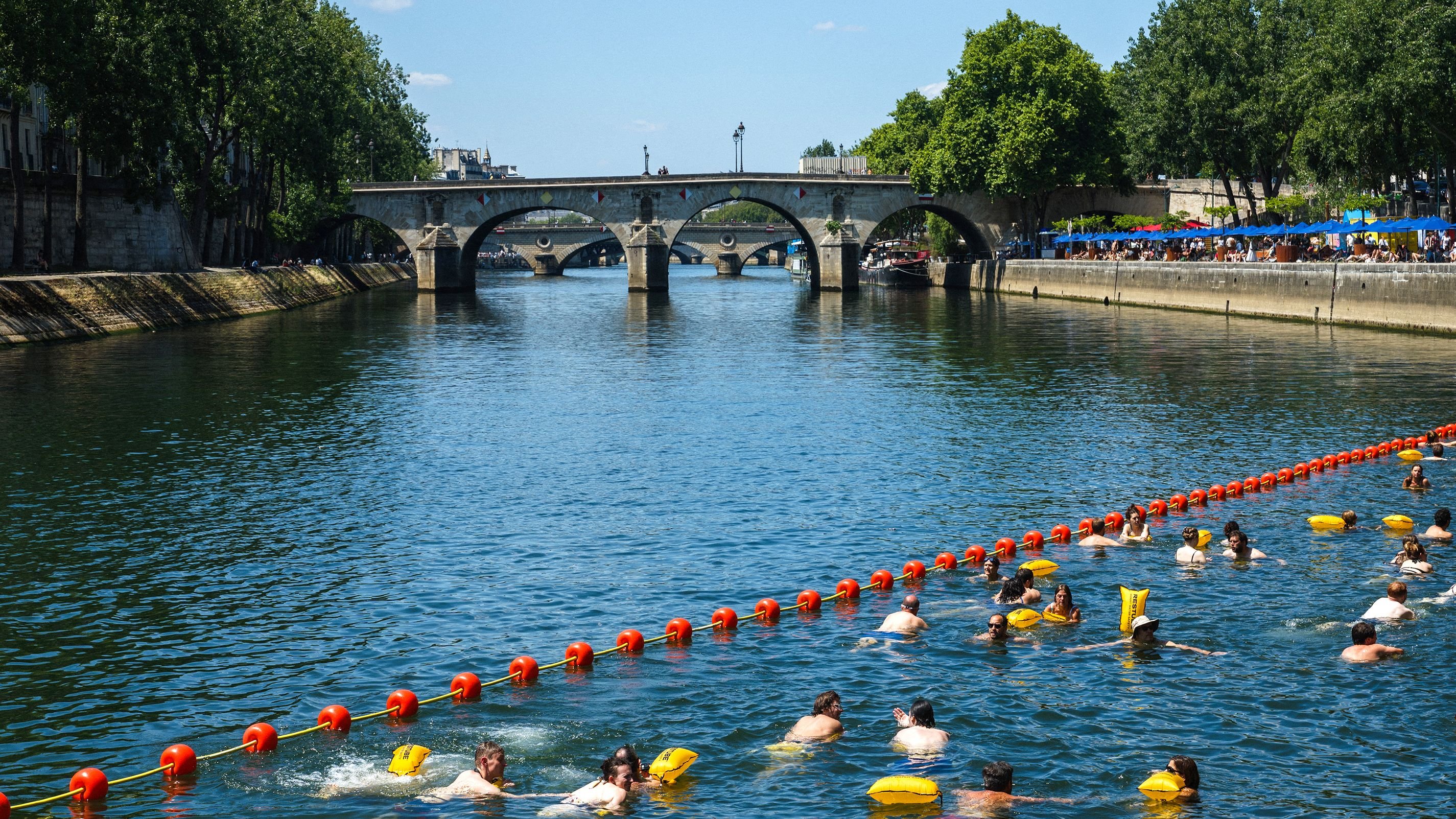

As record-breaking heat waves push European cities to their limits, more are reopening long-polluted rivers for public swimming. Paris, Copenhagen, Basel, Zurich, Bern and Oslo have spent years upgrading sewage systems and stormwater infrastructure to make their waterways safe again.
In Paris, generations grew up believing the Seine was too dirty to touch, after the city banned swimming outright in 1923 following decades of wastewater and industrial runoff. Officials began discussing a cleanup in 1988, but the effort gained momentum only in 2016.
That year, Mayor Anne Hidalgo made restoring the Seine central to Paris's bid to host the 2024 Summer Olympics, turning a long-stalled ambition into a funded, time-bound project with international visibility attached.
The work paid off. When the Seine reopened to swimmers in July 2025, more than 100,000 people used its three designated bathing sites, prompting the city to extend the season into September.
Paris endured its most extreme heat wave on record in June 2026. With only about a quarter of French homes fitted with air conditioning, residents turned to the city's newly cleaned rivers and canals to cool down.
Authorities test the Seine daily for E. Coli and enterococci and have consistently found the water safe under European Union bathing standards, even as old perceptions of a dirty river linger among many Parisians.
Switzerland shows what a fully normalized relationship with urban rivers looks like. Baselers have swum in the Rhine since at least the 15th century, and floating downstream in inflatable dry bags known as Wickelfisch has been a summer tradition for four decades.
Switzerland spends roughly 230 dollars per person annually on wastewater treatment, well above the European average, making its rivers among the cleanest in the world. A 1986 chemical fire near Basel once turned the Rhine red, triggering the strict water legislation the country now relies on.
Comments (0)
Leave a Comment
No comments yet. Be the first to share your thoughts!