

A version of this article appeared on Nation Africa.
Nigerian industrialist Aliko Dangote has offered to construct a major oil refinery in East Africa, pitching the cross-border industrial project directly to regional heads of state during a high-level summit in Nairobi.
The proposal hinges on securing strong political and policy support from regional governments, particularly Kenya and Uganda.
Speaking at the inaugural Africa We Build Summit, the founder of Dangote Group stated that his conglomerate is prepared to build a facility identical to his flagship 650,000 barrels-per-day (bpd) refinery in Lagos, Nigeria.
The project, which Dangote estimated could be delivered within four to five years, aims to reshape fuel supply and enhance energy security across a regional market that encompasses Kenya, Uganda, Tanzania, South Sudan, and the Democratic Republic of Congo (DRC).
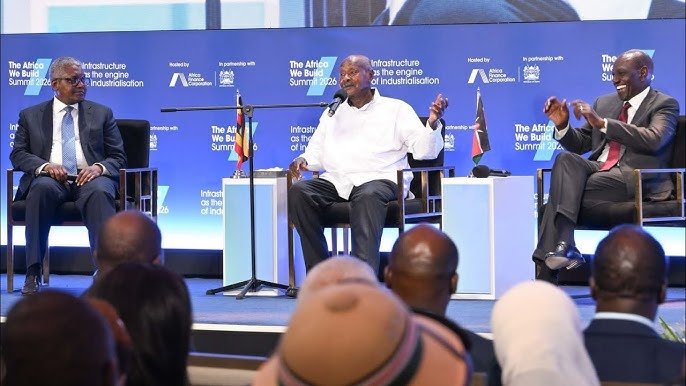
The industrialist made the commitment during a panel session alongside Kenyan President William Ruto and Ugandan President Yoweri Museveni.
The proposal comes at a time when regional leaders are actively pushing for greater industrial self-sufficiency and a reduced reliance on imported petroleum products, which continue to strain foreign exchange reserves across the continent.
Dangote argued that Africa possesses the necessary financial institutions and raw resources to fund large-scale industrial assets without depending entirely on external investors.
He criticized the long-standing economic model of exporting raw materials and importing finished goods, noting that the practice essentially exports local jobs while importing poverty.
The existing $20 billion Dangote Refinery in Nigeria was presented as proof that African-led engineering and industrial developments can succeed at a global scale.
The Lagos facility has already commenced international shipments, exporting approximately 1.1 billion litres of aviation fuel to European markets.
President Ruto backed the industrialist's call for local value addition, questioning why the continent should fail when it possesses the market, the capital, the raw materials, and the execution capacity.
President Museveni similarly supported the regional infrastructure push, describing the continuous export of unprocessed natural resources as an economic loss and calling for coordinated planning to move projects from conception to actual implementation.
The Ugandan leader commended the decision to challenge structural bottlenecks through regional cooperation, adding that market integration is vital for large-scale production.
Beyond the proposed refinery, Dangote disclosed that his group has committed to investing $40 billion across manufacturing, fertilizer, petrochemicals, and refining sectors by 2030.
He emphasized, however, that regulatory consistency is paramount, warning that policy uncertainty historically deters long-term institutional capital.
The billionaire also used the platform to urge African governments to eliminate visa restrictions, pointing out that administrative barriers currently make it faster for a European passport holder to move across Africa than a citizen of the continent.
The two-day event, hosted by the Africa Finance Corporation (AFC) in collaboration with the Government of Kenya, convened policymakers, infrastructure operators, and institutional investors at the JW Marriott Hotel Nairobi.
Discussions at the summit focused on shifting infrastructure projects from mere priorities to tangible execution, utilizing regional transport and industrial corridors as engines for broader economic transformation.
Comments (0)
Leave a Comment
No comments yet. Be the first to share your thoughts!