
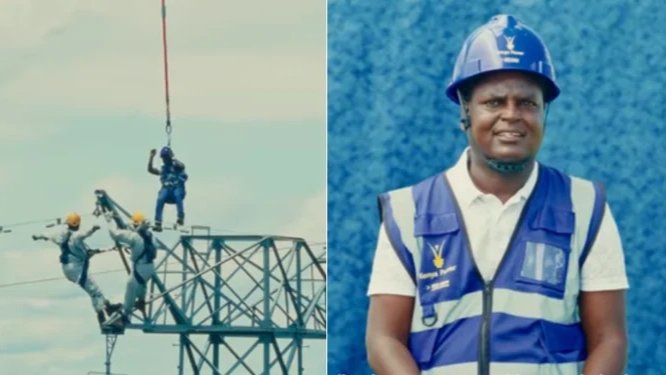

For most Kenyans, flipping a switch is routine. Few consider the engineers who keep the current flowing, sometimes from a position just centimetres away from wires carrying up to 500,000 volts.
Engineer George Korir, a manager at Kenya Power, has spent more than two decades maintaining the national grid. According to an article by The Kenya Times, his work includes helicopter-assisted restorations and building the country's first 132 kilovolt (kV) concrete pole transmission line.
According to Kenya Power, the national electricity network stretches roughly 320,000 kilometres (198,838 miles), a distance comparable to circling the Earth about eight times. Power generated at plants such as Olkaria travels through high-voltage lines before being stepped down for household and commercial use.
Korir explained that distribution transformers common in residential estates typically carry about 11,000 volts, while substation power transformers handle between 66,000 and 220,000 volts. Transmission lines carry between 220,000 and 500,000 volts, making them the network's most hazardous segment.
Access to substations is tightly controlled. Even certified engineers cannot enter without clearance from system controllers, who issue permits and enforce strict communication procedures before any maintenance begins.
The riskiest part of Korir's work involves climbing transmission towers to repair lines that remain energised throughout the process. Cutting power entirely would trigger widespread blackouts, so certain repairs are carried out live instead.
While suspended above the ground, Korir secures himself to the tower structure before easing closer to the live conductors. He says the task requires total focus, since any miscalculation could prove fatal.
"When I get up there, everything goes silent. It's just me and the electricity," he said, describing the narrow margin between safety and disaster in that moment.
Reaching that level of expertise took years of specialised training, professional certification, examinations and recurring refresher courses, Korir said. He described the profession as one demanding courage, physical endurance and discipline.
Asked why he chose such a hazardous career, his response was direct. "Somebody has to do it. For them, for you," he said, pointing to the sacrifices engineers make so households rarely notice the grid at all.
Korir joined Kenya Power's predecessor, the Kenya Power and Lighting Company, in 2003. He rose through technical and leadership roles, including Chief Engineer for Transmission Network Maintenance between 2017 and 2024, before his current management post.
His project history includes pioneering helicopter-based blackout restoration in 2020, leading corrosion protection programmes for transmission infrastructure, and overseeing emergency tower deployments in Naivasha, Sabaki, Lamu and Loiyangalani.
He also helped build Kenya's first 132kV concrete pole transmission line between Rabai and Kilifi and introduced the country's first 220kV telescopic monopoles.
Korir holds a bachelor's degree in Electrical Engineering from Jomo Kenyatta University of Agriculture and Technology, completed between 1997 and 2001, and a Master of Business Administration from Moi University.
Comments (0)
Leave a Comment
No comments yet. Be the first to share your thoughts!