
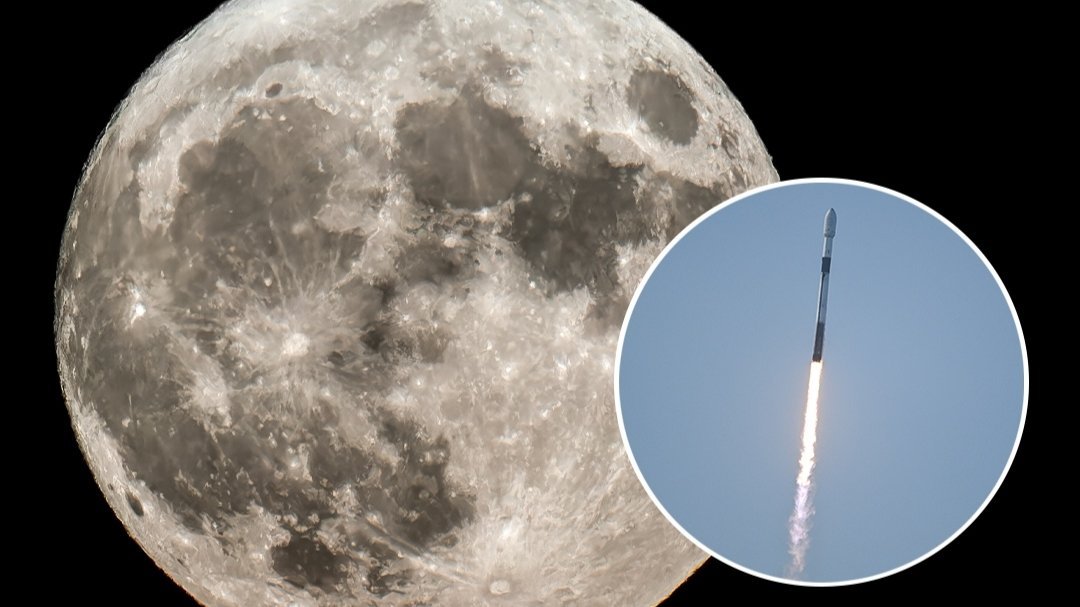

This article has been adopted from BBC News live coverage.
A discarded upper stage from a SpaceX Falcon 9 rocket is believed to have crashed into the Moon on Wednesday, after drifting through space for more than 18 months following its January 2025 launch.
The impact was expected at around 07:35 BST, with the section travelling at roughly 2.43 kilometres per second, or 5,400mph. The stage, about the size of a five-storey building, weighed at least 4,000kg (8,800lbs) on Earth.
The rocket originally launched two lunar landers built for the United States and Japan before its spent upper section was left in a long, looping orbit around Earth. Solar activity and gravitational pull gradually pushed it toward a collision course with the Moon.
The suspected crash site lies near the Einstein Crater, on the Moon's near side, in an area that receives sunlight. It sits roughly on the opposite side of the Moon from the Apollo 11 landing site, where Neil Armstrong and Buzz Aldrin first walked in 1969.
The National Aeronautics and Space Administration (NASA) said the collision posed no danger to Earth. The agency added it hoped to gather lunar data from the event and refine methods for tracking objects in space.
Confirmation has proven slow. None of the spacecraft currently orbiting the Moon were positioned to observe the impact directly, meaning scientists must instead compare before-and-after images of the surface to identify any new crater.
Rodrigo Palominos, a telescope operator at Chile's Paranal Observatory, told the BBC he detected a change in emission lines around the predicted impact time, describing it as an encouraging preliminary result that may point to debris released by the collision.
NASA's Lunar Reconnaissance Orbiter is expected to photograph the site in the coming days, while South Korea's Danuri probe, which passed near the area shortly before impact, has not released footage pending analysis by domestic research institutes.
Dr Matt Bothwell, an astronomer at the University of Cambridge, called the event a useful experiment but warned that accumulating space debris could eventually make it harder to leave Earth's orbit if the problem is left unchecked.
Professor Hugh Lewis, a space safety expert at the University of Birmingham, said tighter regulation may be needed as lunar traffic increases, warning that future debris could threaten human life, infrastructure, or scientific equipment on the surface.
What is known so far:
The rocket section was expected to strike the Moon around 07:35 BST near the Einstein Crater
It measured roughly the size of a five-storey building and weighed at least 4,000kg on Earth
NASA confirmed the event poses no danger to Earth and will keep monitoring the site
What remains unclear:
The exact impact point within the 180km-wide Einstein Crater, and the scale of any resulting explosion
Whether a lunar satellite's imagery, expected within about a week, will confirm a new crater
Whether ground telescopes managed to capture the impact flash itself
The collision adds to a lunar surface that now holds an estimated 3,000 human-made objects weighing around 190 tonnes combined, a figure that has grown steadily since the Soviet Union's Luna 2 became the first spacecraft to reach the Moon in 1959.
Comments (0)
Leave a Comment
No comments yet. Be the first to share your thoughts!