
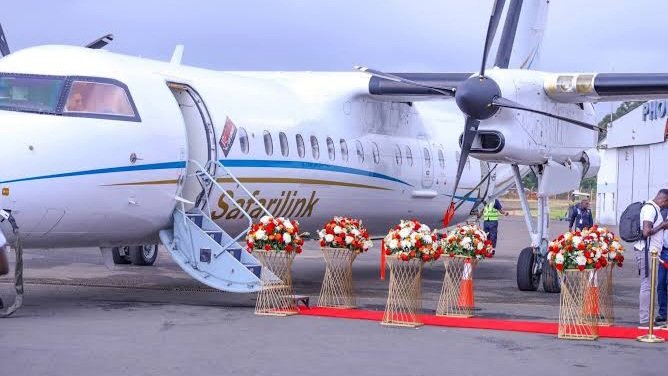

Regional carrier Safarilink Aviation has expanded its aircraft fleet, as rising tourist arrivals drive up demand for domestic flight capacity. The airline recently brought in an additional Cessna Grand Caravan, which landed at Wilson Airport (WA) following a delivery flight from the United States (US).
The acquisition boosts operational flexibility on routes connecting Nairobi to popular wildlife parks and coastal destinations. Increased passenger traffic across East Africa has pushed regional operators to add frequencies, while improving schedule reliability on remote airstrips.
Kenya’s safari air network relies heavily on turboprop aircraft capable of landing on short, unpaved runways. Destinations such as the Maasai Mara, Amboseli, Samburu, Nanyuki, Lamu, and Diani depend on these specialized air links, which connect international arrivals coming through major airport hubs.
Beyond tourist travel, expanded fleet operations support regional commerce, conservation projects, medical evacuations, and emergency response. Short-haul air routes remain vital in areas where surface road transport infrastructure is limited or undergoing long-term maintenance.
The airline works in close coordination with the Kenya Association of Travel Agents (KATA), to align flight schedules with broader travel booking trends. Increased seat availability gives travel operators greater certainty during peak safari seasons, when passenger traffic spikes across primary safari corridors.
Domestic airlines continue to adjust their operations, as Kenya experiences broader growth in leisure travel and international arrivals. Improved flight connections between secondary airstrips allow regional lodges and tourism operators to handle larger visitor numbers efficiently.
Industry stakeholders note that fleet growth helps cushion carriers against operational delays. Having extra aircraft capacity allows operators to run scheduled maintenance programs, without disrupting daily flight schedules during high-demand months.
Cross-border routes have also seen increased attention from regional carriers. Safarilink recently introduced additional daily flights linking Nairobi and Arusha, reflecting growing regional integration and cross-border commercial traffic between Kenya and Tanzania.
Collaboration between domestic carriers and major international airlines has further simplified regional travel. A code-share arrangement with Kenya Airways (KQ) now enables passengers to book international flights and domestic safari connections on a single ticket.
This integration reduces ground transfer delays for incoming travellers, while improving aircraft utilization across domestic corridors. It also provides direct economic support to remote communities that depend on safari tourism for local employment.
Aviation sector players continue to call for modern airstrip infrastructure and streamlined regulations across regional air hubs. Upgraded runways, improved navigational aids, and simplified border clearance procedures remain critical to sustaining growth in regional air transport.
As domestic passenger volumes continue to rise, regional airlines are positioning their fleets to meet long-term transport needs. Continuous investments in aircraft capacity and ground support help sustain Kenya's position as a primary travel hub in East Africa.
Comments (0)
Leave a Comment
No comments yet. Be the first to share your thoughts!