
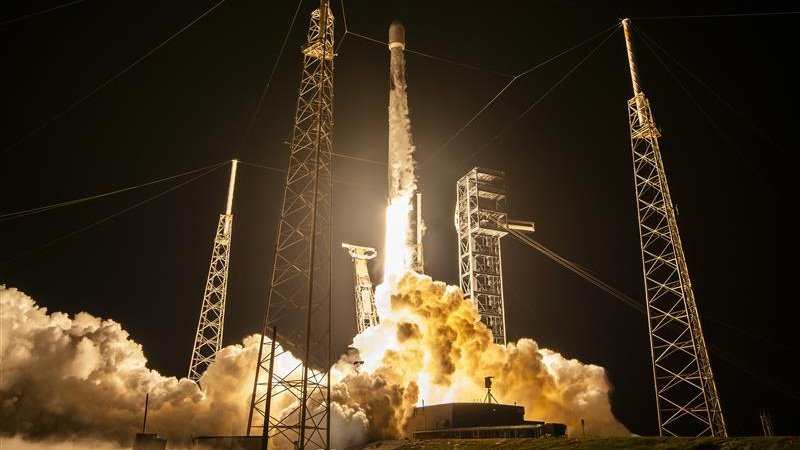

SpaceX has completed two orbital missions within thirty-eight minutes, marking its fastest turnaround between rocket liftoffs. The dual missions involved separate launches from Florida and California, underscoring the company’s high-cadence launch operations.
The initial liftoff occurred at Cape Canaveral Space Force Station (CCSFS) in Florida at 9:12 p.m. EDT, sending eight satellites into low-Earth orbit for telecommunications provider Globalstar.
Deployment of the commercial payload began roughly fifty-six minutes after launch. The first-stage booster completed its flight by landing back at the site eight minutes after blastoff, executing its fourteenth mission.
Just thirty-eight minutes after the Florida departure, a second Falcon 9 rocket lifted off from Vandenberg Space Force Base (VSFB) on California's central coast. That mission, designated United States Space Force 366 (USSF-366), carried a classified national security payload into orbit.
The first-stage booster for the California operation landed on the autonomous spaceport drone ship Of Course I Still Love You in the Pacific Ocean, marking its eighteenth successful flight.
This back-to-back sequence broke SpaceX’s previous record of sixty-five minutes between orbital launches, which was set in August 2024. The rapid execution highlights the growing operational efficiency of reusable infrastructure in orbital spaceflight.
The dual flights brought the total number of Falcon 9 launches to ninety-six for the year. The majority of those flights continue to support the expansion of the Starlink satellite network.
Comments (0)
Leave a Comment
No comments yet. Be the first to share your thoughts!