
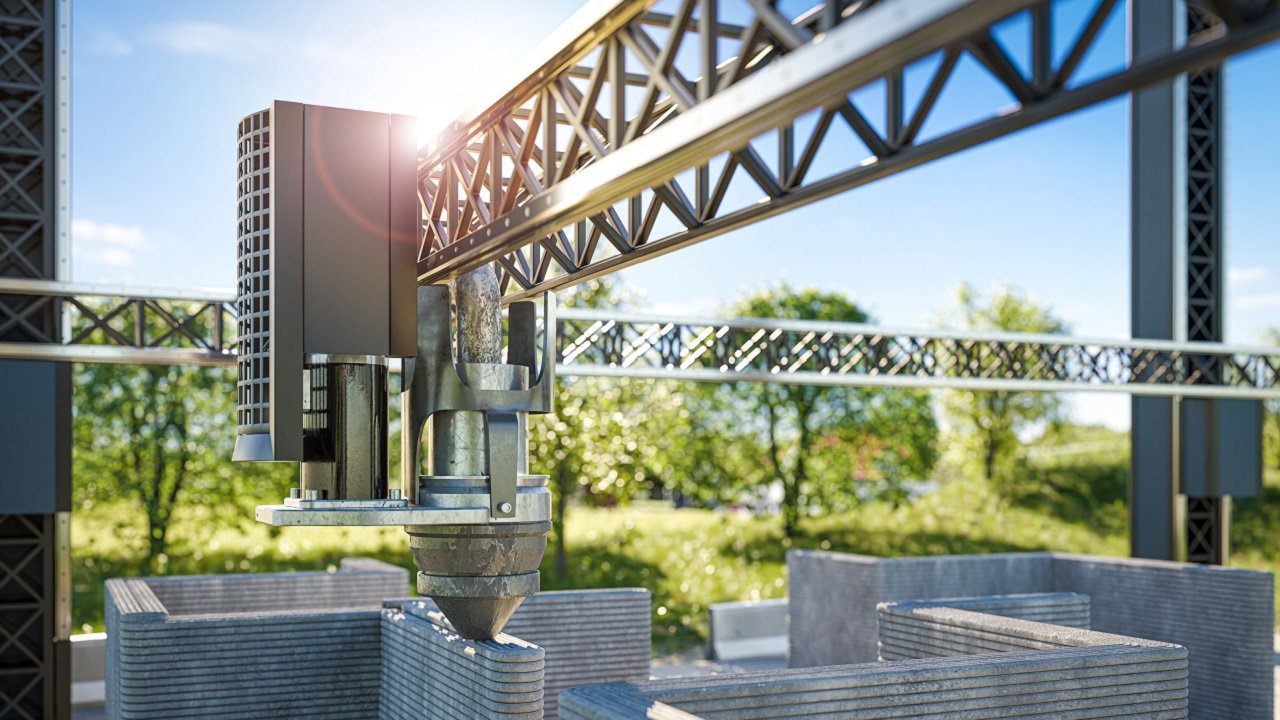

The printer lays down one vertical inch at a time. Within days, walls stand. Within weeks, people move in.
That is the reality of 3D printed construction in 2026, and it is happening across more countries than most people realise.
In Holstebro, Denmark, Europe's largest 3D printed housing development is nearly complete. The Skovsporet project, commissioned by affordable housing organisation NordVestBo and designed by SAGA Space Architects with 3DCP Group and COBOD, is delivering 36 student apartments using a BOD3 printer running on a ground-based track system. The entire concrete structure for each unit was printed in five days. Human crews followed to install roofs, windows, interiors and utilities. Residents are expected to move in by August 2026.
In Denver, Colorado, Azure Printed Homes opened a factory in April 2026, combining 3D printing with modular steel frame construction, using recycled plastic polymers as the primary wall material. The facility is projected to produce up to 7,000 housing units annually for Colorado and neighbouring states.
Japan printed its first two-storey home this year. The country's construction industry faces a documented productivity crisis, an ageing workforce, chronic labour shortages, and a housing stock simultaneously oversupplied in rural areas and undersupplied in cities. The two-storey printed structure is being watched closely by an industry historically slow to adopt new building methods.
In California, developer 4dify is building the state's first micro-community of 3D printed homes in Yuba County, a five-home test run before scaling to 19 units in Sacramento and a planned 75 to 100 printed duplexes in Southern California. The printer batches its own concrete on site at roughly a third of the cost of buying pre-mixed material.
The global picture is broader still. Georgetown in Texas has the Wolf Ranch subdivision, described by Reuters as the world's largest 3D printed neighbourhood, with 100 homes built using ICON's Vulcan printer. Germany's Mense-Korte House in Beckum was the first 3D printed home certified under a national building code, printed in approximately 100 hours. In Melbourne, a four-bedroom 3D printed home is being completed in five weeks against a conventional timeline of up to a year.
The consistent advantages cited across all these projects are speed, reduced labour and lower material waste. The World Economic Forum has noted that printed homes can cost up to 45 percent less than conventionally built equivalents, though costs vary by market and specification.
The technology is not without limits. Most current projects involve relatively simple structures. Complex designs, multi-storey towers and regulatory compliance across different building codes remain active challenges. In Illinois, a 3D printed housing project in Cairo stalled mid-construction, with the Federal Bureau of Investigation (FBI) opening an inquiry into the developer over alleged fraud. No charges have been filed.
What 2026 has confirmed is that 3D printed construction has cleared the proof-of-concept stage. The question now is speed of adoption, and whether markets with acute housing shortages, including Kenya's two-million-unit deficit, will move quickly enough to use it.
Comments (0)
Leave a Comment
No comments yet. Be the first to share your thoughts!