
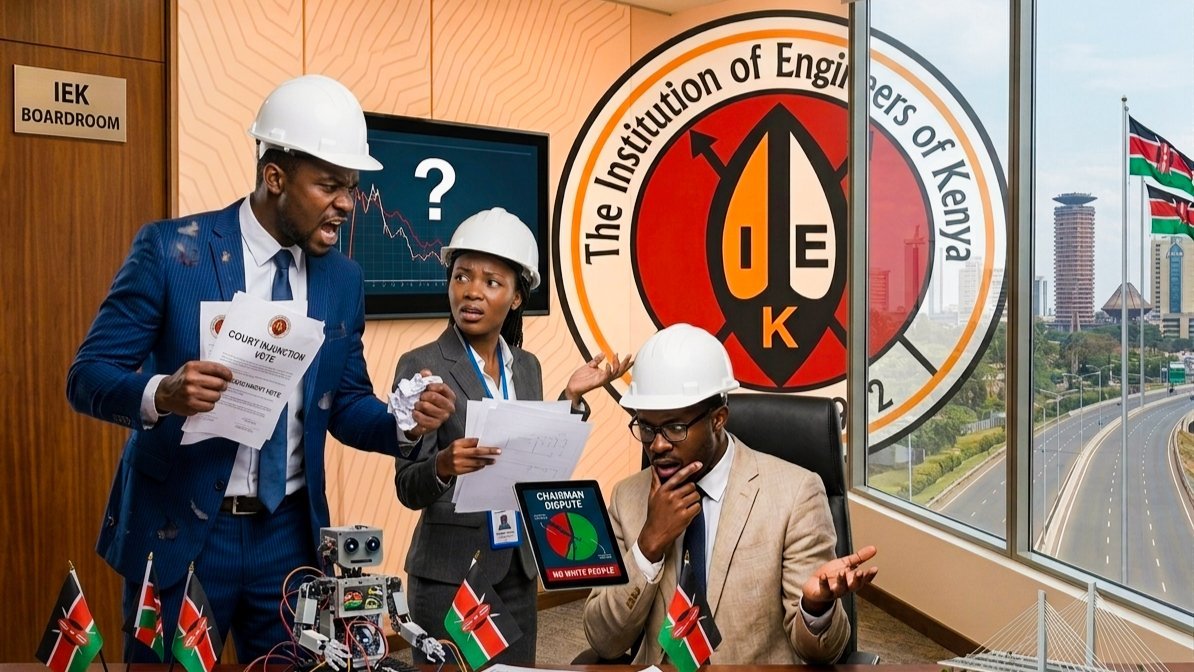

The Institution of Engineers of Kenya Council has formally declined a requisition for a Special General Meeting sought by members frustrated with the stalled leadership transition. On 11 May 2026, it issued two documents signed by President Eng. Shammah Kiteme. One replied directly to Eng. Howard A. M'mayi. The other updated the entire membership.
M'mayi, a professional engineer employed at the Kenya National Highways Authority and a senior member of the Chartered Institute of Arbitrators Kenya Branch who has previously sought the IEK presidency, had been elected unopposed as 1st Vice President for the 2026-2028 term before the court-ordered suspension.
He wrote under Article 11.05 of the IEK Constitution 2015. His letter and annexed motions carried substantial backing from engineers eager to address the governance vacuum. The proposed meeting date was 21 May 2026. The motions covered the lapsed terms of current office bearers, constitutional review issues, inclusivity, voting rights and possible member-driven solutions to the crisis.
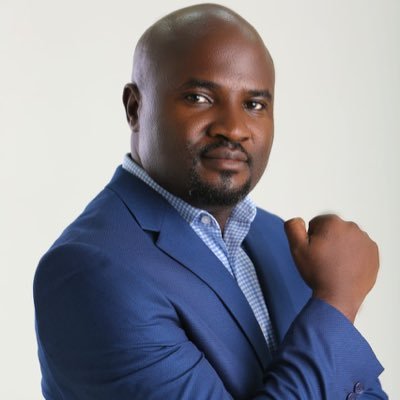
Eng. Howard M'mayi /X
The Council began its response by acknowledging receipt. It stated: “The Council acknowledges receipt of your letter and memorandum requisitioning for a Special General Meeting (SGM) pursuant to Article 11.05 of the IEK Constitution 2015 together with the annexed motions proposed for discussion.”
It also recognised “the concerns raised regarding the current governance and transition challenges facing the Institution following the suspension of the scheduled elections.”
Despite that acknowledgement, the Council rejected the proposal on two main grounds. The first was procedural. “The proposed SGM does not adhere to the 30-day notice period as per clause 11.05,” the letter explained. The constitution requires enough time for proper participation, circulation of agenda papers, verification of membership status and logistical arrangements. The suggested date was therefore ruled “not practicable and cannot lawfully be implemented within the required timelines.”
The second ground invoked the sub judice doctrine. The Council wrote that “the doctrine of sub judice, restrains parties from deliberating upon or making determinations on matters actively pending before a competent court where such deliberations may prejudice, pre-empt, interfere with, or appear to undermine the judicial process.” Several motions, it said, touched directly on issues still before the High Court in the Dennis Barongo and Sam Aberi petitions.
It then addressed each motion in detail. On Motion 1, concerning lapsed terms and a possible caretaker council or tenure extension, the Council stated: “There is no constitutional framework for appointment of a caretaker committee. Leadership in IEK can only be assumed through elections.”
It added that “Discussing the matter in a general meeting is therefore sub-judice” and warned that “Disobeying lawful court orders will subject IEK to contempt of court proceedings.”
Motion 2(a) sought the recall of the draft constitution document. The Council linked it to the Barongo petition and said any deliberation “would risk interfering with issues pending judicial determination.” Motion 2(b) on timelines for inclusivity and voting rights was tied to the Aberi case and ruled unsuitable “pending judicial guidance.” Motion 2(c) on constitutional safeguards and Motion 2(d) on communication with the Registrar and courts received similar treatment. Motion 3, described as “Any other motion towards a member-driven solution to the prevailing crisis,” was dismissed as “too vague and ambiguous for a properly constituted meeting.”
A separate communique sent to all members provided a broader update following the Council’s special meeting on 8 May 2026. It included a table detailing the two court cases. The Dennis Barongo petition (HCCHRPET/E853/2025) challenges the 2025 constitutional amendments. The Milimani High Court ordered the status quo preserved on 12 February 2026. Further directions are set for 27 July 2026.
The Sam Aberi petition (HCCHRPET/E009/2026) contests graduate member voting rights. The Kiambu High Court suspended the March 2026 elections on 13 March 2026. Judgment expected on 17 April was not delivered after the judge’s transfer, leaving parties awaiting fresh directions. The case itself has had interesting theories to say the least.
On the current Council’s position, the communique declared: “Under the Doctrine of Necessity, the duly elected council, currently in office, continues to manage the affairs of the Institution until the elections are held and a new council takes over.” It stressed that the sitting body “remains the only constitutionally recognised governing body of IEK” until handover under sections 9.15 and 9.16 of the 2015 Constitution.
The communique also tackled unofficial communications. It stated: “The Council has noted that some flier has been shared in social media purporting to convene an SGM for members of IEK. Members of IEK are hereby informed that the Council, being the only legally mandated organ to convene the SGM or any meeting of members, has not convened any such meeting. Members are therefore advised to ignore such fliers.” It promised that any legitimate meeting would be announced through official channels.
Both documents were attached to the February and March 2026 court orders and were copied to the Registrar of Societies. The Council ended by appealing for patience and urging petitioners to “consider and withdraw them so that the leadership transition can be completed as initially planned.” It reiterated its commitment to “upholding constitutional governance, institutional stability, and the rule of law.”
The exchange captures the sharp tension inside IEK. Members who supported M'mayi’s requisition see the SGM as a legitimate democratic route out of months of uncertainty caused by the suspended elections. The Council, by contrast, insists every step must remain within constitutional notice rules and court boundaries to avoid further litigation.
This is not the first time IEK elections have generated such drama. Previous polls have featured similar disputes over procedures and constitutional changes. Last year’s elections, for instance, faced claims of irregularities that were ultimately ruled unfounded, clearing the way for Eng. Shammah Kiteme to take office as president. The pattern of legal petitions and internal pushback has become a recurring feature of leadership transitions at the institution, leaving many members weary of prolonged uncertainty.
No new election date has been set. The current leadership continues under the preserved status quo. Members have been told to rely solely on official IEK communications.
The coming weeks will hinge on the High Court’s next moves. Until then, the professional body remains caught between member urgency and institutional caution.
Comments (0)
Leave a Comment
No comments yet. Be the first to share your thoughts!