

Anthropic announced the Autodesk Fusion connector on Tuesday. The integration allows users with a Fusion subscription to build and alter 3D models directly through conversation with Claude.
The capability targets workflows long handled manually in CAD environments. Engineers and designers can now issue instructions in plain language instead of clicking through menus and timelines.
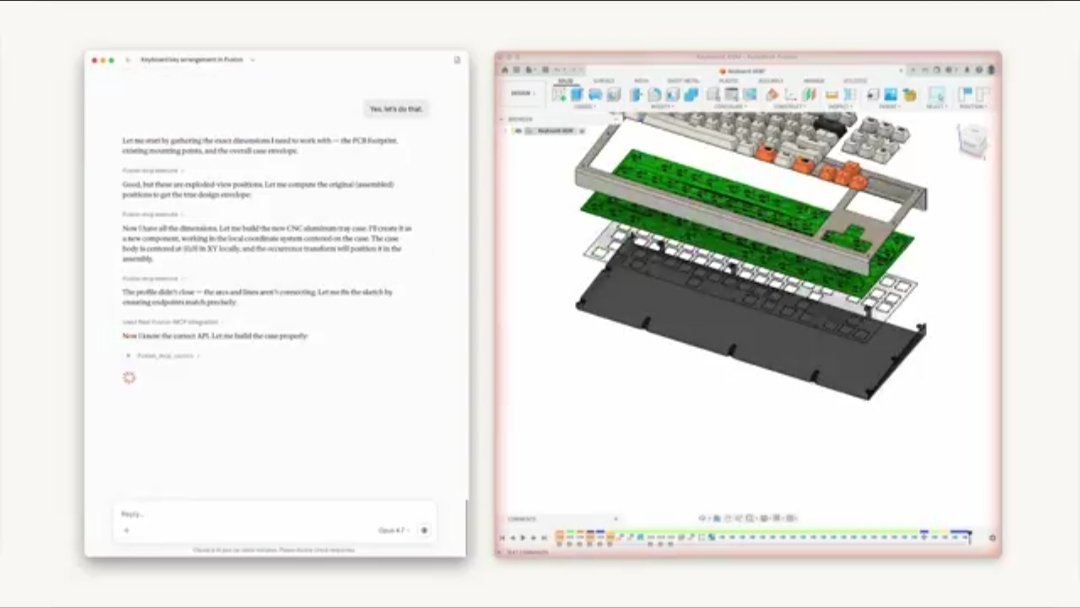
A demonstration video posted alongside the announcement shows the process in action. In one sequence Claude receives a request to rearrange keys properly on a keyboard assembly. The AI analyses the existing geometry, identifies misalignment issues with the PCB and casing, and executes the repositioning across the model.
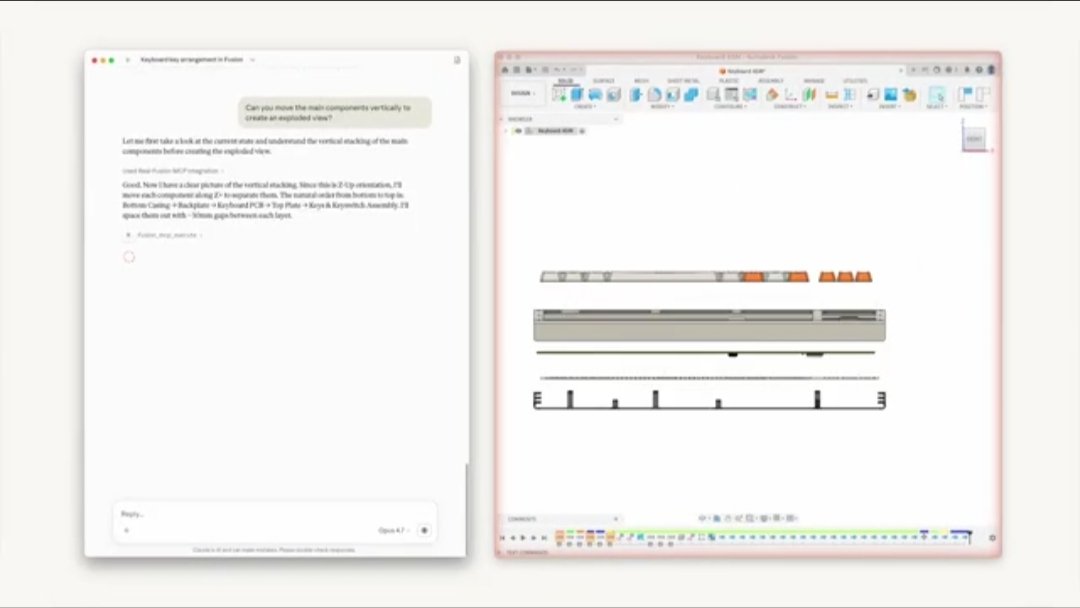
Further prompts in the same demo ask for an exploded view. Claude first maps the vertical stacking order of components, then separates each layer along the Z-axis with measured gaps. It adjusts spacing on the fly after spotting uneven distribution between the top plate, PCB and backplate.
The conversation continues into material and detail refinements. Claude suggests options for a premium CNC-machined tray-style case, adds rubber foot recesses and applies an anodised aluminium appearance. Each change updates the parametric history without the user touching the software interface.
This connector sits alongside several others launched the same day. SketchUp integration, for instance, turns natural-language descriptions of rooms or structures into initial 3D geometry ready for refinement. Blender users gain a natural-language interface to the Python API for scene debugging and batch operations.
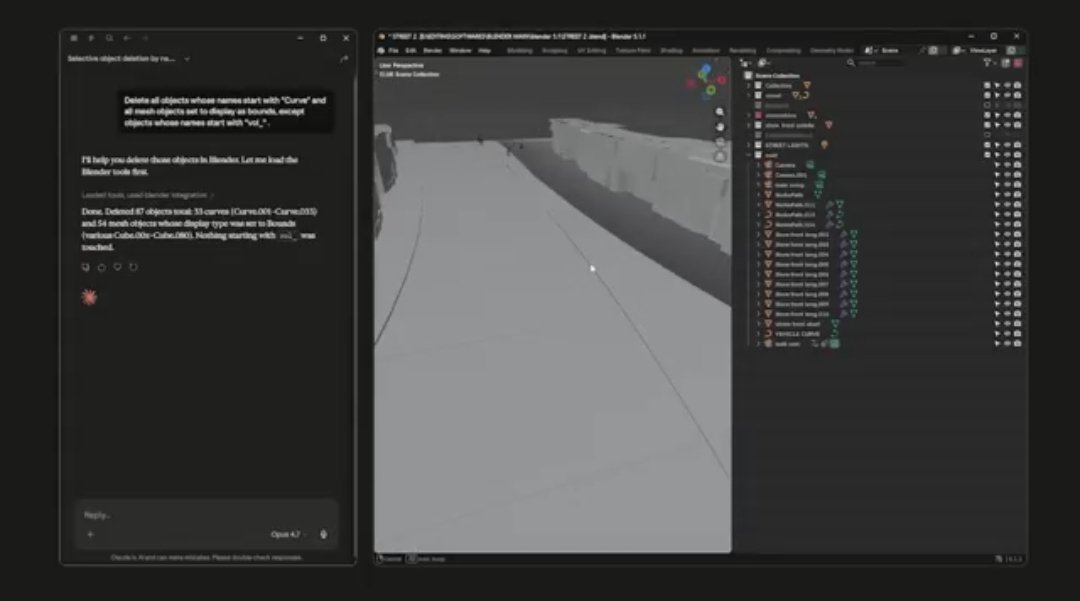
Anthropic also confirmed it has become a patron of the Blender Development Fund to support ongoing open-source work.
The Fusion connector arrives at a time when engineers across mechanical, product and infrastructure disciplines rely on parametric modelling for everything from component assemblies to fabrication prep. Autodesk Fusion itself combines CAD, CAM and simulation tools in a single cloud platform used globally on projects ranging from prototypes to larger assemblies.
Early reactions on social media highlighted both the speed of simple edits and lingering questions about complex, manufacturing-ready outputs. Some engineers noted the tool handles repetitive adjustments efficiently while others pointed out that final validation for tolerances and assembly constraints still rests with human oversight.
The announcement does not claim to replace engineers. It instead positions the AI as an embedded assistant inside familiar software. Users remain in control of the final model and can intervene at any step.
Access to the connector is available now through Claude’s connectors directory for eligible Fusion subscribers. No additional software installation is required beyond the existing integration setup.
For construction and infrastructure teams that incorporate mechanical systems or custom fabrication, the development offers another route to accelerate design iteration. Global engineering practice has seen steady incorporation of cloud-based tools over the past decade. This latest step extends that pattern into conversational interfaces.
The broader rollout also includes connectors for Adobe Creative Cloud, Ableton, Splice and Affinity by Canva, signalling Anthropic’s focus on embedding AI across creative and technical applications rather than building standalone design platforms.
Engineers using Fusion for daily work will decide how deeply to adopt the feature. Early demos suggest it handles straightforward modifications and explorations quickly. Whether it scales to the most demanding infrastructure detailing remains a practical question each team will test on its own projects.
Comments (0)
Leave a Comment
No comments yet. Be the first to share your thoughts!