
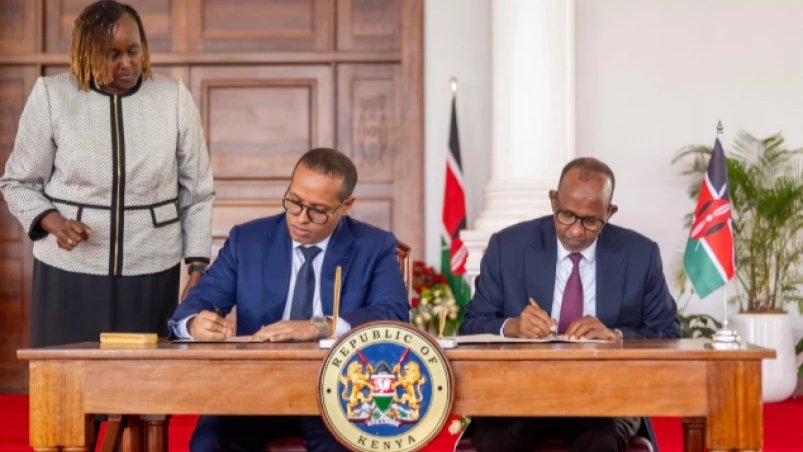

President William Ruto has signed an agreement with the Amsons Group for the construction of 10 mother and child hospitals across Kenya.
The initiative, known as "A Promise to Life", will see the private sector partner design, build and equip the new facilities. They will focus on regions with limited access to specialised maternal care.
Ruto witnessed the signing at State House on April 28. He described the project as a targeted effort to address gaps in healthcare delivery.
"This initiative demonstrates the strength of partnerships between the government, the private sector, and partners working together to deliver scalable and sustainable solutions," he said.
Long distances, infrastructure shortages and staff gaps have left many mothers and newborns at risk. The new hospitals are meant to change that.
Each hospital will include an antenatal section, maternal intensive care unit, labour ward, delivery room, recovery area and two operating theatres. They will also come with supporting equipment.
Bed capacity per hospital stands at a minimum of 250. Each is estimated to cost about Sh4.5 million. Once running, each facility is expected to handle at least 300 patients daily. The government will supply additional medical equipment through the National Equipment Service Programme.
The hospitals will be built in nine counties. Nairobi will receive two. The others are Kisumu, Uasin Gishu, West Pokot, Mombasa, Garissa, Embu, Kwale and Nakuru.
Construction will roll out in phases. The first three facilities form Phase One, with full rollout targeted by 2028.
The project aligns with the global "Every Woman Every Newborn Everywhere" campaign, launched in Kenya earlier this year by WHO and UNICEF. Ruto said Kenya will push this through a Rapid Results Initiative focused on cutting preventable deaths.
Health ministry data highlights the need. Kenya loses around 15 women and 92 newborns daily to preventable causes.
Amsons Group will handle the build under a public-private arrangement. The President emphasised shared responsibility for staffing and long-term operations.
The move forms part of broader efforts to strengthen county-level healthcare. Specialised maternal facilities remain scarce in many parts of the country, especially in arid and rural areas.
Once complete, the hospitals should ease pressure on existing referral centres and bring services closer to communities.
No detailed timelines for groundbreaking or completion of individual sites have been released. Implementation will depend on coordination between the Ministry of Health, county governments and the private partner.
Comments (0)
Leave a Comment
No comments yet. Be the first to share your thoughts!