
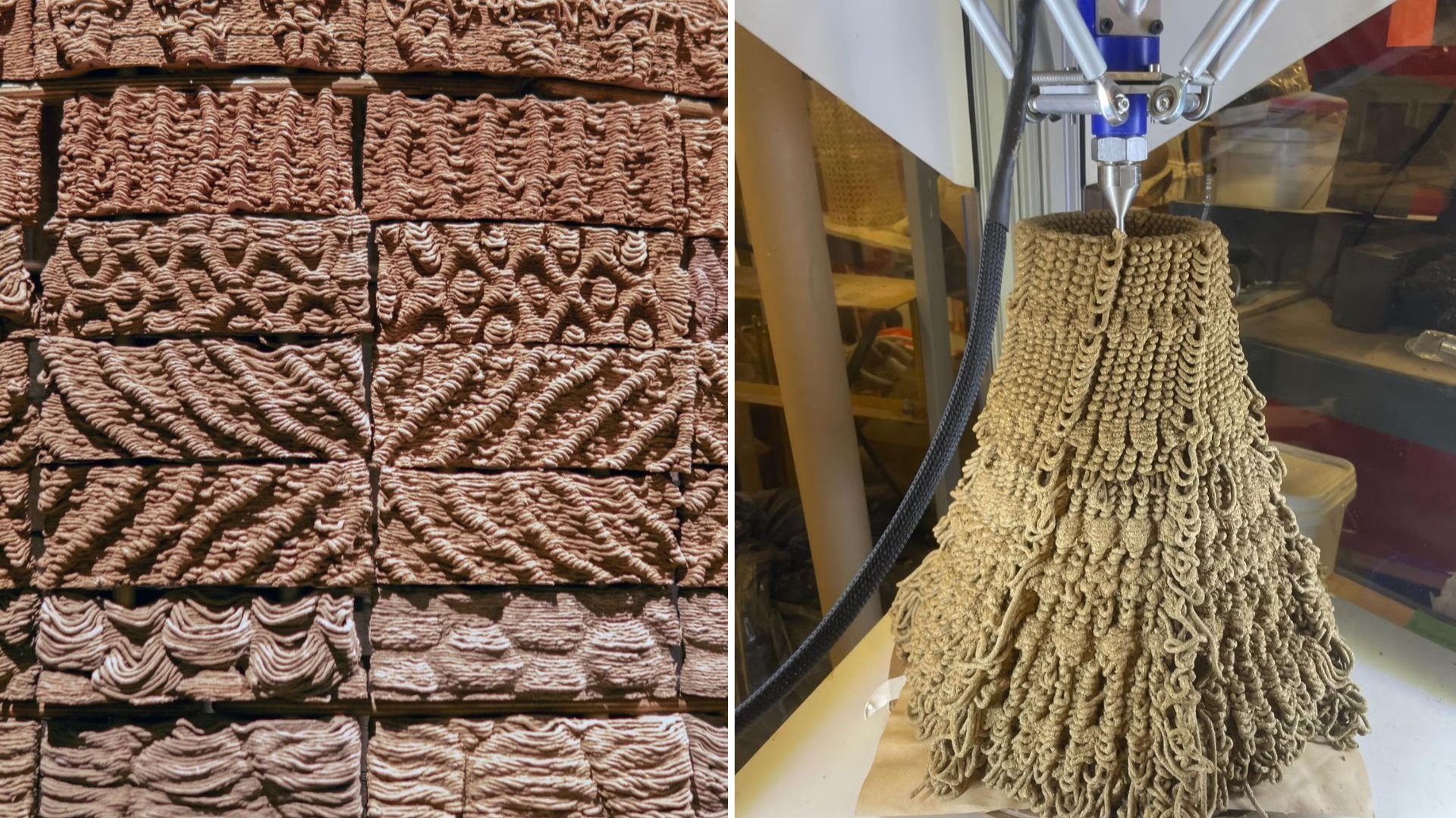

Researchers at the University of Colorado Boulder and Columbia University have found that sodium alginate, a seaweed-derived biopolymer best known for giving ice cream its creamy texture, can turn ordinary excavated earth into a viable 3D-printable building material without concrete.
Adding just 0.12 percent of the extract to raw clay and sand makes the mixture print 33 percent faster and produces finished walls that withstand 25 percent more compressive pressure than untreated earth. The numbers come from laboratory testing using earth quarried directly from a Colorado site.
The mechanism centres on particle behaviour. Sodium alginate alters the electrical charges on clay particles, causing them to repel each other rather than clump. The mixture flows cleanly through a printer nozzle, then sets into a rigid, load-bearing structure once printed.
Getting there took testing. The team evaluated five natural binders before sodium alginate emerged as the candidate that worked. Xanthan gum and guar gum, both common food thickeners, bound the soil so tightly they blocked the printer nozzle entirely.
"From termite mounds to adobe buildings, humans and animals have been building with earth since the dawn of time," said Wil Srubar, professor in the Department of Civil, Environmental and Architectural Engineering at the University of Colorado Boulder. "But there hasn't been a lot of science to how earthen builders design the materials. So, we wanted to use scientific knowledge and tools to understand it."
The researchers drew inspiration from nature directly. Termites, wasps, and honeycomb worms construct durable structures using biological molecules from their own saliva to bind earth, with no manufactured inputs at all.
Structural testing pushed the material hard. The team printed a wall panel just 8 millimetres (0.3 inches) thick, angled outward at 60 degrees. It held without support, a lean steeper than the Tower of Pisa.
The implications for construction waste are practical. Sites routinely excavate large volumes of soil for foundations and basements, most of which ends up in landfills. This method allows that same waste earth to be fed into a printer on-site and printed into structural walls.
Clay and sand are available on virtually every construction site globally, including across regions where the cost and logistics of conventional building materials remain persistent barriers to affordable housing delivery.
Earthen walls also carry performance qualities that concrete lacks. They regulate indoor humidity, provide natural thermal insulation, and trap airborne pollutants, benefits that matter most in climates with extreme heat or cold.
An installation titled Earthen Rituals, built using this technique, was exhibited at the 2026 Venice Architecture Biennial. The researchers note their framework can now be applied to other natural biopolymers, potentially uncovering additives that push durability further.
Comments (0)
Leave a Comment
No comments yet. Be the first to share your thoughts!