
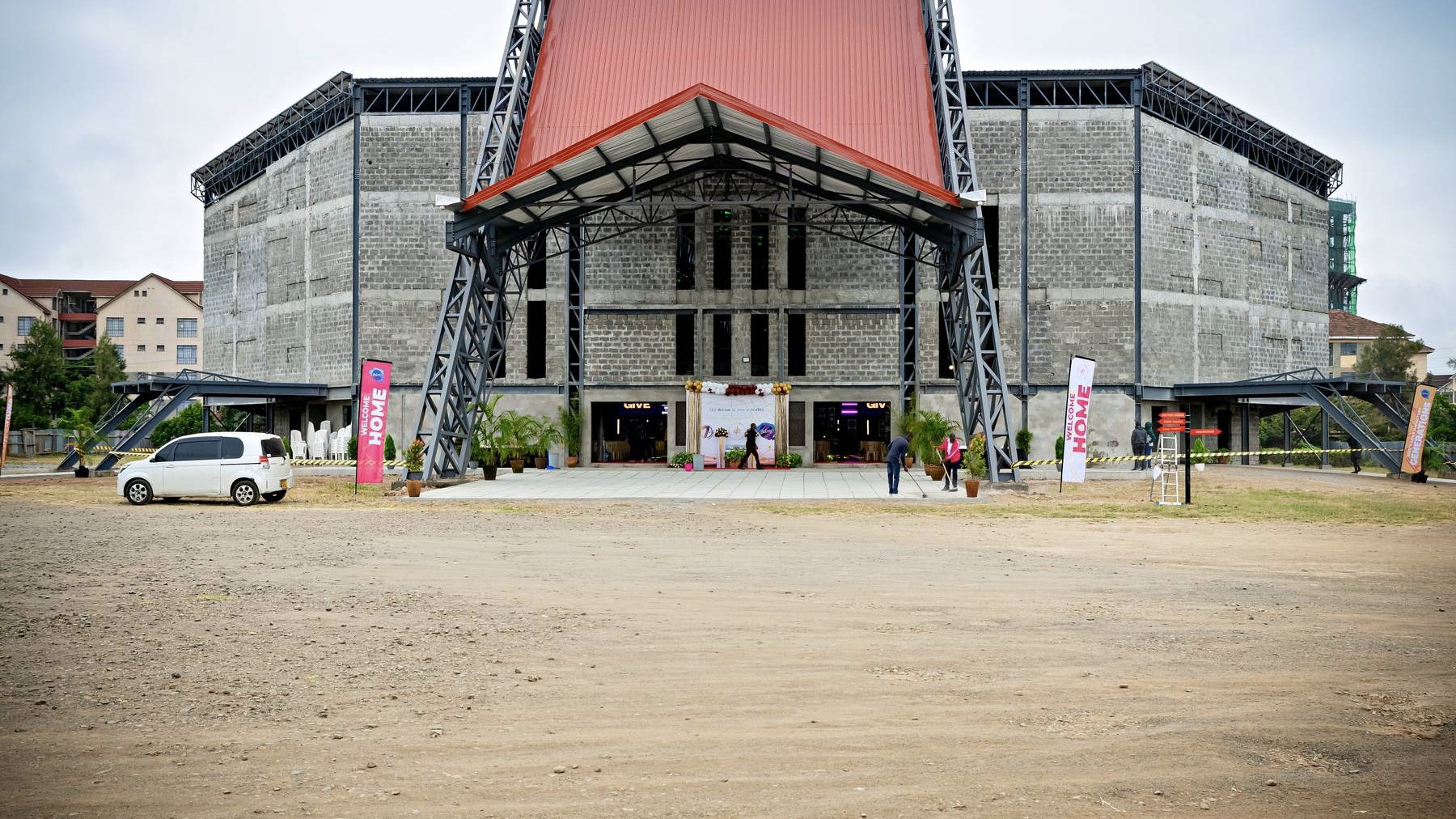

The iBelong sanctuary at ICC Imara in Imara Daima, Nairobi, did not go up the way most buildings do. The project, funded through years of weekly congregational contributions and completed around mid-2024, involved a structural redesign mid-construction and a construction sequence that runs counter to how most buildings in Kenya are put up.
Not many buildings in Nairobi get built top-down. The method is more commonly associated with high-rise commercial developments and basement-heavy projects in land-constrained urban cores. The idea is straightforward enough in principle. The roof or upper deck goes up first, supported on temporary or permanent columns, and the lower levels are constructed beneath it. In practice, it demands a level of temporary works engineering and sequencing discipline that bottom-up construction simply does not require.
On the iBelong project, that sequence shaped everything from how the site was organised to how loads were managed during the intermediate construction stages. Before the permanent structure below could take over, propping systems or king post columns had to carry the weight of what was already built above. Temporary works of that nature carry the same structural responsibility as the permanent works, even if they rarely receive the same attention.
The structural redesign adds a separate layer to the story. The project started life as a masonry build, which in the Kenyan construction context typically means load-bearing blockwork or concrete block infill within a reinforced concrete frame. It is familiar, locally available, and relatively straightforward to price and manage on site. Switching to structural steel mid-project is not a minor adjustment.
Masonry could not deliver the large column-free spans required for the open worship hall the church had in mind. Steel framing transfers loads through a skeletal system of beams and columns connected at engineered nodes. It behaves differently from masonry under load, requires fabrication off-site to precise tolerances, and demands a different set of trades on site. When that switch happens after construction has already started, the foundation design has to be revisited, the procurement chain has to be rebuilt, and the programme has to be re-sequenced around fabrication lead times and erection methodology.
For a project of this nature, those are not small asks. The iBelong build was not delivered by a commercial developer with a full technical team. It was driven by a congregation giving consistently every Sunday, managed through a client body without the deep contractual infrastructure that large developers carry. That context makes the engineering decisions on this project more striking, not less.
ICC Imara had previously completed the Connection Centre on the same Imara Daima campus in 2015, which houses Jabali Christian Schools. The iBelong sanctuary was the next major phase, a dedicated worship space that the church had been working toward for years. By April 2024, members were being invited to visit the site and see progress. The thanksgiving service marking the building's commissioning was held on 30th June 2024, and the Impacting Generations Summit in 2025 became the first major event inside the new sanctuary.
What the project leaves behind, beyond the building itself, is a useful case study in how structural decisions compound on site. A scope change of this scale mid-construction is the kind of thing that project teams in Kenya's faith-based and community-driven building sector navigate more often than industry literature acknowledges. The iBelong sanctuary is a concrete example of what that looks like when it goes through to the end.
Comments (0)
Leave a Comment
No comments yet. Be the first to share your thoughts!