
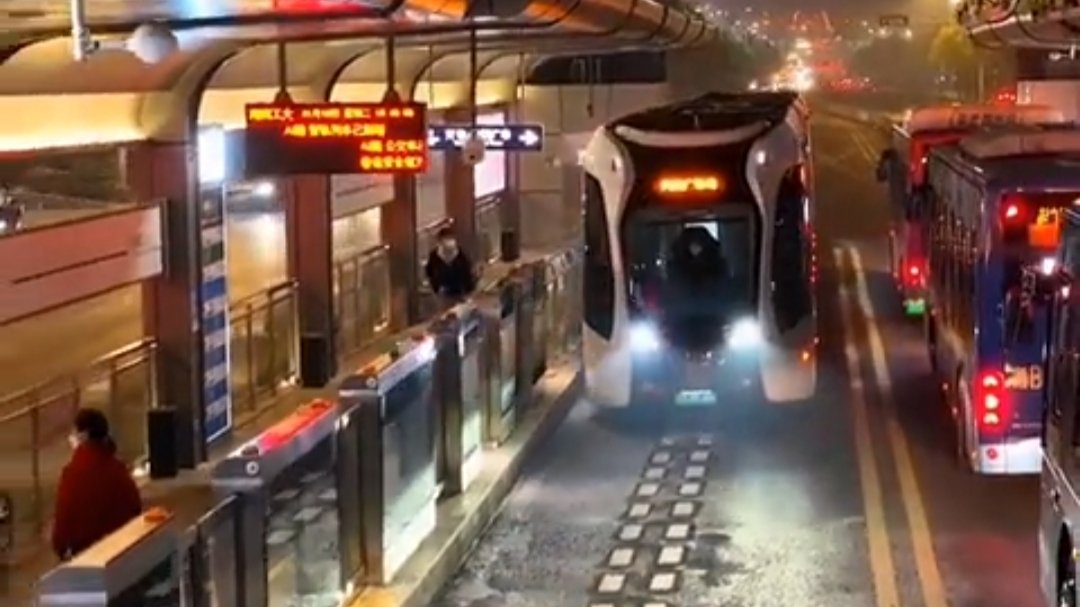

A video circulating on social media shows a sleek, white vehicle gliding toward a platform in the dark, its headlights cutting through the night along a road marked with dotted white lines. The clip highlights what many describe as the world's first railless tram in Zhuzhou, China, operating on virtual tracks that eliminate traditional rails. Though the footage dates from an earlier period, it captures the essence of a system that has been in daily use in Hunan province for several years, combining bus-like flexibility with tram-style capacity.
Developed by CRRC Zhuzhou Institute, the Autonomous Rail Rapid Transit, known as ART, was first unveiled in June 2017. Engineers presented a prototype designed to guide vehicles along predefined paths marked on existing roads, avoiding the need for steel rails. The first public line opened in Zhuzhou in May 2018, stretching 3.6 kilometers with four stations. A second line was added in 2021, bringing the total network length to 7.1 kilometers with additional stops. These routes serve downtown areas, with passengers boarding at modern platforms fitted with digital displays and safety barriers.
The ART uses lidar sensors and optical guidance to follow virtual tracks, usually painted as dashed lines on the pavement. The vehicle itself is a bi-articulated bus with rubber tires built around a reinforced core, measuring roughly 32 meters in length and capable of reaching 70 kilometers per hour. It can carry up to 307 passengers in the standard three-section version, with larger configurations available. Power is supplied by lithium-titanate batteries that support rapid charging: ten minutes delivers enough energy for 25 kilometers of travel, while a 30-second charge can cover shorter distances. Operators control speed manually, but the system provides automated steering assistance to maintain alignment.
Some observers, including commenters on the original video, view it as essentially an advanced bus. Comparisons have been drawn to guided busways in other countries, where vehicles follow physical or painted paths without full autonomy. Supporters counter that the ART offers substantial cost savings, often estimated at around one-fifth the expense of conventional tram construction, since it skips rail installation and prolonged road closures. Roads may require reinforcement to support the vehicle's weight, but the overall approach enables faster deployment in densely populated urban areas.
The technology has expanded beyond Zhuzhou. In Yibin, Sichuan province, a 17.7-kilometer line with 16 stations began service in 2019. Shanghai's Lingang district operates a larger network exceeding 47 kilometers across multiple lines introduced between 2021 and 2023. Similar systems now run in Yancheng and Yongxiu, each adapted to local conditions. Internationally, Mexico implemented the ART for a 14.6-kilometer light train in Campeche that entered service in July 2025. Malaysia is constructing lines in Kuching, with operations expected to start by 2026.
The system's flexibility stands out. Without fixed rails, routes can be modified to match changing traffic patterns or city expansion. Bi-directional cabs allow easy direction changes, and multiple units can couple together during peak hours for greater capacity. Safety elements include collision detection, electronic mirrors, and low-floor boarding for accessibility. The vehicles still operate under standard road regulations, sharing lanes with other traffic and stopping at signals, which can affect performance in congested conditions. Long-term wear on road surfaces remains a practical concern in areas with variable maintenance standards.
Globally, guided transit concepts have existed for decades, with optical or magnetic systems in cities such as Adelaide and Nancy. China's adoption fits its broader emphasis on electric mobility and smart urban planning, where rapid population growth demands cost-effective public transport. The electric drivetrain helps lower emissions, aligning with worldwide sustainability goals.
In Kenya, Nairobi continues to face severe traffic congestion and reliance on informal matatu services. The Nairobi Metropolitan Area Transport Authority has long planned bus rapid transit corridors, including Line 2 along Thika Road, which envisions dedicated lanes, stations, and potentially electric buses. Progress has been slow, hampered by funding constraints and policy revisions. Recent developments include European Investment Bank backing for Line 3, a proposed 12-kilometer zero-emission corridor linking hospitals, markets, and residential zones. Phase II planning, running through May 2026, focuses on low-emission vehicles and inclusive design features.
A system like Zhuzhou's ART could offer practical lessons for Nairobi, using marked lanes on existing carriageways to improve speeds without extensive civil works. The challenge lies in securing reliable financing and coordinating implementation. China's state-supported model enabled swift execution, while Kenya's approach depends on partnerships and incremental funding. Infrastructure specialists continue to monitor these developments, seeing virtual-track systems as a realistic intermediate step toward more advanced transit solutions.
As clips like the Zhuzhou footage reappear online, they prompt discussion about innovation boundaries. Whether the ART qualifies as a true tram, a guided bus, or a hybrid remains debated. It carries thousands of passengers daily in Chinese cities and demonstrates that sensor-based guidance can function reliably in real-world conditions. Its potential influence on cities like Nairobi will hinge on local economics, technology integration, and political commitment.
Comments (0)
Leave a Comment
No comments yet. Be the first to share your thoughts!