
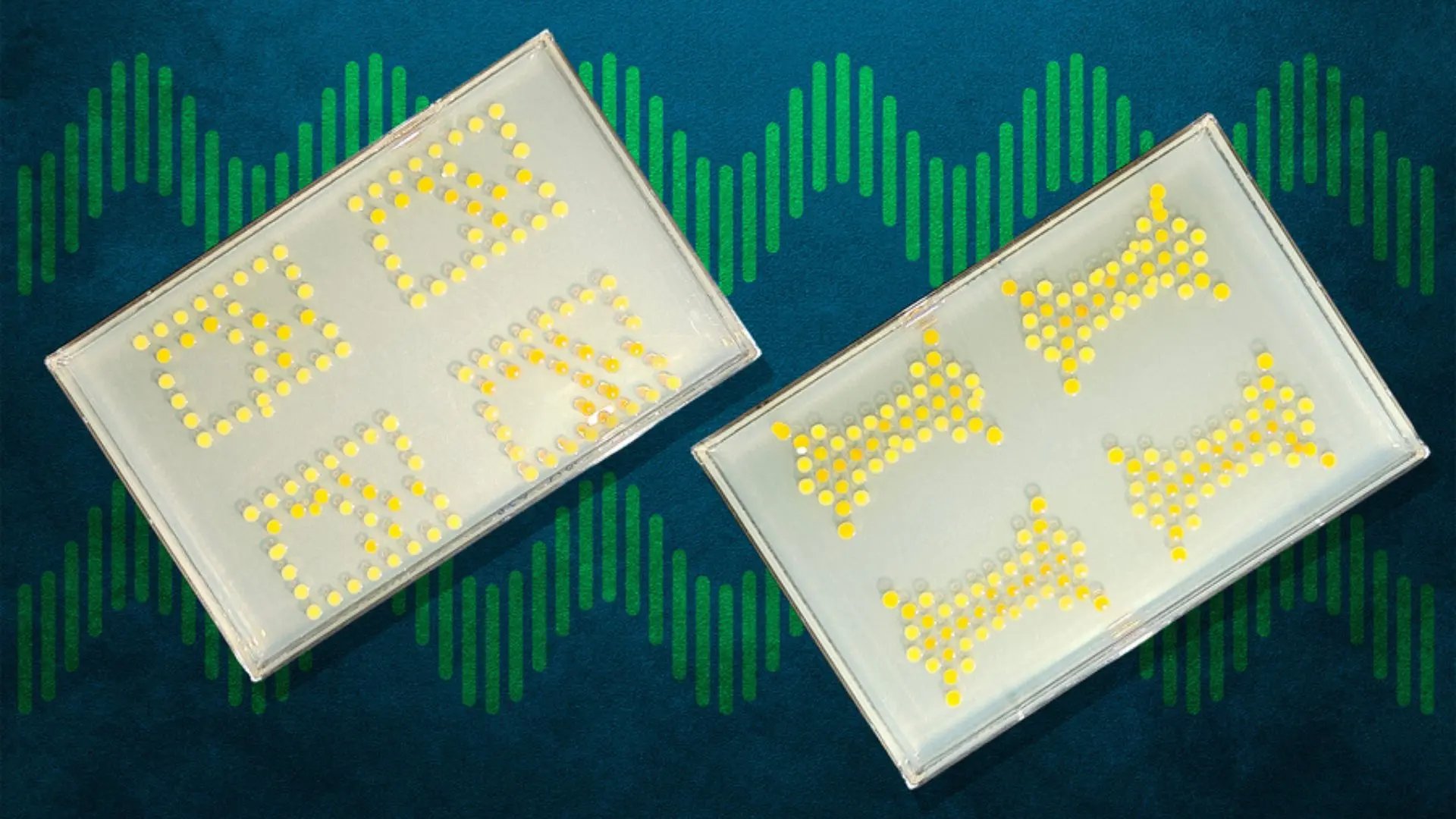

Engineers at the Massachusetts Institute of Technology (MIT) have developed a technique to grow living circuit boards inside Petri dishes using genetically modified bacteria.
Published in the journal Nature Chemical Biology, the research demonstrates how bacterial cells can function similarly to electronic transistors, opening possibilities for biological computing systems deployed on natural surfaces.
In standard electronics, transistors serve as physical switches that regulate electrical current to perform logical tasks.
The research team adapted this principle into biological systems by engineering strains of Pantoea agglomerans, a bacterium commonly found on plant surfaces, to control molecular flows. Instead of electricity, these cellular switches respond to and release specific signal molecules.
To construct the biological circuits, researchers designed two distinct transistor strains along with three relay strains. The relay cells channel molecular signals strictly in one direction across agar growth plates, preventing chemical interference across nearby colonies.
By using an acoustic liquid handler to deposit droplets of bacteria roughly five millimeters apart, the team created structured biological networks.
The physical placement of the bacterial colonies determines the function of the living circuit board. This design allows researchers to assemble different computational systems simply by changing cell layout rather than altering genetic code for every new application.
Demonstrated configurations include multi-input logic gates, demultiplexers, and half-adder circuits capable of adding incoming molecular signals. The largest demonstrated biological circuit linked 24 bacterial colonies to execute arithmetic calculations.
While conventional microchips operate at gigahertz speeds, these bacterial systems require approximately eight hours to complete a calculation.
Lead author Hamid Doosthosseini noted that such processing speeds are suitable for biological environments, where monitoring agricultural soil or plant health occurs over extended growth cycles rather than milliseconds.
Senior author Christopher Voigt emphasized that the goal is not to replace silicon processors, but rather to embed cellular computing directly into living ecosystems.
Future applications could include living coatings on crop leaves or roots that continuously monitor biological threats, calculate responses to pests, and deliver targeted chemical defenses autonomously.
Comments (0)
Leave a Comment
No comments yet. Be the first to share your thoughts!