
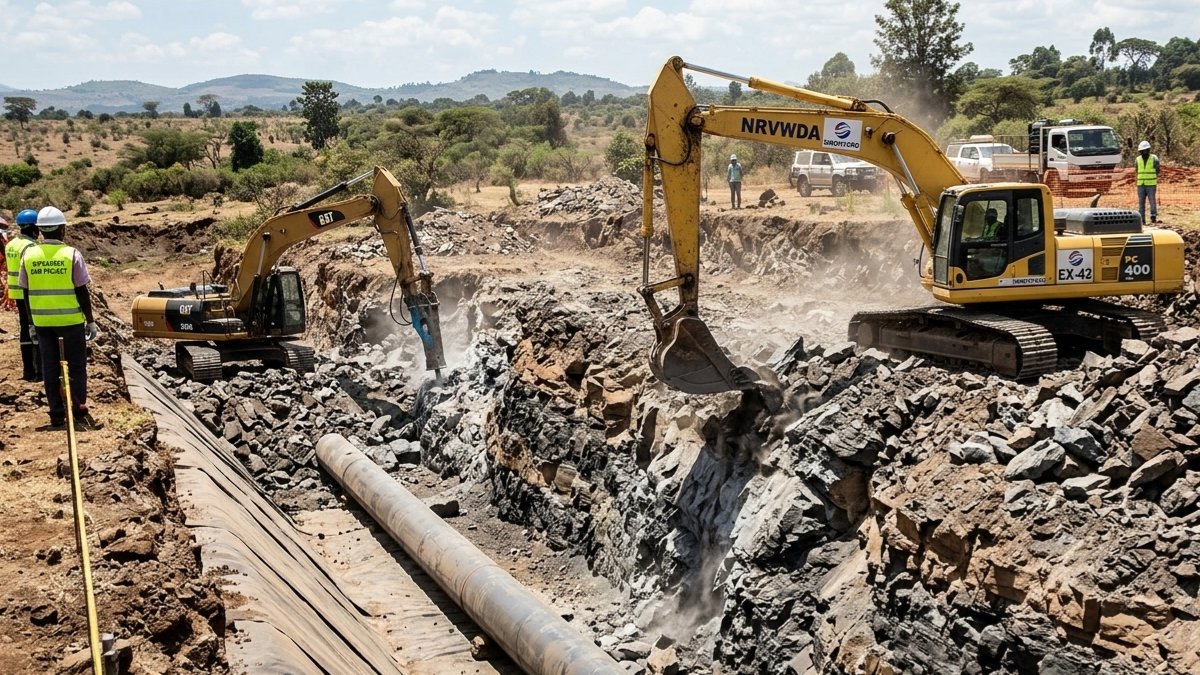

Heavy earthmoving machinery and site crews are navigating dense subterranean rock layers while cutting trenches for the Kipkarren Dam Water Treatment Works. The ongoing civil works target primary distribution networks across neighbouring agricultural regions, where heavy rock structures continue to impede rapid progress along designated pipeline corridors.
Cabinet Secretary (CS) for the Ministry of Water, Sanitation, and Irrigation, Eng. Eric Mugaa, confirmed that site crews are carrying out specialized excavation across affected sections. Civil engineering teams must carefully fracture underground stone beds without damaging adjacent utility lines or surrounding soil stability, which adds operational complexity to daily laying schedules.
The dual-county development aims to stabilize potable water availability for thousands of households across both Uasin Gishu County and Nandi County. Ground crews are installing high-density polyethylene pipelines alongside raw water steel mains, which will eventually transport untreated intake water straight from the dam reservoir to processing units.
The expansive scope includes building a high-capacity treatment facility alongside storage tanks designed to supply domestic and commercial users. Water engineers designed the network to serve expanding trading centres, nearby rural settlements, and fast-growing urban hubs like Eldoret, which continue to demand expanded bulk water supply systems.
Engineers on site are using hydraulic breakers and mechanical excavators to penetrate hard rock layers exposed during trench clearing. These subsoil conditions require extra machinery operating hours, which forces contractors to adjust daily laying schedules to maintain safe trenching standards before lowering pipe sections.
The project relies on joint coordination between regional water boards, including the North Rift Valley Water Works Development Agency (NRVWWDA) and the Lake Victoria North Water Works Development Agency (LVNWWDA). Technical teams conduct regular joint site inspections, which help monitor contractor compliance and track structural progress against baseline civil engineering schedules.
Proper pipeline depth remains crucial to safeguard buried infrastructure against surface traffic loads and agricultural soil movement. Contractors must maintain uniform bedding using crushed stone dust, although clearing the underlying basalt strata requires careful mechanical fracturing before pipe placement begins.
President William Ruto has previously stressed that expanding bulk water infrastructure remains a central priority for national development plans. Government funding partners, including the African Development Bank (AfDB), continue to back major regional water programs aimed at improving public health and economic growth through reliable tap water access.
Water coverage across western Kenya has historically lagged behind rapid population expansion, which puts severe pressure on localized groundwater reserves. Upgrading bulk treatment plants and building expansive piping networks provides a long-term solution, although local geological formations consistently present field challenges during initial trenching operations.
Contractors continue to clear rock along the distribution alignment while preparing foundations for associated pumping stations and storage tanks. Heavy machinery operators remain on site, where work will continue until the remaining pipeline segments achieve full depth alignment and structural approval.
Comments (0)
Leave a Comment
No comments yet. Be the first to share your thoughts!