
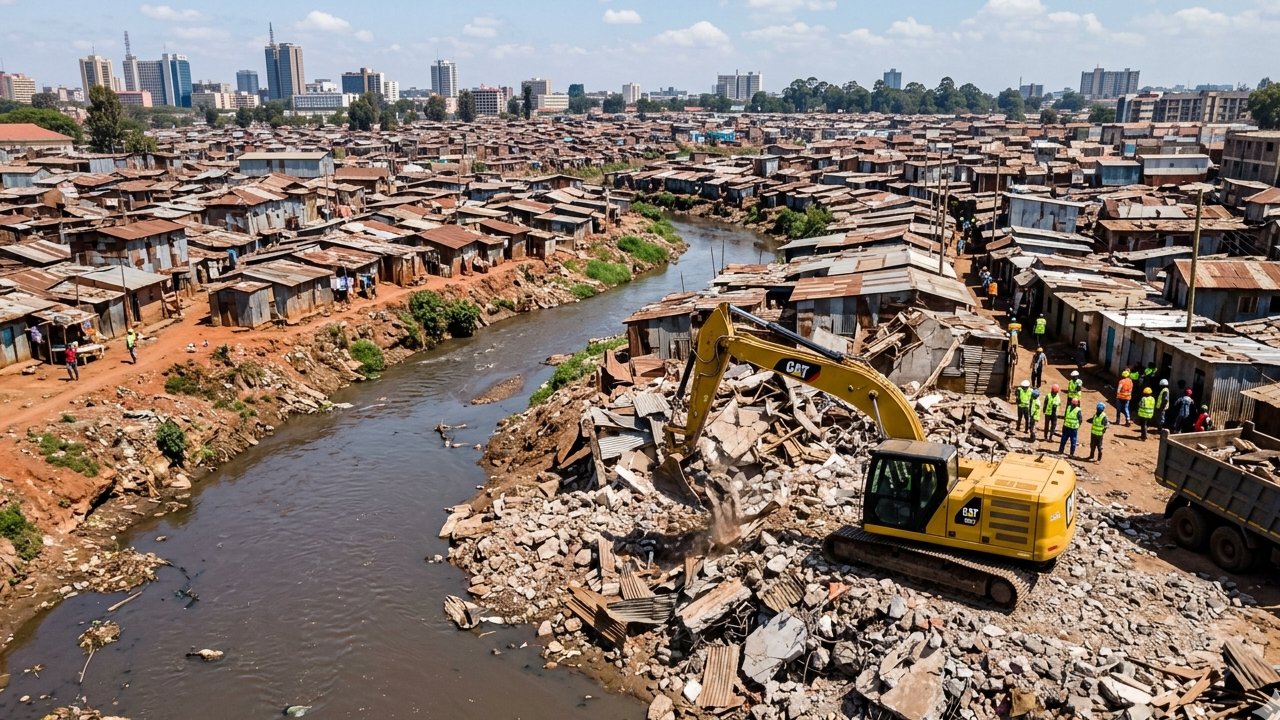

The Nairobi County government is preparing to extend its demolition exercise to high-end residential estates, targeting structures built on riparian land. Governor Johnson Sakaja confirmed that the crackdown will move into neighborhoods such as Runda, Muthaiga, Kileleshwa, and Lavington.
This announcement follows recent demolitions in Mathare and other informal settlements located along the Nairobi River. Governor Sakaja addressed concerns regarding selective enforcement, stating that the law would apply equally to all residents regardless of their social or economic status.
The Governor emphasized that notices have already been issued to property owners in these affluent areas. He noted that some individuals have attempted to use court orders to stall the process, but the county remains committed to clearing the waterways.
According to the Governor, the move is a necessary response to the recent flooding that devastated parts of the city. He explained that illegal structures blocking the natural flow of water contributed to the severity of the situation during the heavy rains.
"We are not just targeting the poor," Governor Sakaja stated while overseeing operations in Nairobi. He added that those who have encroached on the riverbanks in high-end estates would be the next to see their walls and buildings brought down.
The Nairobi River reclamation project is part of a wider national effort to restore the city's drainage systems. President Ruto previously ordered the evacuation of people living within 30 meters of riverbanks to prevent further loss of life during extreme weather events.
Critics and human rights groups have raised concerns over the speed of the demolitions and the adequacy of compensation for those displaced. However, the Governor insisted that the primary focus is public safety and environmental restoration.
Technical teams from the county are currently mapping out the specific boundaries of the riparian land in the targeted estates. This process involves verifying property titles against the original city plans to identify where boundaries have been illegally pushed into the river zones.
In Runda and Muthaiga, several properties are reported to have perimeter walls and extensions that sit directly on the banks of the Gitathuru and Ruaka rivers. These tributaries feed into the main Nairobi River and are critical for the city's overall drainage.
The exercise is expected to be a test of the county's resolve in facing influential property owners. Many of these landowners have historically relied on legal maneuvers to prevent the interference of local authorities with their developments.
Governor Sakaja maintained that the regeneration of the Nairobi River cannot be successful if sections of the river remain obstructed in some areas while others are cleared. The county intends to create a continuous green belt along the riverbanks once all illegal structures are removed.
Residents in the affected high-end areas have been urged to voluntarily remove their structures before the county deployment begins. Failure to do so will result in the forceful removal of the buildings at the owners' expense.