
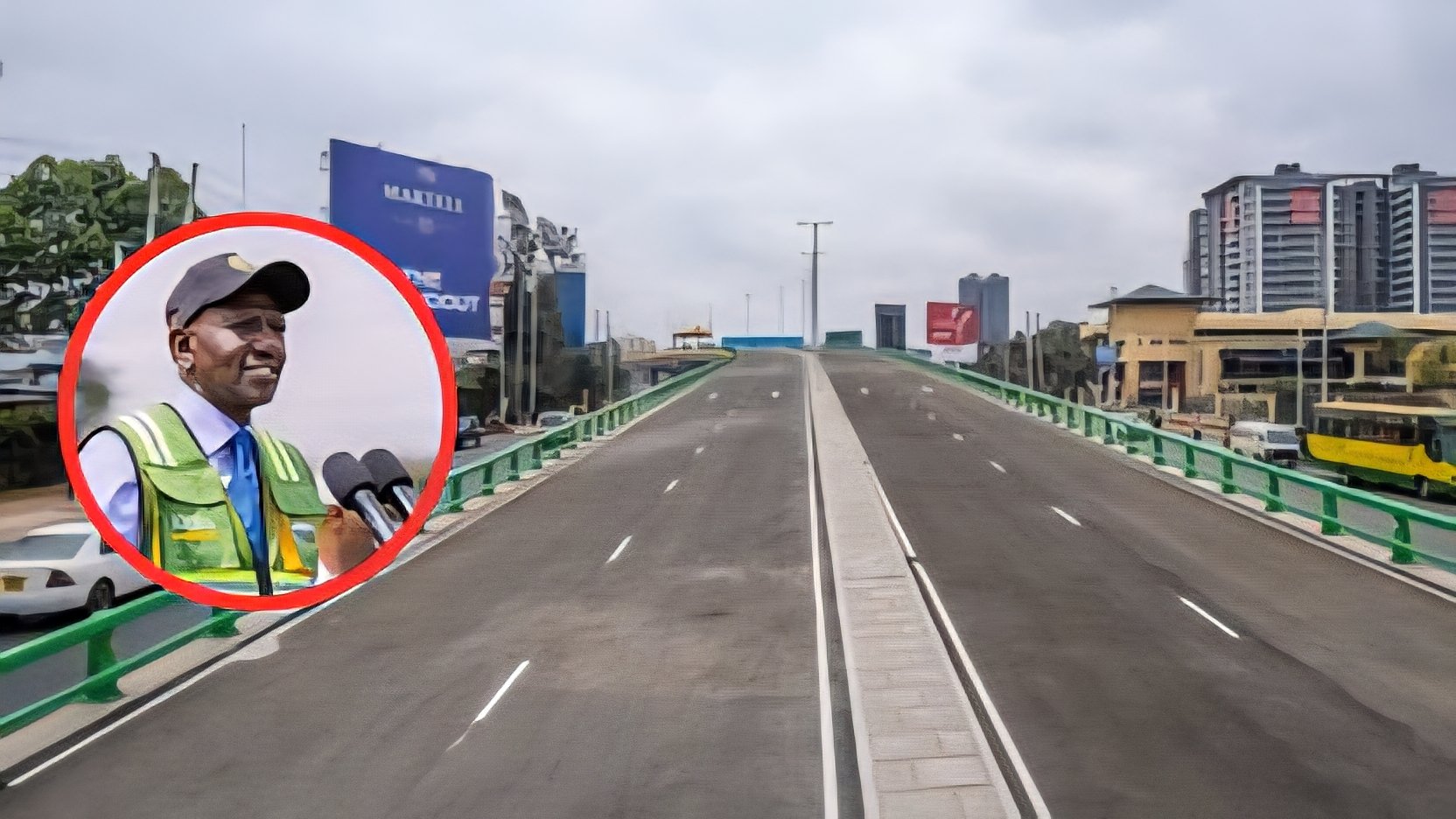

The Kenya Urban Roads Authority (KURA) has disclosed the financing details behind the recently completed Ksh3.8 billion Ngong-Naivasha Road Flyover.
According to project details from the roads agency, the 820-metre infrastructure development was primarily financed through a Ksh3.58 billion concessional loan from the Government of Spain.
This international funding was sourced from the Spanish state fund, known as the Corporate Internationalisation Fund (FIEM).
The disclosure follows the official commissioning of the elevated dual carriageway by President William Ruto, who presided over the public opening ceremony at the busy Junction Mall intersection.
The infrastructure project addresses a severe traffic bottleneck, which has historically caused heavy delays for commuters travelling between Nairobi and surrounding areas.
Spanish engineering firm Centunion S.A. undertook the construction works, completing the infrastructure in 22.5 months, which was significantly ahead of the original contract schedule.
Officials noted that the accelerated construction timeline helps Nairobi prepare for upcoming international events, including the 2027 Africa Cup of Nations (AFCON).
The engineering works involved building a 400-metre flyover structure, along with another 400 metres of expanded and upgraded adjoining road sections.
The new overpass separates through-traffic along Ngong Road from local traffic accessing Naivasha Road and King'ara Road, but it also includes dedicated lanes for non-motorized transport.
Pedestrians and cyclists will use these newly built facilities, which ensure safer movement around the busy commercial zone.
Speaking during the launch, President Ruto stated that the capital city requires modern transport networks, if it is to remain a competitive regional hub for trade and investment.
The President prioritized transport investments, when noting that traffic delays impose a heavy economic burden on businesses when productive hours are lost in daily gridlock.
Several senior government figures attended the launch event, including Cabinet Secretary for Roads and Transport Davis Chirchir, and Nairobi County Governor Johnson Sakaja.
Governor Sakaja attributed the successful execution of the project to a close cooperation agreement, which exists between the county and the national government.
Beyond this flyover, President Ruto outlined an array of other major road projects currently active across the capital city.
The government is currently constructing the Ksh3 billion Upper Hill-Kenyatta Avenue Viaduct, although that project stands at approximately 60 percent complete.
Funding has also been allocated for the Ksh3.9 billion Talanta Sports City access roads, which will serve the stadium complex currently under construction.
Additional capital investments include a Ksh1.6 billion modernization program for State House Road, and a massive plan for dualling the 23.5-kilometre Kiambu Road corridor.
The Kiambu Road project carries an estimated budget of Ksh30 billion, but it remains in the planning phases.
Nairobi is also rolling out a Ksh45 billion Intelligent Transport System (ITS), which will eventually manage traffic across more than 210 signalised intersections using real-time data monitoring.
The first phase of the smart mobility project is already active, with a modern traffic management centre and 25 signalised junctions currently under construction at a cost of approximately Ksh7 billion.
In total, the national government is maintaining 729 kilometres of roads within Nairobi County to upgrade the broader urban transport network.
Public discussions emerged regarding the specific unit cost of the project, after local calculations indicated the engineering works cost an average of Ksh46,341 per centimetre of infrastructure.
The calculation divides the total project budget of Ksh3.8 billion by the 82,000 centimetres that make up the 820-metre length of the development.
However, engineering experts clarified that this total does not represent the cost of physical concrete alone, because the contract covers various sophisticated urban construction requirements.
The comprehensive budget includes expenses for extensive drainage systems, utility relocation for power and water lines, street lighting installation, and complex traffic management during the construction period.
Nairobi residents around Dagoretti Corner noted that the newly opened lanes have already started attracting local enterprise, although full economic impacts will be measured over the coming years.
Comments (0)
Leave a Comment
No comments yet. Be the first to share your thoughts!