

A version of this article appeared on LinkedIn by Mary Gichaga.
A cable-stayed bridge and a suspension bridge look similar from a distance, but they are structurally completely different. Understanding these differences requires looking at how each system transfers loads, uses anchorages, and manages deck forces during operation.
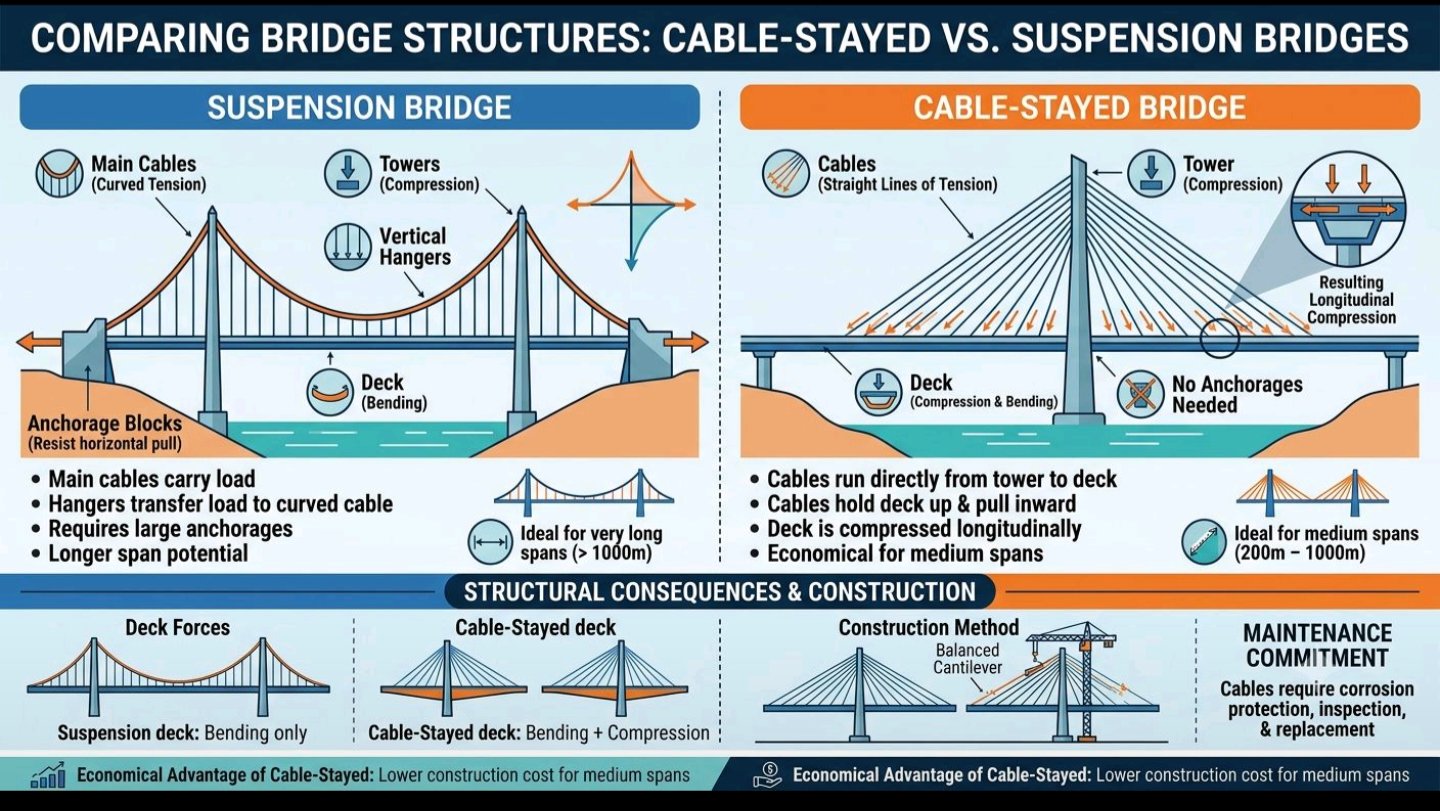
In a suspension bridge design, main cables hang in a parabolic curve between support towers and connect directly to vertical anchorages. These main cables carry the primary load, while vertical suspenders transfer the weight of the bridge deck up to the main cables.
This configuration requires massive concrete anchorage blocks anchored into solid rock or heavy foundations at both ends of the bridge to resist tension forces. Suspension systems feature a longer span potential, making them ideal for very long spans exceeding 1,000 metres.
By contrast, a cable-stayed bridge connects cables directly from the support towers to the bridge deck in a fan or harp pattern. The cables hold the deck up while pulling inward, compressing the deck longitudinally without requiring massive external anchorages.
Because the cables connect straight to the deck, cable-stayed structures eliminate the need for end anchorages, which lowers foundation construction costs on medium spans. Structural engineers consider cable-stayed designs ideal for medium-length spans ranging between 300 metres and 1,000 metres.
The structural forces acting on the bridge deck also differ significantly between the two systems. A suspension bridge deck experiences bending forces only, whereas a cable-stayed deck undergoes a combination of bending and compression forces.
Construction methods for the two types vary based on structural demands. Cable-stayed bridges are typically built using balanced cantilever erection methods, extending outward from central towers. Suspension bridges require initial cable spinning before hanging individual deck sections.
Maintenance requirements present another critical operational consideration for infrastructure authorities. Cable-stayed systems require continuous cable corrosion protection, periodic inspection, and occasional cable replacement over the lifespan of the asset.
Choosing between these bridge configurations depends heavily on site conditions and budget limits. Economical considerations favour cable-stayed designs for medium spans due to lower overall construction costs, while suspension designs remain necessary for extreme water crossings.
Comments (0)
Leave a Comment
No comments yet. Be the first to share your thoughts!