
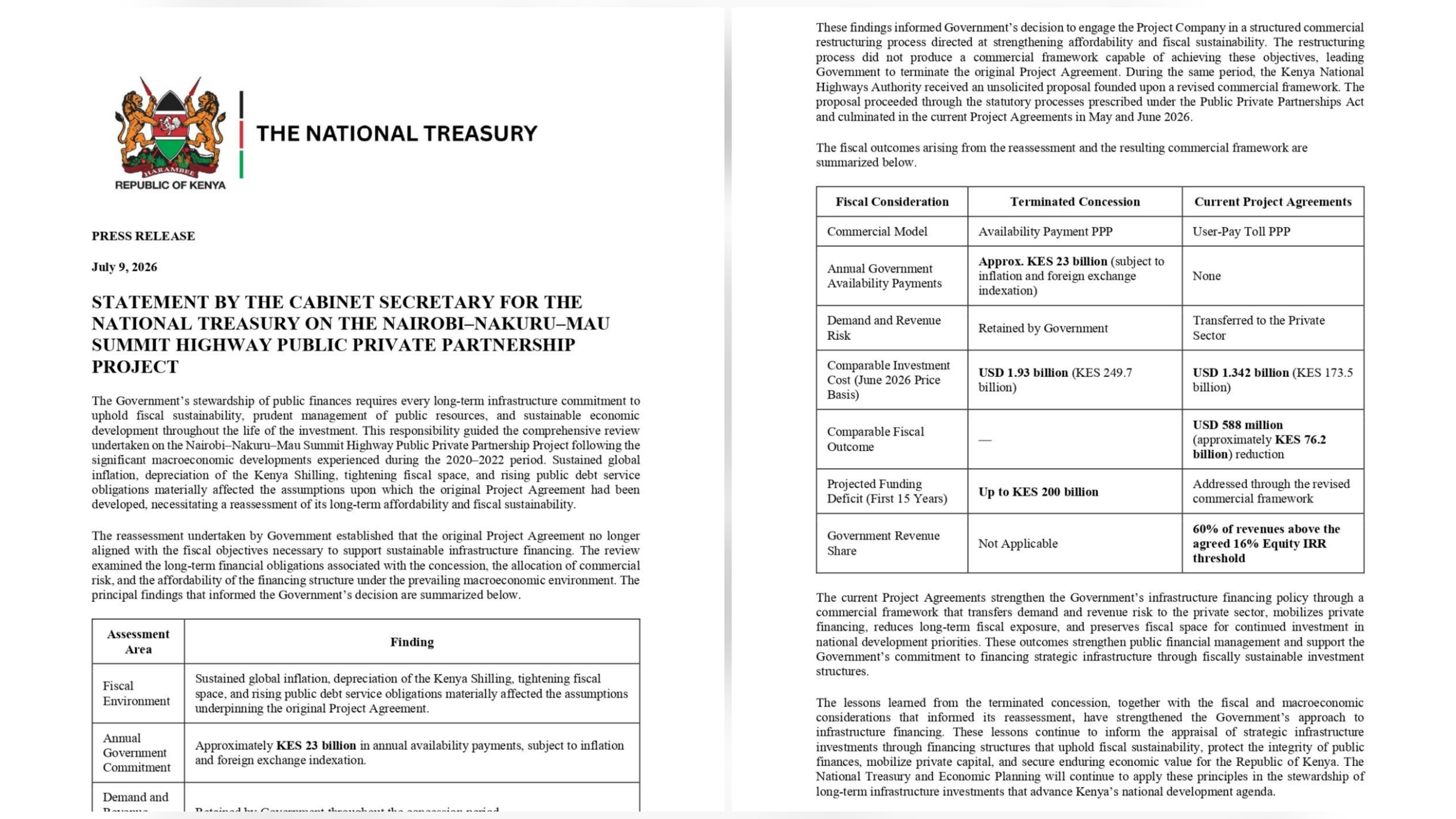

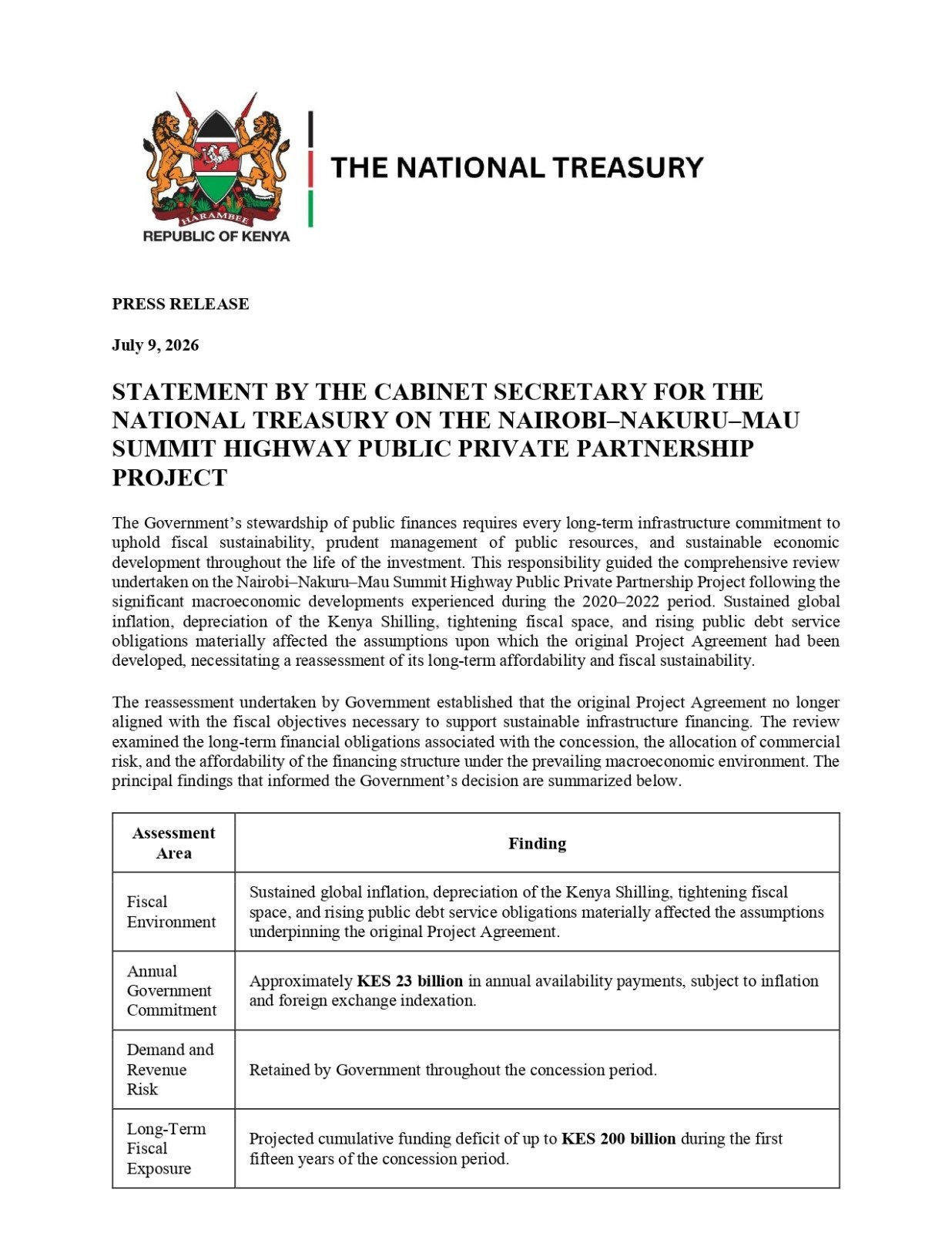
The National Treasury has restructured the Nairobi-Nakuru-Mau Summit Highway project, moving away from an availability payment framework to a toll-by-tariff concession model. This change eliminates a significant financial commitment for the state, which previously faced multi-billion shilling annual obligations.
Cabinet Secretary (CS) John Mbadi confirmed the details in a formal statement, noting that the new arrangement alters how risks and costs are distributed. The previous framework bound the government to heavy long-term expenditures, regardless of the actual traffic volume on the highway.
Under the new Public Private Partnership (PPP) agreement, the private partner will assume the demand and revenue risks. This transfers the burden of traffic fluctuations entirely to the investor, protecting public funds from potential shortfalls.
The previous terminated concession required annual government availability payments of approximately 23 billion Kenya Shillings (KES). This massive sum was also subject to inflation and foreign exchange fluctuations, which added unpredictable fiscal risks for the state.
The updated project agreement reduces the comparable investment cost from 1.51 billion United States Dollars (USD), which is about 201.7 billion KES, to 1.341 billion USD, or 175.5 billion KES. This represents a clear reduction in the baseline cost of the infrastructure development.
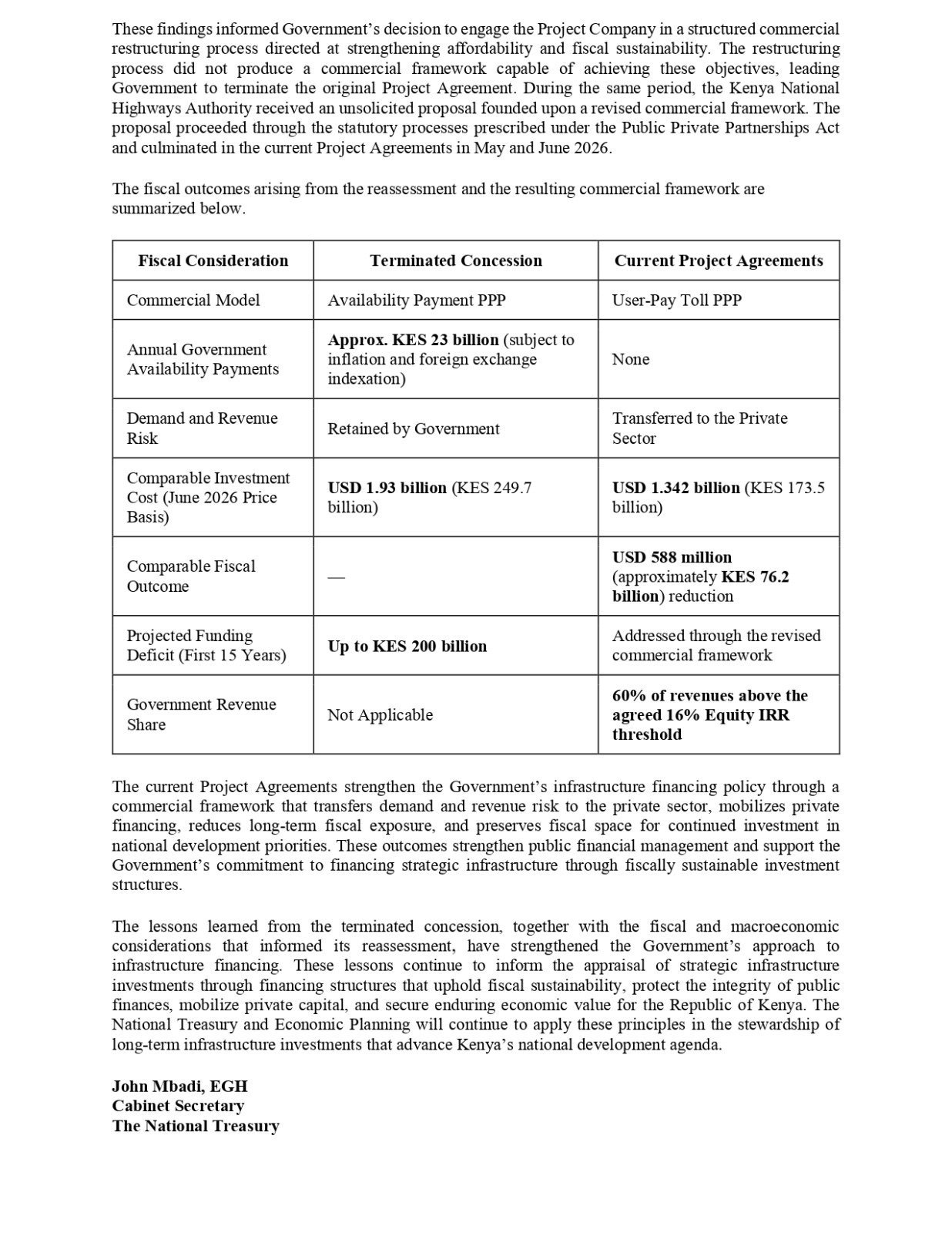
Financing structures have also changed under the new terms. The current framework involves 500 million USD in equity alongside an estimated 78.2 billion KES debt window, whereas the previous model relied on financing up to 200 billion KES.
A new revenue-sharing mechanism has been introduced in the latest contract. The government will receive a ten percent share of revenues, but this only applies if the project exceeds an agreed sixteen percent Equity Internal Rate of Return (IRR) threshold.
The restructuring follows a comprehensive review of fiscal sustainability and value for money. The state sought to realign the project, which connects the capital to major western regions, with current economic realities and national debt management strategies.
The Nairobi-Nakuru-Mau Summit Highway serves as a critical artery for transit cargo heading to western Kenya and neighboring nations. Upgrading this corridor remains an essential priority, although the financial model required extensive adjustments to protect the national budget.
By shifting the revenue risk, the government aims to ensure that the private developer relies entirely on efficient toll collection. This alignment ensures that public resources are not drained, if traffic projections fail to meet expectations.
The decision reflects an ongoing effort by the ministry to manage infrastructure spending prudently, while maintaining investor confidence. The treasury maintains that the revised framework provides a sustainable path, which supports development without worsening the deficit.
Lessons learned from the terminated concession have strengthened the government's approach to major infrastructure financing. These lessons emphasize tight fiscal management, which helps protect the long-term integrity of public finances.
The revised framework intends to mobilize private capital effectively, while delivering value for money. This strategy protects the state from long-term liabilities, but it keeps strategic infrastructure delivery firmly on track.
The state remains committed to creating a predictable environment for international investors, who look to participate in local infrastructure. Prudent risk allocation is central to this objective, as the nation balances growth with fiscal discipline.
The Kenya National Highways Authority (KeNHA) has been involved in overseeing these contractual transitions. The authority aims to maintain the structural momentum of the highway expansion, while enforcing the newly established financial guidelines.
Proper execution of this tollway contract will serve as a baseline for future public infrastructure developments. The ministry believes this model establishes an equitable balance between state oversight and private sector investment.
Comments (0)
Leave a Comment
No comments yet. Be the first to share your thoughts!