

A version of this article appeared on Business Daily.
Kenya has initiated a shift in how it finances public works through the newly operationalised National Infrastructure Fund (NIF).
Under the stewardship of a recently appointed board, the fund is designed to attract private capital, which will reduce the state’s reliance on expensive public debt.
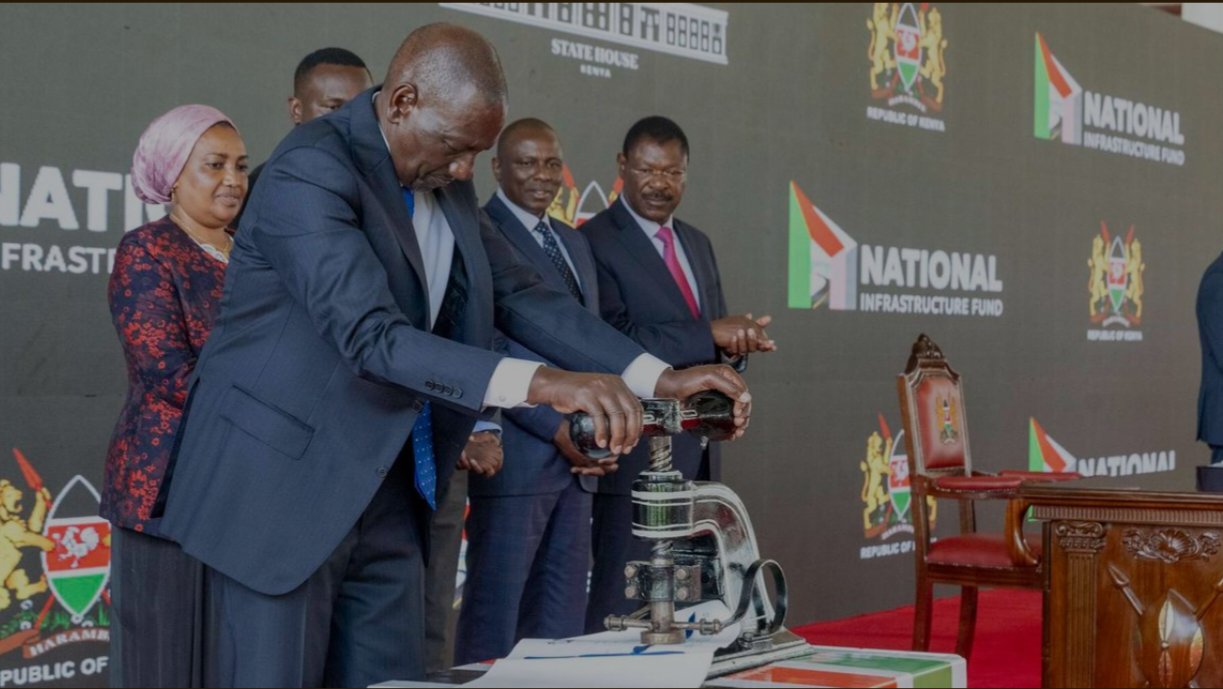
President Ruto signed the National Infrastructure Fund Act, 2026, into law in March, establishing a structure to mobilise up to Sh5 trillion over the next decade.
This legislation addresses long-term funding challenges by utilising an investment-led model that blends public allocations, privatisation proceeds, and private capital.
National Treasury Cabinet Secretary John Mbadi appointed six professionals to the board of directors for a three-year term to oversee operations.
The board includes Centum Investment Company Chief Executive Officer (CEO) James Mworia Mwirigi, who has highlighted the fund’s potential to change the country's development pathway.
According to Mworia, the NIF has already secured initial capitalization of approximately Sh347 billion, which is equivalent to about 2.7 billion United States Dollars (USD).
This substantial capital base was raised through the partial privatisation of state enterprises, including Safaricom PLC and Kenya Pipeline Company (KPC).
By comparison, the Africa Finance Corporation (AFC), which is a leading infrastructure investor on the continent, began operations with a paid-up capital of only 1 billion USD.
With its larger starting pool, the Kenyan fund has the financial capacity to act as a catalyst for much larger investments.
The board has already held its inaugural meeting and started preparing the Investment Policy Statement (IPS), which will govern how these massive resources are deployed across the country.
Mworia notes that, if the fund achieves a conservative annual cash return of 12 percent, it would yield about Sh42 billion each year.
Deploying Sh34 billion of that income annually into new projects would unlock unprecedented local infrastructure development while preserving the underlying capital.
The fund does not operate in isolation, but instead seeks to crowd in local pension funds, insurance firms, and foreign institutional investors.
This co-investment model allows the government to deliver large-scale projects without further straining the national treasury or adding to the public debt burden.
Among the priority projects identified for funding is the modernization of Jomo Kenyatta International Airport (JKIA) in Nairobi to expand its passenger and cargo capacity, although this requires vast capital.
The government also plans to utilize the fund to extend the Standard Gauge Railway (SGR) to Malaba, but this requires substantial structured financing.
Other targeted investments include constructing dual highways, such as the Nairobi-Namanga road, and developing 10,000 megawatts of clean energy.
Additionally, the state has expanded the Railway Development Levy (RDL) to support the rail network under this new financial framework.
The National Treasury has also commenced the search for the fund's first chief executive, who will manage daily operations and capital mobilization.
This executive will be tasked with identifying bankable projects and ensuring strict compliance with public investment guidelines.
The transition to an investment-led model marks a departure from traditional funding methods, which have frequently relied on high-interest sovereign loans.
The board believes that, if the fund succeeds, it will demonstrate that strategic state assets can be leveraged without risking fiscal stability.