
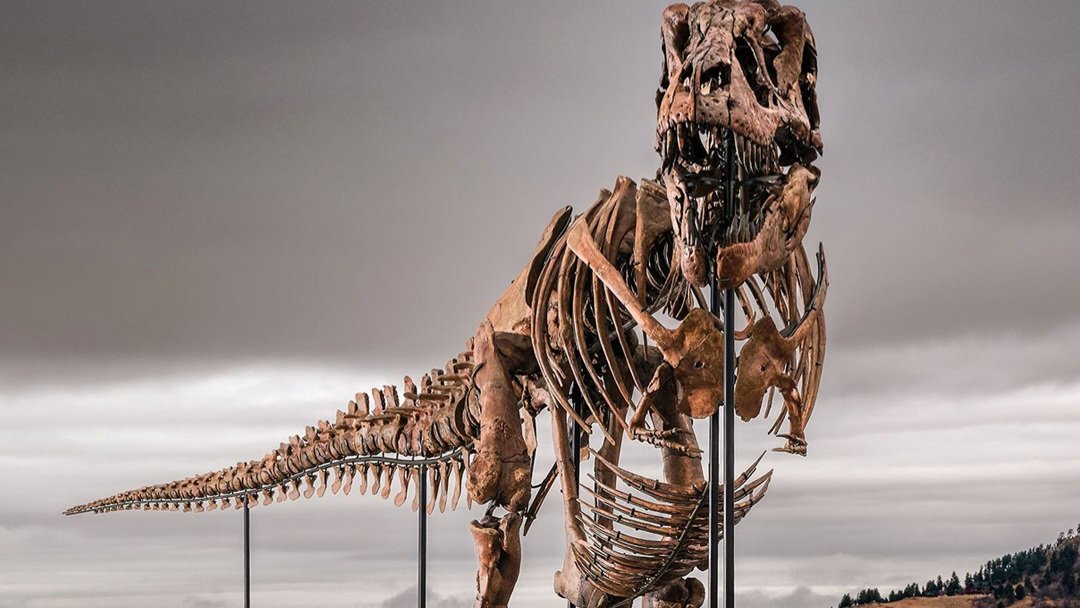

Private collectors are preparing bids for a rare Tyrannosaurus rex skeleton named Gus, which is heading to the auction block.
The upcoming sale has triggered intense concern among paleontologists, who warn that the fossil could become the most expensive ever sold.
When specimen sales reach millions of dollars, public museums and research institutions find themselves priced out of the market entirely.
Academic researchers fear the loss of Gus will permanently damage scientific progress, as specimens in private hands are rarely accessible for study.
The Society of Vertebrate Paleontology (SVP) has historically opposed these commercial auctions, arguing that fossils are non-renewable natural resources of scientific value.
Under United States law, fossils discovered on private land belong to the landowner, who is legally permitted to sell them to the highest bidder.
This legal framework has enabled a booming commercial market, drawing criticism from international researchers who advocate for strict heritage preservation laws.
In Kenya, the National Museums of Kenya (NMK) strictly regulates all palaeontological excavations, ensuring that national heritage remains in public custody.
The NMK framework contrasts sharply with the commercialized system in the United States, where high-profile fossils frequently enter private collections.
The trend of auctioning apex predators gained global attention in 1997, when a Tyrannosaurus rex named Sue sold for over eight million dollars.
That purchase was only made possible through significant corporate backing, which allowed the Field Museum in Chicago to secure the specimen.
In 2020, another Tyrannosaurus rex skeleton, known as Stan, shattered records by selling for over thirty-one million dollars to a private buyer.
Though Stan was later revealed to be heading to a public museum in Abu Dhabi, scientists remain uneasy about the precedent it established.
Without public access, other researchers cannot verify published claims, which violates the fundamental scientific principle of reproducibility.
Private owners are under no legal obligation to preserve fossils, meaning specimens can be damaged, modified, or lost to history.
Commercial hunting also encourages landowners to shut out academic researchers, who cannot compete with the financial offers of commercial dealers.
Many landowners now demand high fees for excavation access, which stretches already limited academic budgets to their absolute breaking points.
As the auction date approaches, the fate of Gus remains uncertain, leaving the scientific community to brace for another loss of invaluable data.
For researchers, each commercial sale represents a lost opportunity to study dinosaur biology, evolution, and the prehistoric ecosystems of our planet.
The global community continues to debate how to balance private property rights with the preservation of global scientific heritage.
Meanwhile, dealers argue that high auction prices fund further excavations, which ultimately uncovers more specimens that might otherwise erode away unseen.
This defense does little to reassure paleontologists, who view the commercialization of earth history as an irreversible loss for global education.
The hammer will fall soon, and science may once again be locked out of the room.
Ultimately, the high price of these fossils may cost the world its deepest understanding of prehistoric life.
With every million added to the bid, the gap between commercial wealth and public science grows wider.
Comments (0)
Leave a Comment
No comments yet. Be the first to share your thoughts!