

Dubai was a desert. Nobody believed it either.
Gelephu Mindfulness City is rising from semi-abandoned agricultural land on Bhutan's southern border with India, and the comparison to Dubai is one its architects and investors are not shying away from. The scale, the ambition and the speed of the vision are the same. Everything else is different.
Announced by King Jigme Khesar Namgyel Wangchuck on December 17, 2023, and formally established by Royal Charter in December 2024 as a Special Administrative Region (SAR), Gelephu Mindfulness City covers 2,500 square kilometres, an area three times the size of Singapore. It sits on 5 percent of Bhutan's entire land mass. The masterplan was designed by Bjarke Ingels Group (BIG), the same Danish studio behind the 8 House in Copenhagen, the Shenzhen International Energy Mansion, and the rebranding of LEGO's physical brick design. Collaborators include engineering consultancy Arup and urban strategy firm Cistri.
The city is designed for an eventual population of one million people, in a country that currently has 700,000. Phase one targets 100,000 residents by the mid-2030s.
What makes Gelephu structurally different from every other new city project being built anywhere in the world is its founding philosophy. Dubai was built on oil money and the logic of maximum economic extraction. Gelephu is being built around Bhutan's Gross National Happiness (GNH) index, a national measurement framework that prioritises psychological wellbeing, cultural preservation, ecological diversity and good governance over GDP. The city's own governing documents enshrine GNH as a constitutional principle.
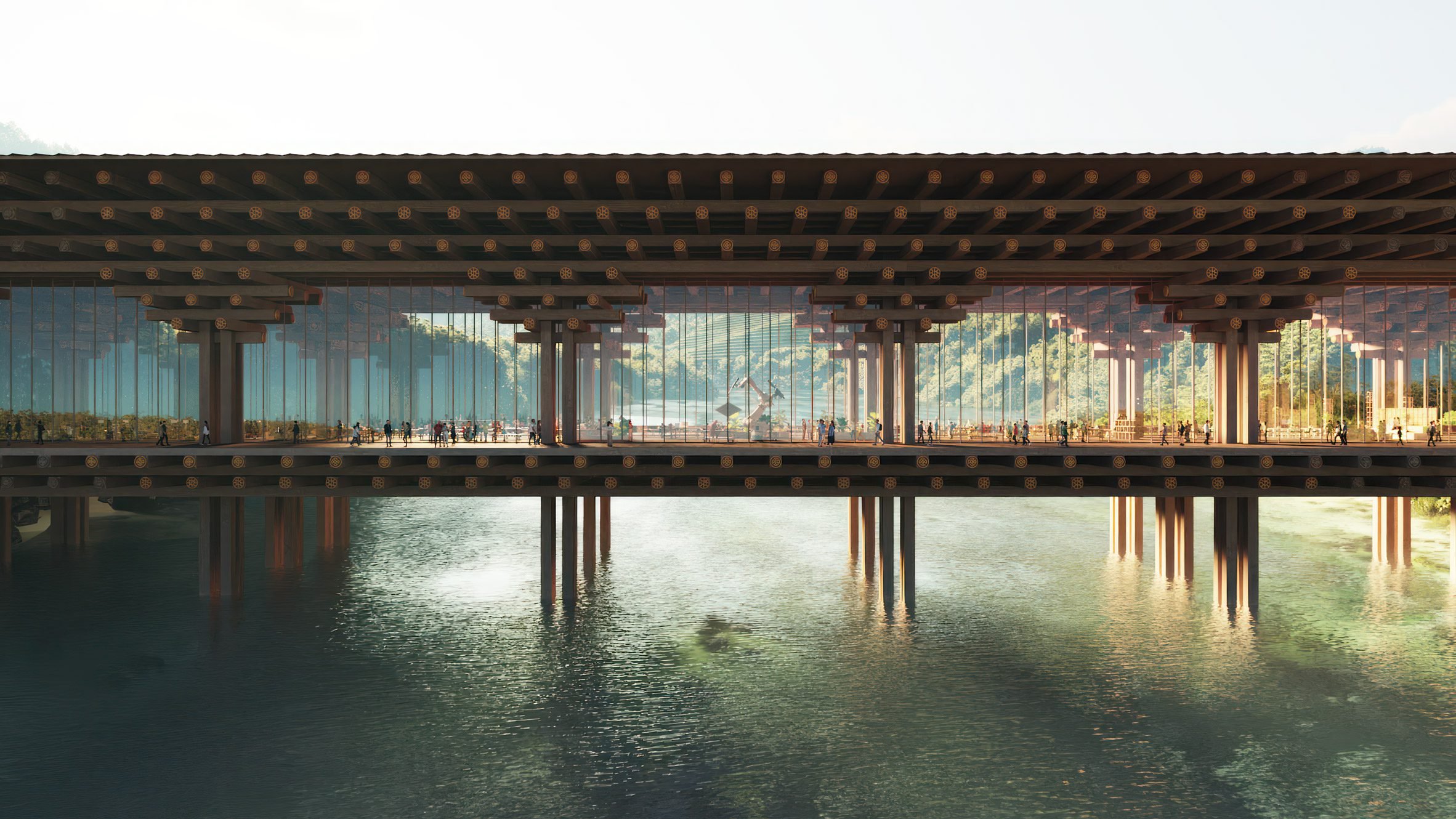
The physical design reflects that. Eleven mandala-inspired neighbourhoods are distributed across the site, each organised symmetrically around a central public space and connected by a series of inhabitable bridges spanning the city's 35 rivers and streams. Each bridge is a functioning civic institution. One houses the international airport terminal. Another contains a Vajrayana spiritual centre offering public access to Buddhist monastic practice. A third holds a healthcare facility designed to integrate Eastern and Western medicine. A fourth is a university. A fifth is a hydroponic and aquaponic greenhouse. The final bridge is a hydroelectric dam with a temple at its centre, its stepped face inspired by India's ancient stepwells.
The airport terminal, currently under construction, uses colourful glulam timber beams referencing kachen, the decorated structural columns of traditional Bhutanese architecture. Its interior brings the surrounding jungle canopy indoors through courtyards and trees. BIG partner Frederik Lyng has described the building as half finished by his office and half completed by Bhutanese carvers and painters from the country's art schools, who take co-authorship of the final structure.
Construction began in earnest in early 2025. The King personally led volunteer clearing of the site vegetation, alongside members of parliament and community groups totalling over 7,050 people across two phases of the national zhabtog tradition of communal labour. The cleared wood was catalogued and redirected into furniture and non-structural building elements. To fund the airport and infrastructure, including high-speed rail links to India and a smart grid system, Bhutan launched its first-ever domestic bond offering in 2025, which drew strong local investor support.
Gelephu is expected to take a decade to complete. Bhutanese officials have said the timeline is less important than the city remaining legible as Bhutanese rather than a generic global development transplanted onto their land. Whether it becomes the next Dubai or something the world has simply never seen before is, for now, an open question.
Comments (0)
Leave a Comment
No comments yet. Be the first to share your thoughts!