
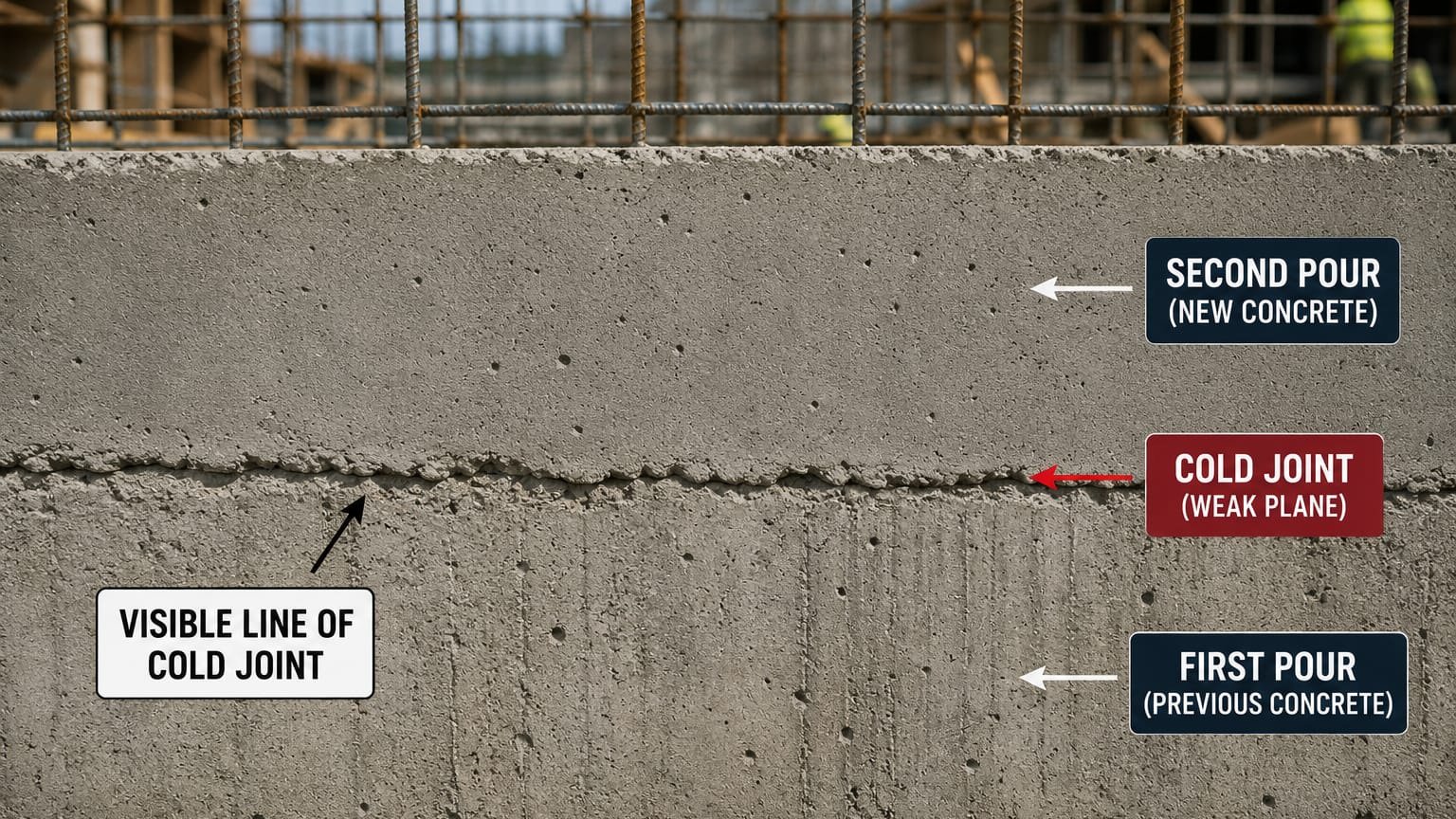

An explainer on why concrete placement timing is just as critical as the design mix itself.
A cold joint occurs when a layer of concrete begins to set before the subsequent lift is placed over it. This delay prevents the two pours from fusing into a single, homogenous mass.
Instead of a solid, continuous structural element, the result is a distinct, weak plane inside the concrete where bonding is severely compromised.
Site supervisors often encounter this issue due to sudden disruptions in the supply chain.
A ready-mix truck might get stuck in transit, or a concrete pump might suffer a mechanical failure mid-pour.
Slow placement rates or extreme weather conditions can also cause the first layer to harden prematurely, particularly in high-temperature environments.
Engineering students and novice site supervisors frequently confuse cold joints with construction joints.
The distinction is critical for site compliance.
A construction joint is a planned, engineered transition. It is properly detailed in the blueprints to occur where structural stresses are lowest, allowing work to pause safely.
Conversely, a cold joint is an entirely unplanned error caused by poor workmanship or logistics failures.
The occurrence of these defects is dangerous in critical infrastructure elements where structural continuity is vital.
Water tanks, suspended slabs, retaining walls, and heavy-duty structural beams are particularly vulnerable to these weak planes.
In water-retaining structures, these poorly bonded lines create immediate pathways for fluid seepage, leading to chronic leaks and internal reinforcement corrosion.
Achieving a durable structure requires more than just specifying the correct compressive strength or water-cement ratio.
Success depends heavily on rigorous on-site coordination, reliable equipment backups, and strict timing control.
Even the most precisely designed engineering project can be permanently weakened if site execution fails during the critical pouring window.
Comments (0)
Leave a Comment
No comments yet. Be the first to share your thoughts!