
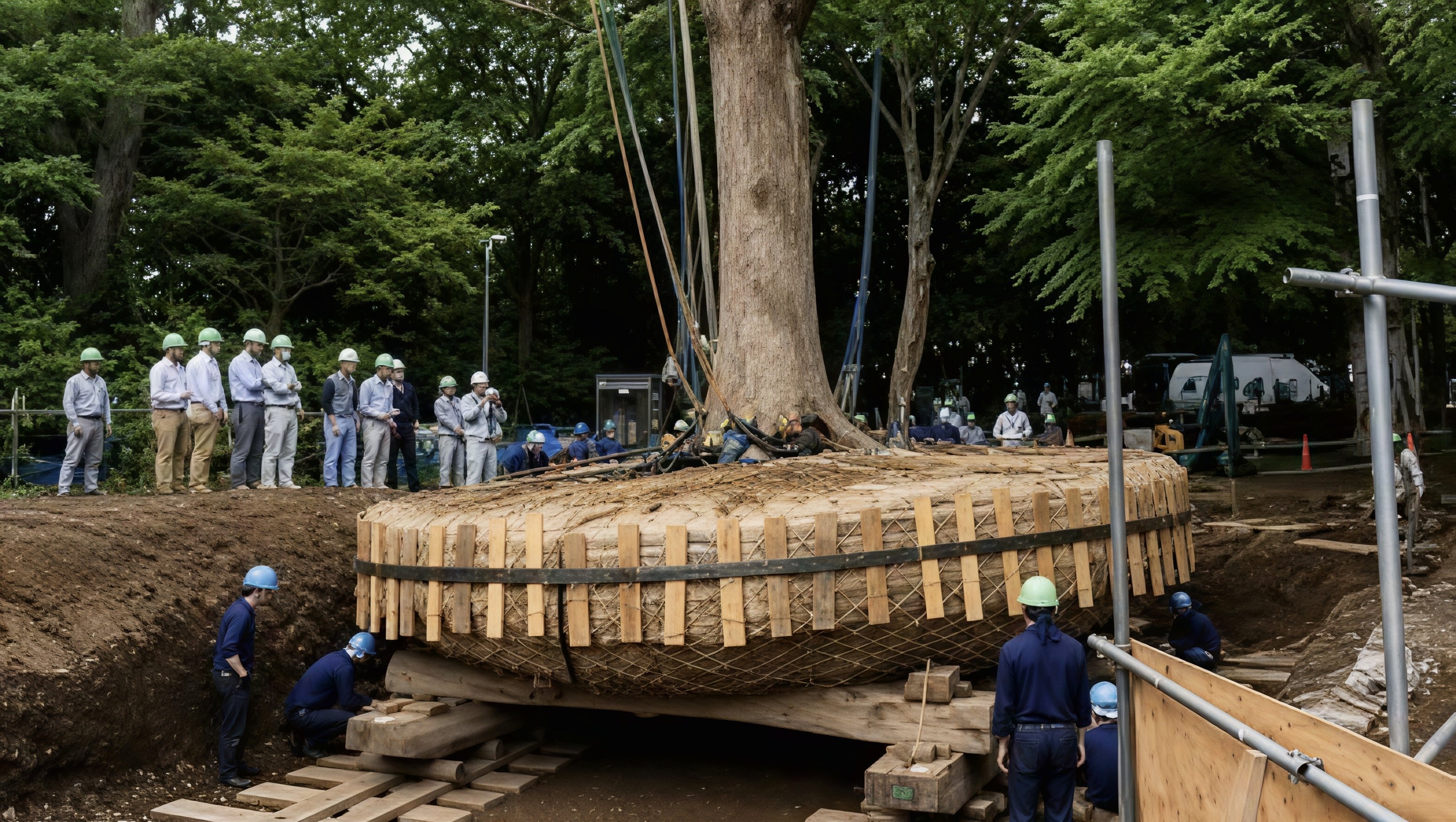

When a mature tree stands in the path of a road or a building project in Japan, developers do not automatically reach for a chainsaw. Instead, specialists often spend months preparing the tree for relocation, a practice known as nemawashi, which translates roughly to laying the groundwork or working at the roots.
The process begins with workers carefully digging around the tree to expose its root system without damaging it. The roots are then wrapped and bound, sometimes with straw, and given time, occasionally spanning months, to adjust to being contained before the tree is physically moved.
Once the roots are ready, crews use cranes, wooden rollers, beams and inflatable platforms to lift and transport the tree to a new site. It is lowered into a freshly dug trench cleared of stones and debris that could otherwise damage the root ball. The full relocation can take close to a year from start to finish.
The technique used to keep the root system intact during lifting is often referred to as root balling, and it has been paired in recent years with newer tools. Arborists now use GPS tracking, 3D modeling and monitoring systems that assess root density and soil composition to plan a move with more precision.
Cultural attitudes help explain why Japan invests so heavily in this approach. In Shinto belief, trees that reach around a hundred years of age are thought to house spirits known as kodama, and older trees have historically been marked with a sacred rope called a shimenawa. Cutting one down is treated as more than a landscaping decision.
Large redevelopment projects have put the practice to a public test. Tokyo's Jingu Gaien district urban redevelopment plan initially proposed removing 743 trees, a figure that drew criticism from architects, environmentalists and economists concerned about the loss of established greenery. The plan was later revised to reduce removals to 619 trees while increasing the total tree count after redevelopment to 2,304.
The revised plan also moved the site of a new baseball stadium further from existing rows of ginkgo trees, increasing the distance by 10.3 meters to 18.3 meters, to give the trees more room to remain healthy. The changes followed sustained scrutiny of the project's impact on the district's older tree cover.
Japan's forestry regulations reflect a similar caution toward large-scale tree removal more broadly. National policy has restricted clear-cutting in favor of selective thinning, an approach credited with helping forests regenerate since the practice was formalized decades ago.
Nemawashi is not confined to arboriculture either. The same term is used in Japanese business culture to describe building consensus among stakeholders before a company announcement or policy change, a linguistic echo of the patience the tree relocation process itself demands. In both settings, the underlying idea is the same: significant change is prepared for gradually rather than forced through quickly.
Comments (0)
Leave a Comment
No comments yet. Be the first to share your thoughts!