

This article was adopted from the The B1M/YouTube.
Egypt is executing an infrastructure project of pharaonic ambition, attempting to construct a entirely new agricultural delta within its Western Desert. The initiative, officially announced by President Abdel Fattah el-Sisi in 2018 as the New Delta Project, aims to reclaim 9,200 square kilometers of barren landscape, an area roughly equivalent to the size of Hawaii. If successful, the scheme will expand the cultivated land area of the country by more than one-third.
The survival of the nation has historically depended on a narrow fertile strip along the River Nile, where 95 percent of the population resides. Decades of intensive interventions, paired with a population that expanded from 60 million in 1990 to 120 million today, have pushed the traditional Nile Delta to the brink of collapse. Rapid urbanization continuously consumes fertile soil, forcing the state to become the world’s largest importer of wheat, buying 12 to 13 million tons annually. The vulnerability of this supply chain became evident in February 2022, when geopolitical disruptions cut off the European black sea imports that previously supplied 82 percent of the grain for the country.
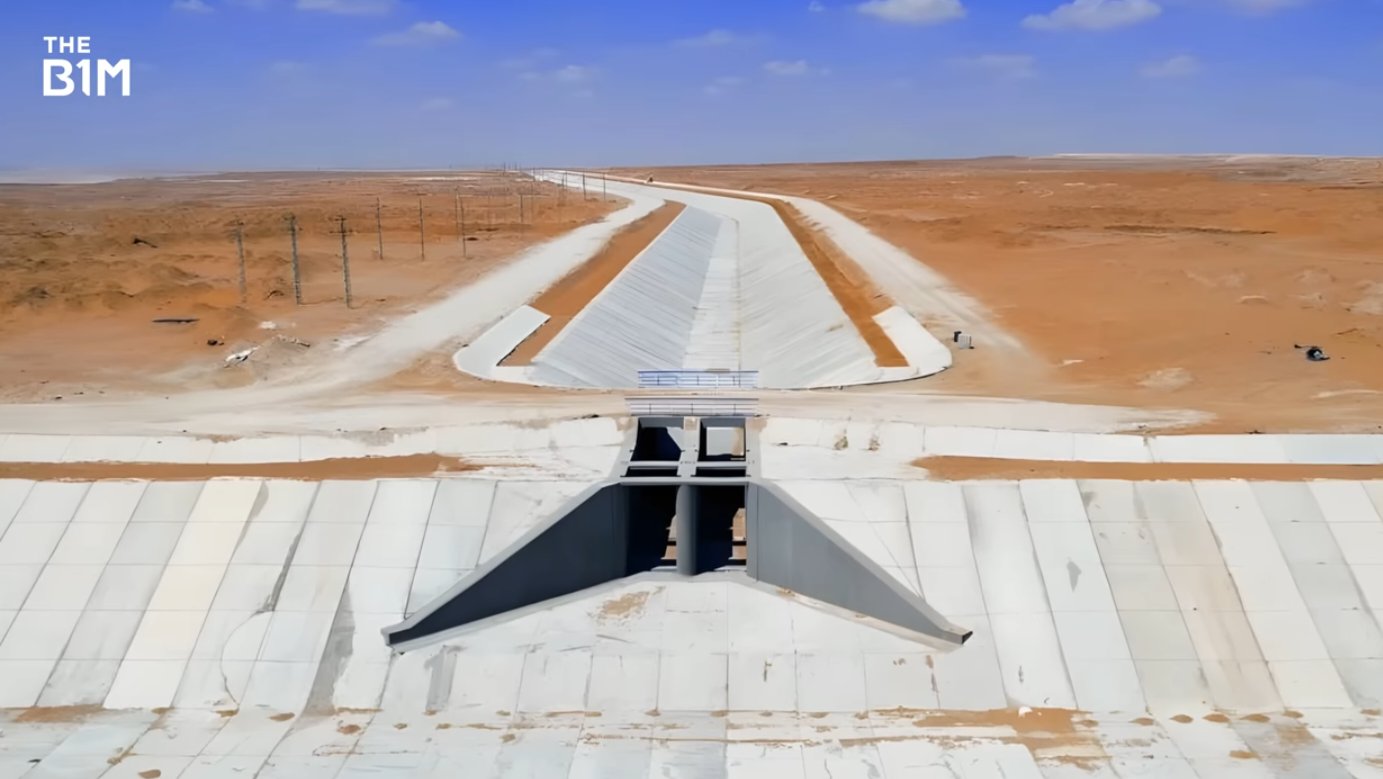
Illustration of the massive Egyptian desert canal. Photo: The B1M/YouTube
Engineering the new agricultural corridor requires overcoming extreme geographical and climatic realities. Water must travel from sea level up to a desert plateau situated 100 meters higher. To achieve this, engineers designed a network of 13 separate pumping stations to push the liquid uphill.
The infrastructure relies on two distinct arterial pathways. The primary line is the Al-Hamam system, which extends 170 kilometers to divert agricultural wastewater that would otherwise drain into the Mediterranean Sea. To minimize evaporation under the intense desert sun, the design incorporates a hybrid configuration. While most of the route consists of an open, concrete-lined canal, the sections most vulnerable to seepage and evaporation route through 10 underground pipes, each measuring three meters in diameter, for a distance of 22 kilometers. The second, smaller channel spans 42 kilometers, drawing raw water directly from the Nile to irrigate approximately 600,000 acres.
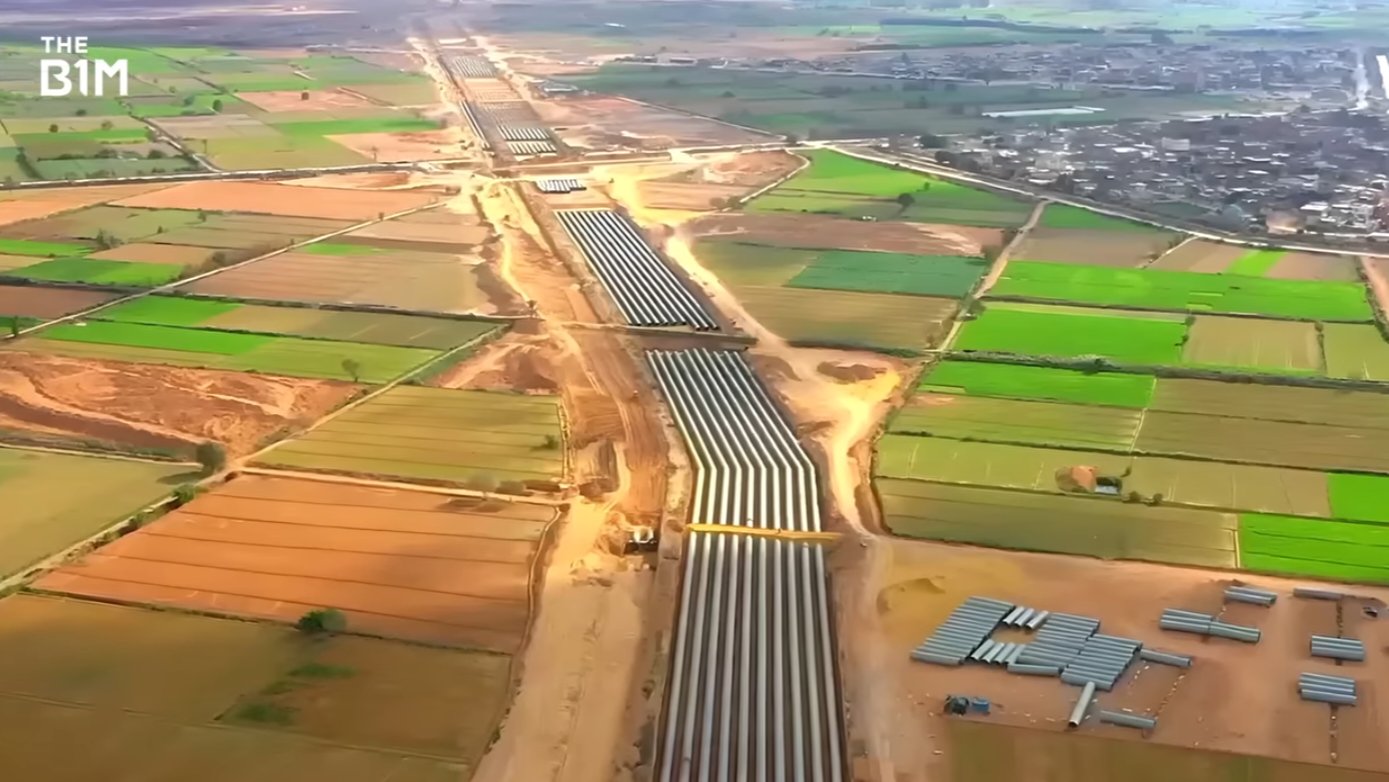
Illustration of the irrigation fields to be fed by the Egyptian desert canal. Photo: The B1M/YouTube
Before this blended water can touch crops, it undergoes processing at the New Delta Irrigation Water Treatment Plant. Occupying over 320,000 square meters, the complex possesses a production capacity of 7.5 million cubic meters of treated water every single day, establishing it as the largest water treatment facility globally.
Despite these engineering feats, severe systemic resource pressures persist upstream. The Grand Ethiopian Renaissance Dam (GERD), which commenced operations in 2025 as the largest dam in Africa, generates 5.15 gigawatts of electricity using the Nile headwaters. This upstream control means Egypt expects to lose three billion cubic meters of water annually by 2055, representing five percent of its contemporary supply. Over the next century, projections indicate up to 85 percent of its river flow could be restricted, creating what state leadership terms an existential threat.
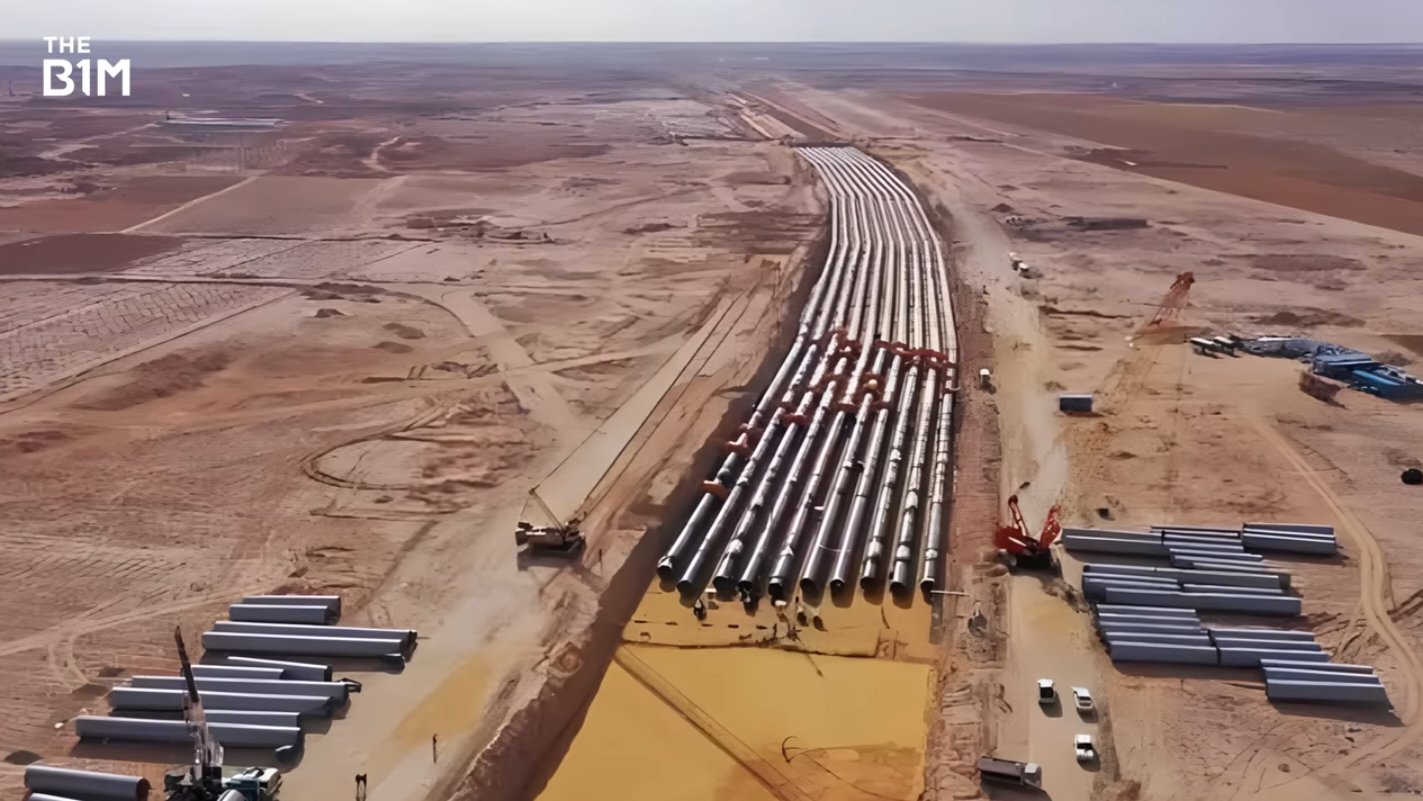
Illustration of the irrigation channel infrastructure for the massive Egyptian desert canal. Photo: The B1M/YouTube
Satellite imagery confirms that over 3,300 square acres of desert have already been successfully reclaimed using large radial irrigation systems. However, current agricultural operations rely heavily on ancient, non-renewable groundwater aquifers rather than the incomplete canal network. Research indicates that the rate of groundwater depletion beneath the Western Desert has doubled over the past 12 years. Furthermore, cultivation currently prioritizes high-value cash crops for export, such as tomatoes, fruits, and nuts, to generate foreign currency rather than growing the wheat required to directly reduce national import bills.
Comments (0)
Leave a Comment
No comments yet. Be the first to share your thoughts!