
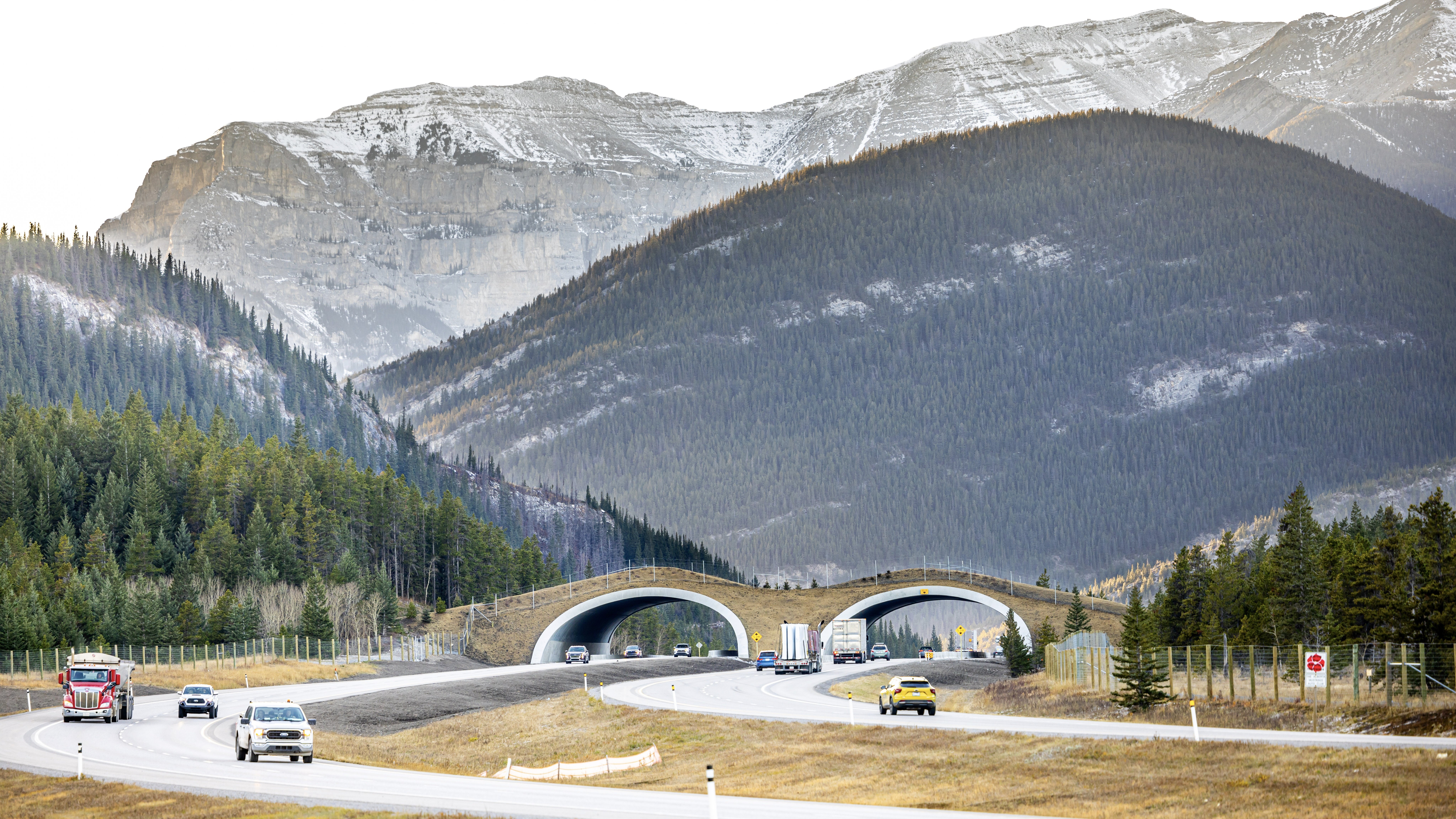

Roads built to move people and goods increasingly double as death traps for wildlife, cutting through habitats and splitting animal populations apart. Around the world, ecologists and engineers are now building crossings designed to let animals pass safely over or under busy highways.
Colorado recently completed one of the largest wildlife overpasses in the world, a 61 meter, or 200 foot, wide structure near the town of Greenland. Paired with roadside fencing, it is expected to cut roadkill by 90 percent along a heavily trafficked stretch of Interstate 25.
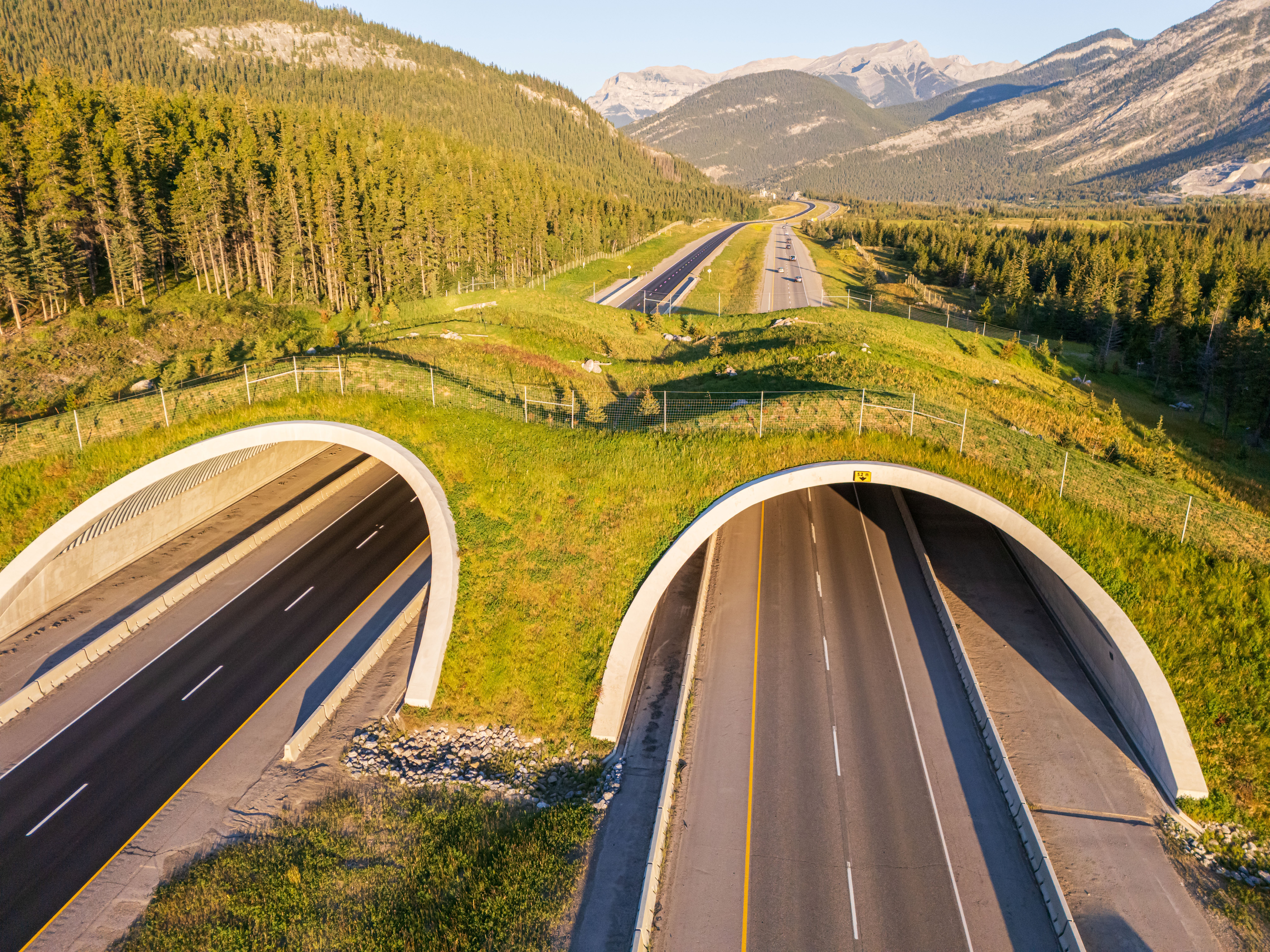
Peter Lougheed Wildlife Overpass | DIALOG
California is preparing a similar project. The Wallis Annenberg Wildlife Crossing, expected to open soon, will let mountain lions cross safely over the ten lane U.S. 101 freeway, one of the busiest roads in the state.
Researchers say the evidence for these structures is now well established. Mike Sawaya, who has studied grizzly bears and wildlife crossings in Canada's Banff National Park, told Mongabay there is little doubt left that such projects can help sustain animal populations.
The push for crossings is driven as much by economics and safety as by conservation. Collisions with white tailed deer kill roughly 440 motorists a year across the United States, and large animal collisions cost the American economy more than 10 billion dollars annually.
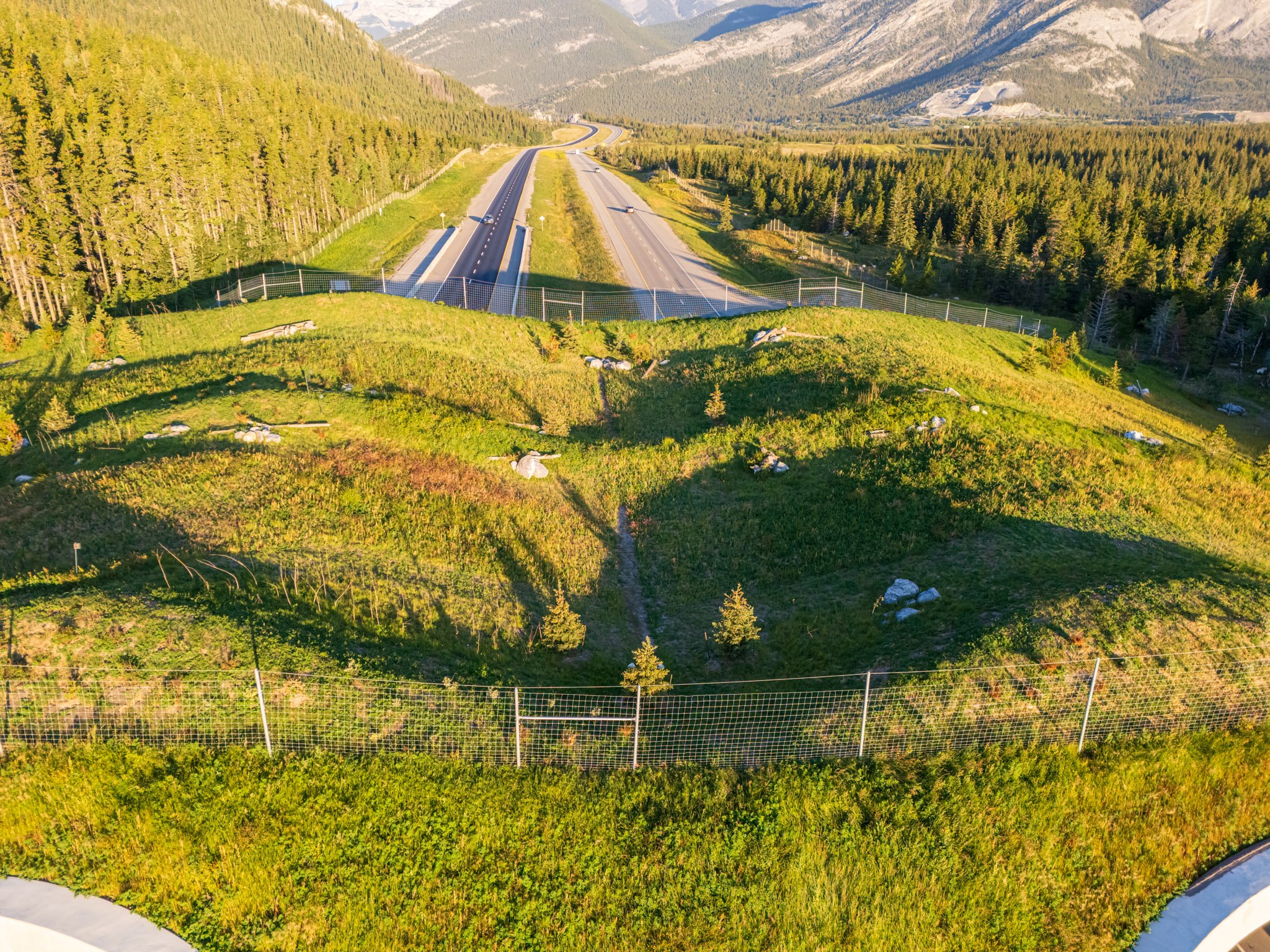
Ariel view of Peter Lougheed Wildlife Overpass | DIALOG
Other countries have taken their own approaches. A mountain highway in Croatia ranks among the most permeable roads on Earth for wildlife, while India is testing so called red roads designed to slow vehicles in animal crossing zones without forcing abrupt braking or driver discomfort.
In Sri Lanka, inexpensive rope bridges built from steel cables and nylon netting let purple faced langurs move between fragmented forest patches without touching the ground. Similar canopy crossings have reconnected treetop habitat for samango monkeys in South Africa and sloths in Costa Rica.
These rope and ladder style crossings are notably cheaper than concrete overpasses. Some designs cost only a few hundred dollars to build and install, making them viable options even where funding for larger infrastructure is limited.
Not everyone views crossings as a complete solution. Ecologist William Laurance has warned that they cannot offset the broader wave of new road construction, which can increase poaching, logging, farming, mining, and the spread of invasive species into previously isolated habitat.
Renee Callahan, executive director of ARC Solutions, a group that studies and promotes wildlife crossings, told Mongabay that the underlying problem could be solved within a generation given enough investment. The United States is now debating how much of that investment to commit.
The federal Wildlife Crossings Pilot Program, established in 2021 with 350 million dollars in funding, has already turned away worthy projects for lack of money. A bipartisan bill in the U.S. House proposes 80 million dollars annually for five years, while a Senate version seeks 1 billion dollars over the same period.
Comments (0)
Leave a Comment
No comments yet. Be the first to share your thoughts!