
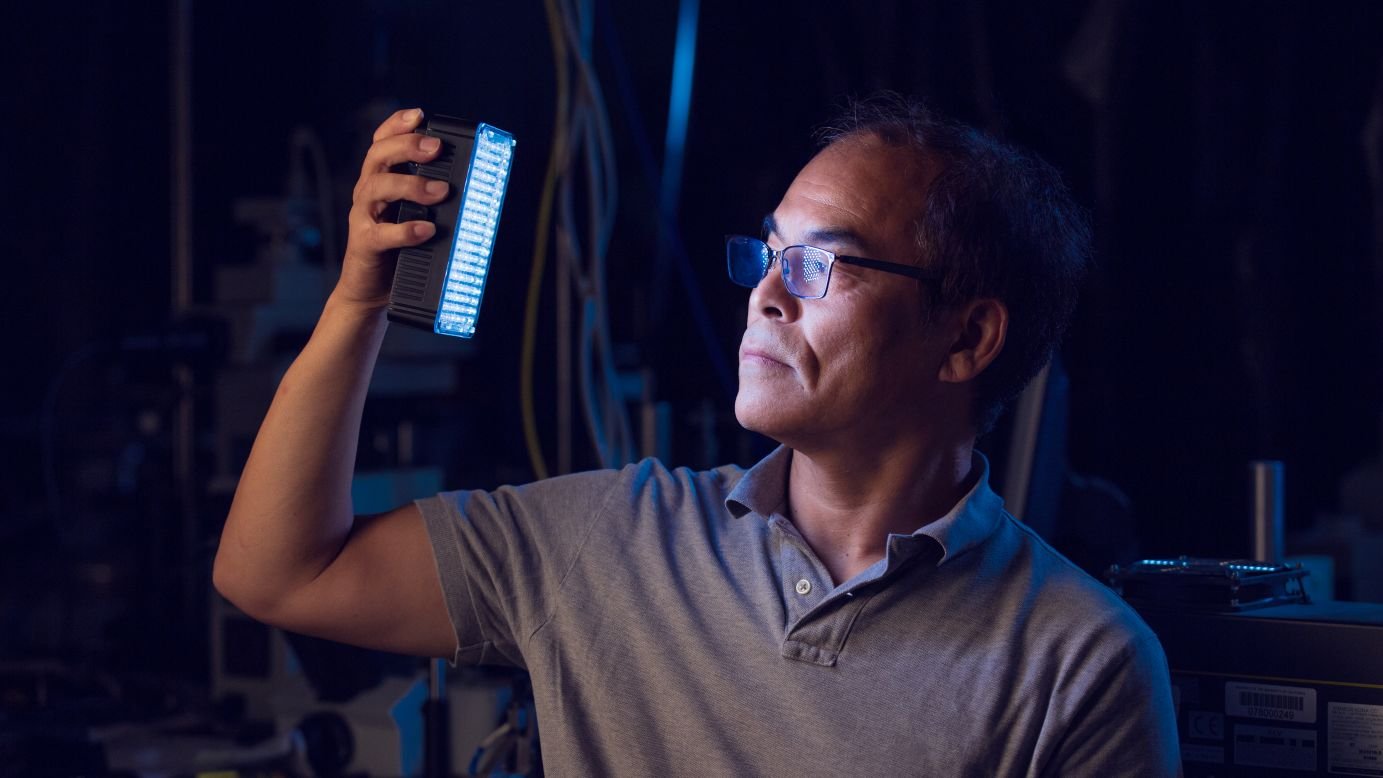

Shuji Nakamura, the physicist credited with inventing the blue light-emitting diode (LED), is now working on a laser-based nuclear fusion project he believes could exceed the significance of his earlier breakthrough. The 72 year old professor is pursuing the goal through a company he co-founded in 2022, Blue Laser Fusion.
Nakamura won the Nobel Prize in Physics in 2014, sharing the honor with fellow Japanese scientists Isamu Akasaki and Hiroshi Amano for their work on blue LEDs. The invention now underpins everyday technology, from smartphone and computer screens to traffic lights and electronic billboards.
His path to that discovery began in 1979 at Nichia Corporation, a then obscure Japanese chemical company, where he led a research and development team of just two people. Nearly a decade in, he had produced only three commercial products, none of which sold well, drawing criticism from colleagues who urged him to quit.
Nakamura pressed ahead by focusing on gallium nitride as the material most likely to produce a working blue LED, departing from the zinc selenide approach favored by most researchers at the time. That decision led to a working blue LED by the early 1990s, a result later described by Forbes as placing him in the lineage of Thomas Edison.
A dispute with Nichia over compensation for the invention followed and was resolved in 2005, when the company agreed to pay Nakamura 8.1 million dollars, a sum well below what a Japanese court had previously determined he was owed. Nichia did not respond to CNN's request for comment on the matter.
Nakamura is now applying laser technology developed from his LED research to a different problem: generating electricity through nuclear fusion, the same reaction that powers the sun. He has said the approach mirrors the long, uncertain process that eventually produced the blue LED.
Roughly 99.5 percent of global fusion research relies on magnetic confinement, according to Nakamura, while his team has instead pursued a laser-driven method. The concept, developed with the University of California, Santa Barbara, centers on an optical amplification chamber that stores high-pulse laser energy and can amplify it up to 100,000 times, with the laser acting to trigger the reaction and the chamber containing and regulating it.
Because the process does not rely on uranium, it carries no risk of a meltdown and would generate substantially less long-lived radioactive waste than conventional nuclear plants, if it works as intended. Blue Laser Fusion is targeting a 1 gigawatt pilot plant near Santa Barbara by 2032, a facility the company says could supply electricity to between 750,000 and 1 million homes.
Asked whether the project might prove to be his greatest contribution yet, Nakamura answered simply, "Yeah." He has also encouraged younger scientists to embrace uncertainty in their own research rather than default to safer, well-trodden approaches. "Taking a risk is most important," he told CNN.
Comments (0)
Leave a Comment
No comments yet. Be the first to share your thoughts!