

A version of this article appeared on LinkedIn by Mary Gichaga.
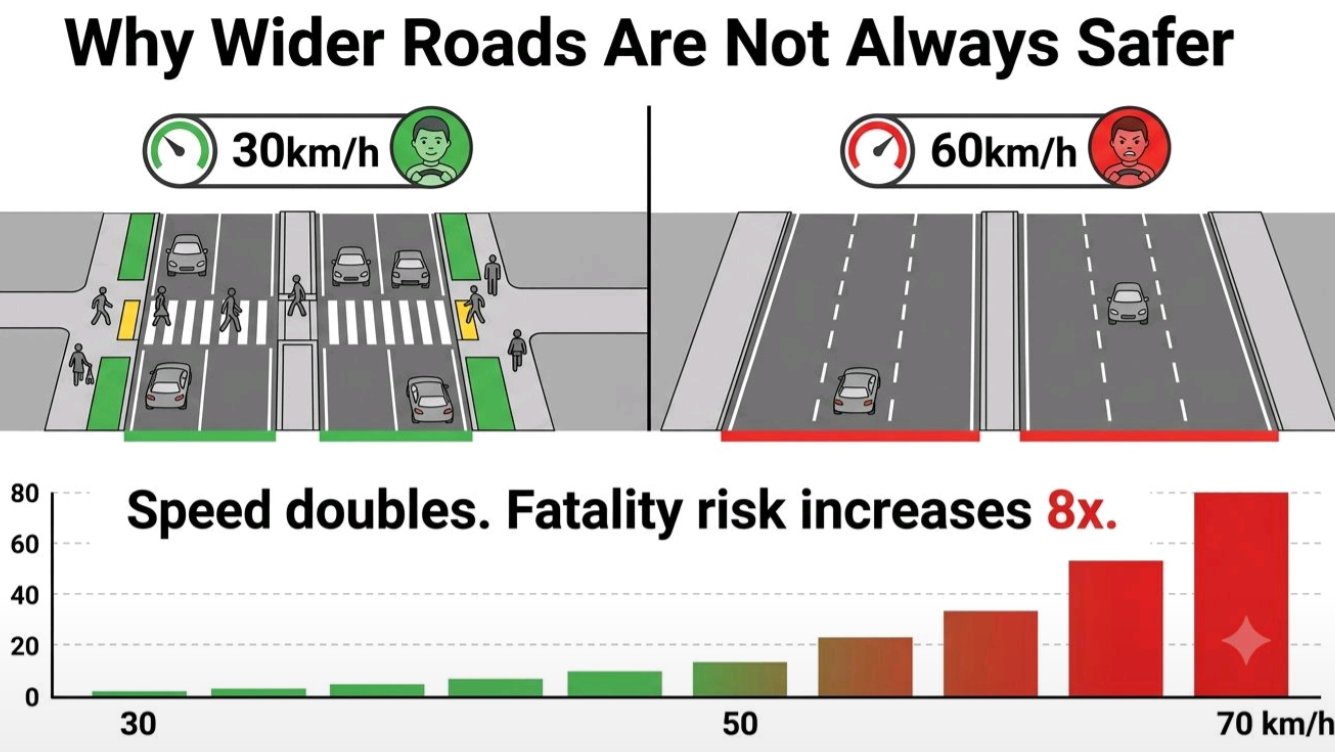
Transportation planners have long assumed that expanding lane widths makes driving safer. Recent civil engineering data from urban road studies shows that wider travel lanes actually encourage motorists to travel faster.
When road lanes expand beyond standard urban dimensions, drivers perceive lower immediate risk and naturally depress the accelerator. This psychological comfort leads to higher travelling speeds, which directly compromises safety for non-motorised road users nearby.
Speed dynamics play a critical role in crash severity, particularly along densely populated municipal corridors. Data compiled by the National Transport and Safety Authority (NTSA) reveals that speeding remains a primary driver of urban road casualties.
A doubling of vehicle speed from 30 km/h to 60 km/h does not merely double collision severity. Graphic analyses of pedestrian impact risk indicate that an eightfold increase in fatality risk accompanies that specific speed jump.
At lower operating speeds around 30 km/h, pedestrians struck by automobiles maintain a remarkably high survival rate. As velocities approach 70 km/h, the likelihood of a fatal outcome escalates sharply, leaving vulnerable road users with almost no margin for survival.
Urban infrastructure guidelines published by the Kenya Urban Roads Authority (KURA) emphasize physical design as a primary speed control tool. Narrower lanes force motorists to maintain heightened vigilance, naturally calming traffic without relying solely on enforcement.
Engineers designing multi-modal corridors in growing cities like Nairobi are reassessing traditional highway standards. Allocating excess asphalt to expanded sidewalks, protected cycle tracks, and dedicated busways creates balanced street environments, while reducing total vehicle speeds.
In addition to reducing pedestrian risk, right-of-way reallocation optimizes overall corridor capacity. Narrowing vehicle lanes from 3.5 meters to 3.0 meters frees substantial surface area, which city planners can repurpose for non-motorised transport infrastructure and urban greening.
Civil engineering institutions are updating street design manuals to reflect these traffic behavior realities. Placing design speed at the center of road geometry choices ensures that urban thoroughfares prioritize human life alongside vehicular throughput across modern transport networks.
Traffic safety advocates continuously urge road agencies to ditch legacy highway blueprints on city thoroughfares. Adopting self-enforcing street layouts with reduced lane dimensions protects vulnerable pedestrians, while providing municipal authorities with a cost-effective strategy to lower preventable road fatalities across rapidly expanding urban centers.
Managing vehicle speeds through spatial geometry remains essential for sustainable urban growth. By designing streets that naturally constrain excessive driving speeds, transport engineers can build safer networks, where pedestrians, cyclists, and motorists safely coexist without risking catastrophic traffic collisions every day.
Ultimately, safer urban transportation relies on designing environments that reflect human limits rather than driver convenience. Narrower lanes, coupled with dedicated pedestrian facilities, offer a proven pathway toward zero traffic fatalities across expanding African cities and major global metro areas.
Comments (0)
Leave a Comment
No comments yet. Be the first to share your thoughts!