
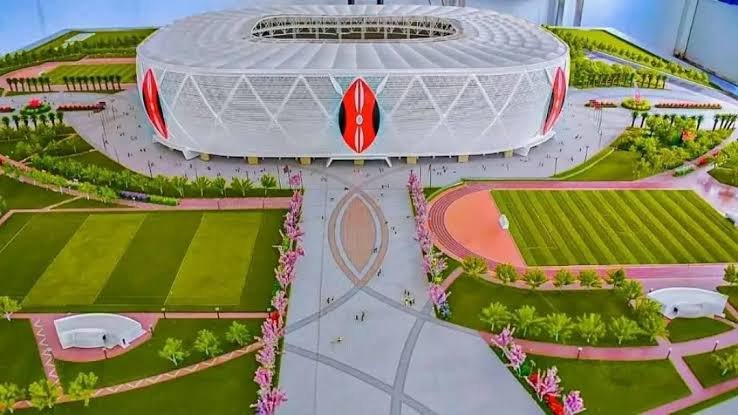

The Kenyan government has formally announced its intention to align with the "Morocco standards" in its preparation for the 2027 Africa Cup of Nations (AFCON). Following the official handover of the tournament flag from Morocco to the East African co-hosts, Kenya is intensifying its efforts to replicate the Northern African nation’s success in sports infrastructure and logistical planning. The strategic shift comes as the Ministry of Sports aims to transition from event-driven preparations to a vision-driven infrastructure model that supports long-term development.
Central to this plan is the Talanta Sports City Stadium, a 60,000-seater facility currently under construction along Ngong Road in Nairobi. Government reports indicate that the project has reached 85 percent completion, with the contractor, China Road and Bridge Corporation, working under the supervision of the Ministry of Defence. The facility is being built to meet stringent FIFA and CAF requirements, featuring advanced pitch drainage and fan safety protocols. The state has invited CAF inspectors to conduct an early validation of the works next month to ensure all technical specifications are met well before the 2027 deadline.
Beyond new construction, the government is executing a multi-billion shilling renovation programme for existing venues. The Moi International Sports Centre in Kasarani and Nyayo National Stadium are undergoing extensive upgrades. At Kasarani, works on the canopy roof and internal facilities are progressing, while Nyayo Stadium has seen the installation of new floodlights and the refurbishment of media centres and VIP sections. These venues, along with the Ulinzi Sports Complex and Kasarani Annex, are designated to serve as primary match and training sites.
To mirror the integrated transport network seen in Morocco, Kenya is prioritizing rail connectivity. A new railway station is planned adjacent to Nyayo National Stadium, complemented by a dedicated rail spur line extending from Nairobi Central Station through Kibera to the Talanta Sports City Stadium. This infrastructure is designed to mitigate Nairobi's notorious traffic congestion, providing high-capacity transit for local and international supporters.
Government officials have emphasized that the current budget for these developments exceeds Sh50 billion, funded primarily through the Sports, Arts and Social Development Fund. This investment is viewed not merely as a cost for a single tournament but as a legacy project intended to position Nairobi as a regional hub for sports tourism. By adopting the Moroccan blueprint, which includes high-speed connectivity and world-class hospitality, Kenya seeks to move beyond reactive planning.
The Confederation of African Football has maintained a close watch on the progress of the "Pamoja Bid," which Kenya shares with Uganda and Tanzania. While challenges remain regarding intra-regional highways and inter-city travel between the three host nations, the Kenyan government insists that its local organizing committee is now focused on achieving 90 percent completion of all required works by December 2026. This timeline is intended to allow for ample testing of the facilities during smaller continental fixtures before the main event begins in 2027.
Comments (0)
Leave a Comment
No comments yet. Be the first to share your thoughts!