

A version of this article appeared on The B1M.
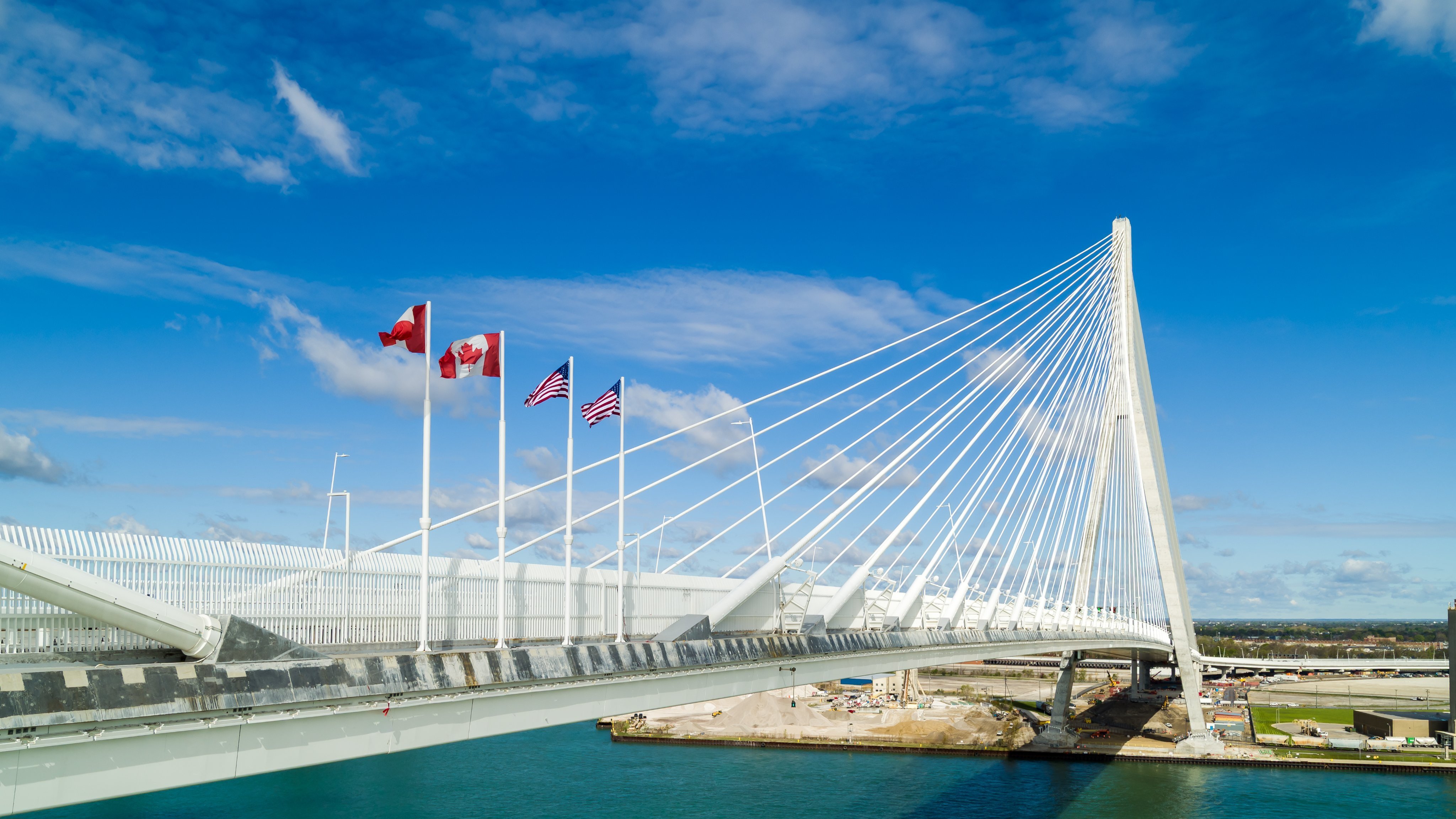
Construction has reached completion on the $4.8 billion Gordie Howe International Bridge (GHIB), creating a major connection between Detroit, Michigan, and Windsor, Ontario. The six-lane cable-stayed structure establishes a new crossing across one of the busiest trade corridors in North America.
Engineered to expand overall freight capacity, the project aims to relieve heavy traffic pressure on the nearby Ambassador Bridge (AB). Thousands of commercial vehicles rely on this border corridor daily to transfer goods between manufacturing hubs in the US and Canada.
The completion arrives during a period of heightened geopolitical friction between Washington, DC, and Ottawa. Rising tariffs and sharp political disagreements have added unexpected strain to trade relations, even as physical infrastructure links between the two countries expand.
Historical precedents show that major civil engineering investments frequently outlast the political climates in which they open. New York City’s Empire State Building (ESB) opened during the Great Depression when commercial office demand plummeted. Mocked initially as the "Empty State Building" due to widespread vacancies, it eventually grew into a globally renowned asset.
The long-term economic rationale behind the new crossing remains rooted in decades of regional growth rather than short-term political disputes. Cross-border supply chains in the automotive, agricultural, and industrial sectors depend heavily on reliable transportation corridors that can handle high volumes of freight.
The sprawling border complex features high-capacity inspection plazas on both sides of the Detroit River. Advanced tolling systems, dedicated bicycle lanes, and multi-modal pedestrian walkways have also been integrated into the overall design.
Direct connections to Interstate 75 (I-75) in Michigan and the Rt. Hon. Herb Gray Parkway (HGP) in Ontario ensure seamless movement for long-haul freight trucks. These strategic highway links prevent commercial traffic from bottlenecking on local municipal streets in Detroit and Windsor.
International bridge infrastructure requires massive initial capital expenditure, but projects of this scale are intended to serve regional trade needs for nearly a century. While current diplomatic friction dominates headline news, civil engineers designed the new crossing to accommodate trade demands well into the future.
Comments (0)
Leave a Comment
No comments yet. Be the first to share your thoughts!