
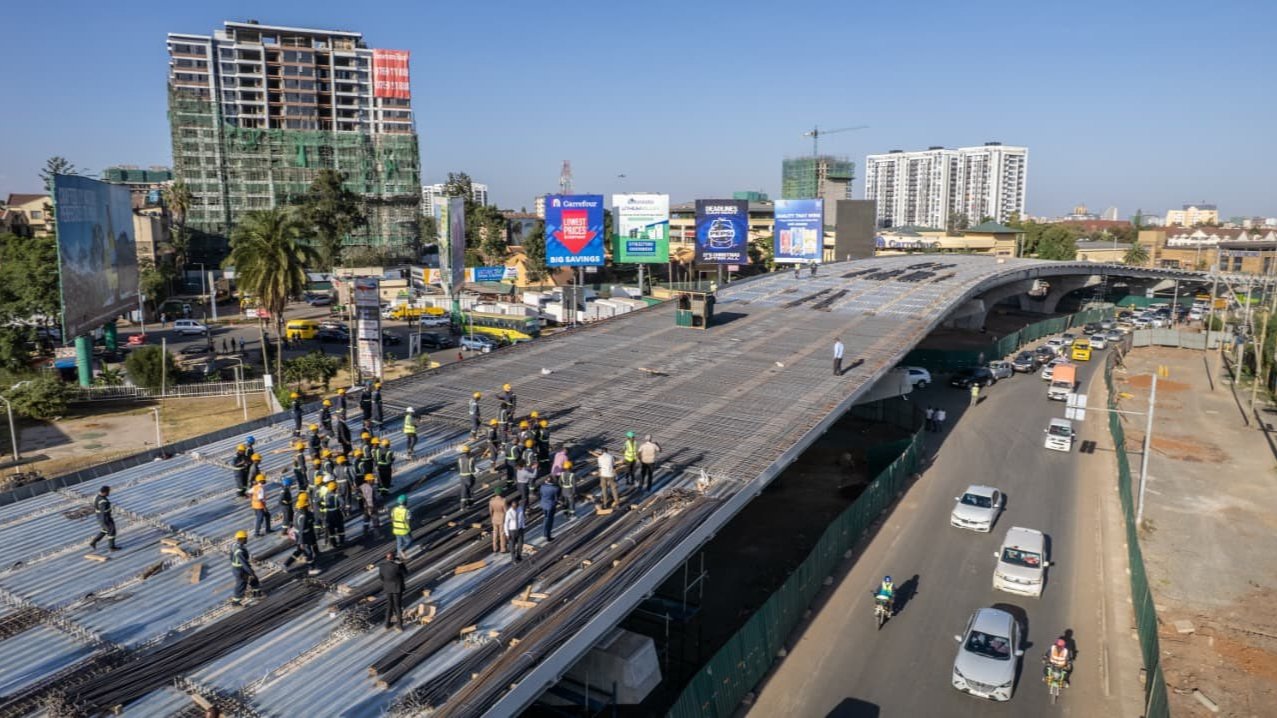

President William Ruto made an unannounced stop at the construction site of the Ngong Road-Naivasha Road junction flyover in Nairobi on Wednesday, getting a firsthand look at the progress on one of the capital's ongoing road upgrades. Contractors on the ground briefed him on the work, noting that the project has hit 85% completion and could wrap up later this year, potentially a full 12 months ahead of the initial timeline.
The visit came as part of broader efforts to monitor infrastructure developments in the city, with Ruto accompanied by officials from the Kenya Urban Roads Authority (KURA) and other team members. Photos from the site show the president, donned in a hard hat and reflective vest, pointing out sections of the elevated structure while discussing details with engineers. The contractor confirmed during the briefing that milestones are being met, keeping the handover on track for July 2026 at the latest, though the accelerated pace suggests it might come sooner.
This flyover, spanning 255 meters as a viaduct with approaches extending to 820 meters overall, targets a notorious bottleneck at the intersection near The Junction Mall. For years, drivers heading toward Ngong Road or Naivasha Road have faced heavy delays, especially during peak hours, as traffic merges from multiple directions including King'ara Road. The four-lane upper deck aims to separate flows, allowing smoother passage for vehicles while incorporating non-motorized transport lanes for pedestrians and cyclists below.
KURA, which oversees urban trunk roads, has managed the project since its start, with funding allocated from the national budget at KSh 3.8 billion. Work began in earnest after initial site preparations, and despite occasional disruptions from weather or supply chains, the team has maintained steady advancement. Aerial views of the site reveal workers laying rebar and paving sections, with the structure rising prominently over the surrounding roads and commercial areas.
Ruto's inspection underscores the government's push on road improvements as Kenya prepares to co-host the Africa Cup of Nations (AFCON) in 2027 alongside Uganda and Tanzania. The flyover's location near the Talanta Hela Stadium, which is also under upgrade for the tournament, makes it a critical link for event logistics. Stadium access could see increased traffic during matches, and easing congestion here would help prevent gridlock that has plagued similar junctions in the past.
Beyond this project, Nairobi's road network has seen several interventions in recent years. The nearby Jamhuri roundabout has been a point of discussion among locals, with some calling for redesigns to handle growing volumes. KURA officials have noted that the flyover includes safety features like barriers and lighting to reduce accidents, a common issue on busy urban arteries.
Contractors highlighted during the visit that the project employs local labor, with dozens of workers visible on the deck handling materials and equipment. This aligns with national goals to create jobs through infrastructure spending, though exact employment figures for this site remain tied to the contractor's reports. The structure itself uses standard concrete and steel reinforcements, designed to withstand heavy loads from commuter buses and trucks that frequent the route.
As the flyover nears completion, attention turns to integration with existing roads. Service lanes below will need final paving, and drainage systems are being installed to prevent flooding, a recurring problem in Nairobi's rainy seasons. Once open, the elevated path should cut travel times significantly for those heading west from the city center, potentially shaving off 20 to 30 minutes during rush hour based on similar projects elsewhere.
Ruto's hands-on approach during the tour included questions on timelines and challenges, with the team assuring him of no major setbacks. This comes amid other national road works, such as the Rironi-Mau Summit highway expansion, a 175-kilometer stretch being dualled under a public-private partnership. That project, flagged off late last year, aims to improve connectivity to western Kenya and is the first of its kind in scale for the country.
In the context of Kenya's urban growth, projects like this flyover represent practical steps to manage expanding populations. Nairobi's metro area continues to draw residents, putting pressure on transport links. Historical data from the Kenya National Bureau of Statistics shows vehicle registrations rising steadily, contributing to the jams that cost the economy billions in lost productivity annually.
While the visit was brief, it provided a snapshot of the project's status, with KURA posting updates on social media shortly after. The authority emphasized that the contractor's briefing confirmed adherence to schedule, echoing sentiments from earlier progress reports. As works continue, residents in nearby areas like Kilimani and Dagoretti have expressed relief at the prospect of reduced disruptions once construction ends.
With AFCON preparations ramping up, the government has tied several infrastructure timelines to the event, including stadium upgrades and road links. The Talanta Hela Stadium, just adjacent, is slated for completion in 2026, positioning the flyover as a complementary piece in the puzzle. Officials have not disclosed specific traffic modeling for tournament days, but the design accounts for higher volumes.
Overall, the inspection highlights ongoing commitments to urban infrastructure, with the Ngong Road flyover serving as a tangible example. As Nairobi evolves, such developments aim to keep pace with demands, though long-term maintenance will be key to their success.
Comments (0)
Leave a Comment
No comments yet. Be the first to share your thoughts!