
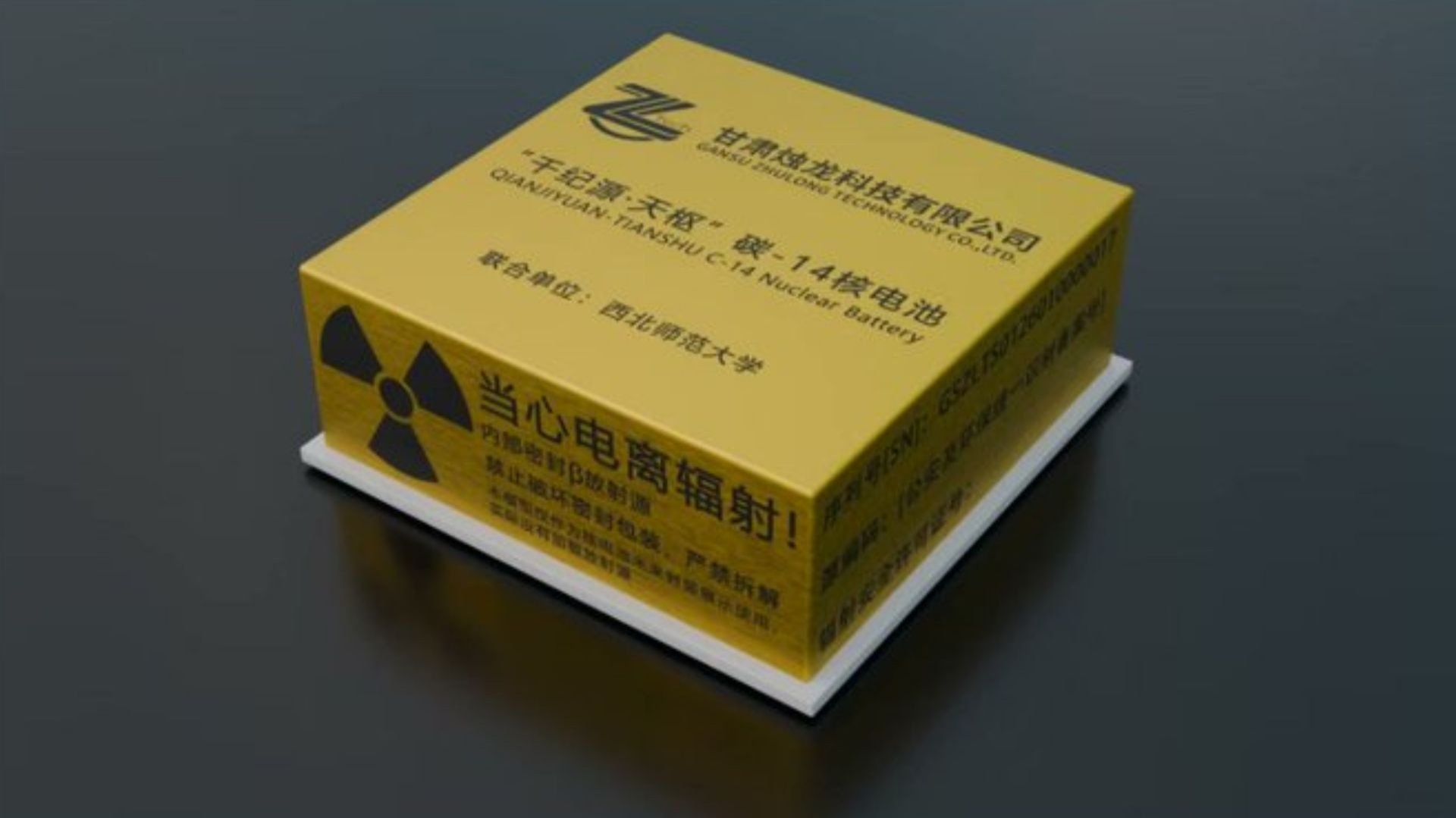

Researchers in China have unveiled a new carbon-14 nuclear battery delivering 2.6 times the power of its predecessor while shrinking to roughly a cubic inch in size.
The device was developed by Northwest Normal University in Gansu province alongside Chinese firm Gansu Zhulong Technology. Researchers said it was built entirely without foreign technology or components.
Named Qianjiyuan Tianshu, the battery is a major upgrade on the team's earlier prototype, known as Candle Dragon-I or Zhulong-1, unveiled in late 2024.
That earlier version already demonstrated the underlying concept of turning radioactive decay into a steady electrical current, proving the basic technology worked before this upgrade arrived.
The new design uses only 22 percent of the radioactive material required by its predecessor, yet still manages to boost short-circuit current by 2.5 times and maximum power output by 2.6 times.
Voltage and stability remained unchanged despite the smaller footprint, according to the research team behind the upgrade.
Volume shrank even more dramatically than power grew. The effective size of the device dropped to just 17 percent of the original, producing a 15.5-fold jump in volumetric power density.
Volumetric power density measures how much power a device generates relative to its physical size, a key benchmark for evaluating compact power sources like this one.
That combination of more power from less material in a smaller shell is the core engineering achievement behind the upgrade, researchers said, calling it central to nuclear battery development worldwide.
The technology relies on carbon-14, a weakly radioactive isotope of carbon with a half-life of 5,730 years, the time it takes half of a radioactive sample to decay.
As the isotope decays, it emits beta particles that interact with a silicon carbide (SiC) semiconductor layer, generating a steady flow of electrons without any moving parts or recharging.
Because carbon-14 decays so slowly, batteries built on this principle carry a theoretical lifespan stretching into the thousands of years, far beyond conventional lithium-ion chemistry.
The tradeoff is low output, measured in nanowatts rather than the watts used by everyday electronics, which limits the battery to applications where tiny, continuous power matters most.
Earlier versions of the technology were tested powering an LED continuously for nearly four months and integrated with low-power Bluetooth components, according to earlier disclosures from the same research team.
Researchers have pointed to uses in environments where replacing a battery is difficult, including implantable medical devices such as pacemakers and remote sensors in polar or deep-sea locations.
Equipment deployed on the Moon or Mars is another target application, since maintenance visits to such locations remain far beyond current technological or economic reach.
The battery's stated operating range spans minus 100 degrees Celsius to 200 degrees Celsius, or minus 148 to 392 degrees Fahrenheit, supporting use in extreme environments.
Such conditions would degrade conventional battery chemistries within a fraction of that time, researchers noted, underscoring the durability advantage nuclear batteries offer over standard alternatives.
China has also been building domestic capacity to produce carbon-14 at scale, reducing earlier reliance on imports from countries including Canada, Russia and South Africa.
That supply chain investment may matter as much as the engineering itself if nuclear batteries move from prototype demonstrations toward wider commercial deployment in future years.
Comments (0)
Leave a Comment
No comments yet. Be the first to share your thoughts!