
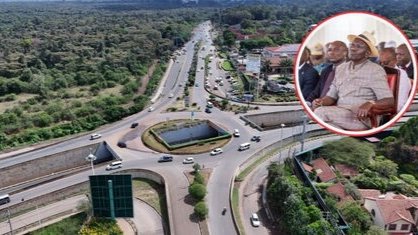

President William Ruto announced plans to upgrade the heavily used Kiserian-Ongata Rongai-Nairobi highway into a dual carriageway. He made the disclosure while addressing a fundraising event in Kiserian on Sunday.
The move comes as commuters continue to face daily gridlock along the route. Ruto pointed to long-standing bottlenecks, especially in sections from Bomas through Ongata Rongai.
He said the government has already started the process. The project will draw funding from the National Infrastructure Fund.
"I have directed the Ministry of Roads and Transport to put that road from Rongai, Kiserian, Nairobi into the National Infrastructure Fund so that we can dual it," Ruto stated.
Officials are conducting feasibility studies. These will help define the project's exact scope and how it will proceed.
The corridor stretches roughly 20 kilometres. It begins at the Lang'ata Road junction near Bomas of Kenya and runs through the busy Ongata Rongai area before reaching Kiserian in Kajiado County. The artery serves both residential commuters and commercial traffic heading in and out of the capital.
Earlier efforts to ease pressure on parts of the route produced mixed results. Work on Magadi Road at Bomas started in 2024 and wrapped up earlier this year. Yet traffic headaches persist further along the stretch toward Kiserian.
Ruto's announcement places the highway among other priority schemes financed through the National Infrastructure Fund. That vehicle has already supported projects such as the expansion at Jomo Kenyatta International Airport.
During the same event, the president flagged additional road works in Kajiado County. The government allocated 500 million shillings for the Mashuru-Ishiara road. Construction is expected to begin next week.
Funding is also in place for the Ngong-Kibiko-Kangira road. A contractor has been selected and work will move forward as scheduled.
The Kiserian-Ongata Rongai corridor handles significant daily volumes. Many residents rely on it for access to jobs and services in Nairobi. Peak-hour delays often stretch travel times considerably.
Transport planners have long identified the route as needing capacity improvements. Its role in linking growing satellite towns to the city centre makes the dualling plan particularly relevant.
Details on timelines, exact costs and land requirements remain under study. The feasibility work will inform the next stages of procurement and design.
The National Infrastructure Fund represents one tool in the government's approach to delivering large-scale projects. By ring-fencing resources, authorities aim to maintain momentum across multiple fronts.
Commuters along the corridor will watch developments closely. Any meaningful relief from congestion could improve daily commutes and support local economic activity in the towns it serves.
Ruto's remarks underscore continued focus on road infrastructure in the greater Nairobi region and surrounding counties.
Comments (0)
Leave a Comment
No comments yet. Be the first to share your thoughts!