
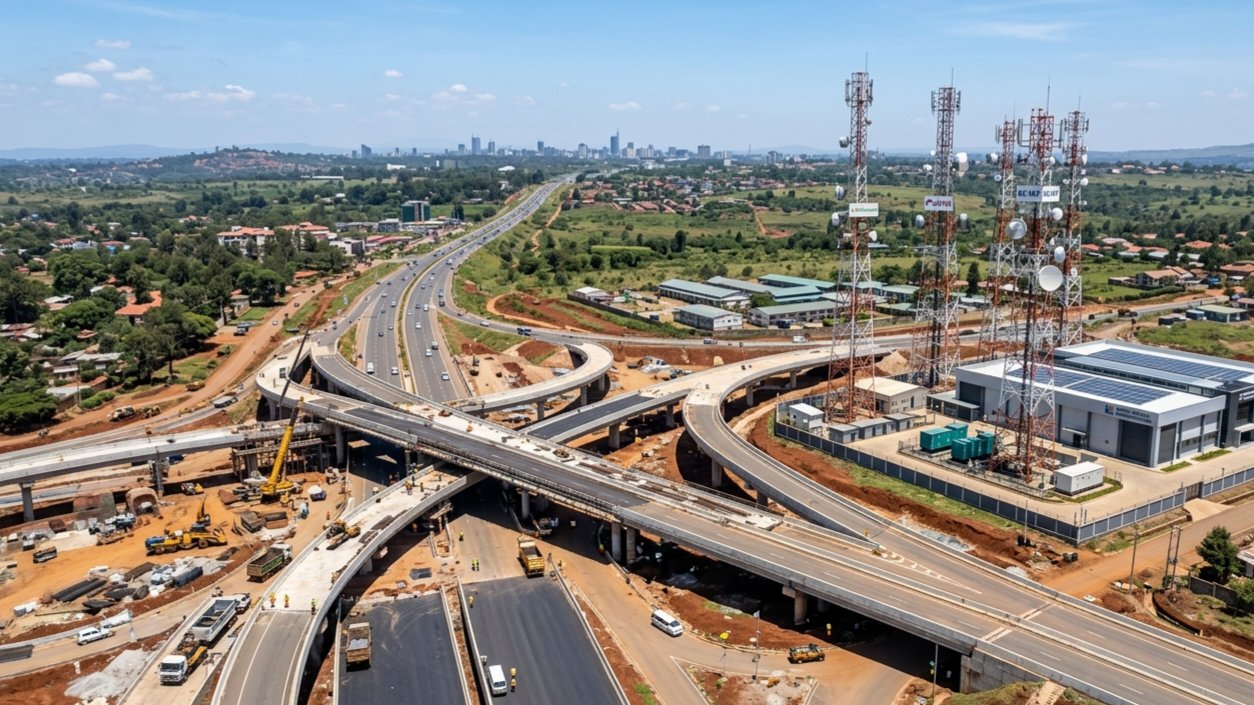

The traditional view of infrastructure in Kenya, long dominated by the pouring of concrete and the laying of bitumen, is undergoing a fundamental shift. Recent developments across the nation indicate that technology is no longer an optional add-on but the central nervous system of new projects. This transition involves embedding digital tools into the very fabric of physical builds to improve efficiency and long-term sustainability.
President Ruto has consistently emphasized that 2026 is a year of execution at scale, particularly regarding transport and digital corridors. The expansion of the Standard Gauge Railway (SGR) toward Malaba and the planned upgrades at Jomo Kenyatta International Airport (JKIA) are now being planned with advanced logistics software and automated monitoring systems. These tools are designed to manage the increased capacity and reduce the bottlenecks that have historically plagued major transit hubs.
Data has become the primary asset for modern planners, if the current trajectory of the Ministry of ICT is any indication. Platforms like Digital Earth Africa are now providing satellite-derived intelligence that allows engineers to monitor land changes, water levels, and structural integrity from space. This predictive intelligence is a departure from the reactive maintenance schedules of the past, which often led to costly emergency repairs and project delays.
The government is also prioritizing the rollout of Digital Innovation Hubs, with over 300 facilities currently operational. These hubs function as localized infrastructure, providing the connectivity necessary for a digital economy to thrive outside of Nairobi. By equipping these centers with high-speed fiber and modern hardware, the state is creating a distributed network of infrastructure that supports both physical trade and digital services.
Financing for these technological leaps is being bolstered by international partners. A KES 50.3 billion loan from the World Bank is currently being utilized to upgrade digital infrastructure and expand broadband access. This funding supports the Kenya Digital Economy Acceleration Project, which aims to create a secure, shared fiber database to attract further private investment into the technology ecosystem.
In the energy sector, the integration of technology is visible at Konza Technopolis. The data center there operates on renewable geothermal energy, reflecting a broader trend of aligning digital growth with environmental goals. Smart grids and AI-driven resource allocation are also being tested to manage power distribution, which helps in reducing the operational costs of large-scale manufacturing and housing projects.
This tech-forward approach extends to water and irrigation, where projects like the Galana-Kulalu dam are incorporating automated sensors. These devices provide real-time data on soil moisture and water flow, ensuring that resources are used efficiently. As Kenya continues to build, the focus remains on ensuring that every new bridge, road, and dam is as smart as it is sturdy.
Comments (0)
Leave a Comment
No comments yet. Be the first to share your thoughts!