

A version of this article appeared on Business Daily Africa.
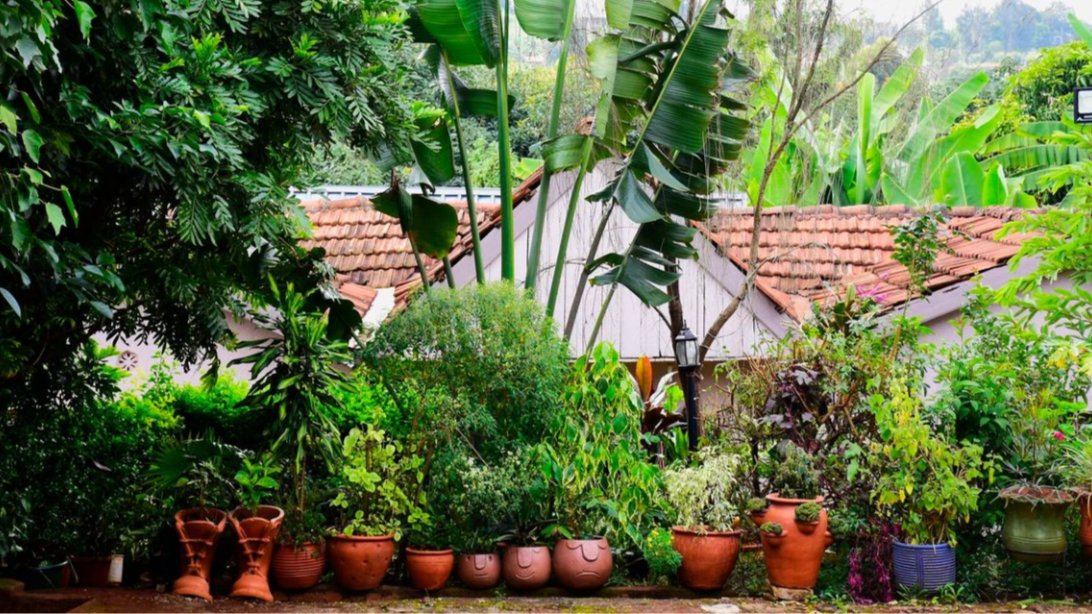
In a quiet residential setting, one homeowner has reworked a conventional compound into a series of outdoor spaces defined not by walls, but by planting. The garden, now home to more than 2,000 plants, is arranged into distinct sections described as “rooms”, each with its own character and planting scheme.
The layout departs from typical lawn-dominated compounds. Instead, vegetation is used as the primary structuring element. Trees, shrubs and climbers form boundaries, guide movement and create visual breaks, allowing each section to function as an independent space while remaining part of a continuous landscape.
The approach reflects a deliberate design process rather than incremental planting. Each “room” is organised around a theme, with plant selection and placement reinforcing its intended use. Some areas prioritise colour and flowering species, while others rely on foliage texture or shade.
Pathways connect the different sections, offering controlled circulation through the garden. These routes are not merely functional. They frame views, reveal new spaces gradually and reinforce the sense of transition between one “room” and another.
The scale of planting is notable. Managing over 2,000 plants requires ongoing maintenance, from pruning and watering to soil management. The density also creates microclimates within the garden, where shade, moisture and airflow vary across short distances.
This form of garden planning draws on principles commonly seen in landscape architecture, where outdoor spaces are zoned similarly to interior layouts. The use of planting as a spatial tool is well established globally, but remains less common in typical residential plots, where boundaries are often defined by fences or built structures.
In this case, vegetation replaces hard boundaries. Hedges act as walls. Trees provide vertical definition. Ground cover and layered planting soften transitions. The result is a garden that feels segmented without being enclosed.
The design also responds to practical considerations. By dividing the garden into smaller sections, maintenance can be managed in phases. It also allows for gradual adaptation, as plants mature or are replaced over time.
Beyond aesthetics, the garden supports biodiversity. A wide range of plant species attracts insects, birds and other small wildlife. This contributes to a more dynamic environment compared to simpler, single-use lawns.
The project highlights how residential outdoor spaces can be rethought using relatively accessible materials. While the scale of planting may not be typical, the underlying idea of dividing space through vegetation can be applied at different sizes and budgets.
It also reflects a broader shift in how homeowners engage with outdoor areas. Rather than treating gardens as passive spaces, there is increasing interest in active design, where layout, planting and use are planned with intention.
For this homeowner, the result is a garden that functions as a sequence of spaces rather than a single open area. Each section offers a different experience, shaped entirely by planting choices and spatial arrangement.
The outcome is not defined by size alone, but by how the space is organised.
Comments (0)
Leave a Comment
No comments yet. Be the first to share your thoughts!