
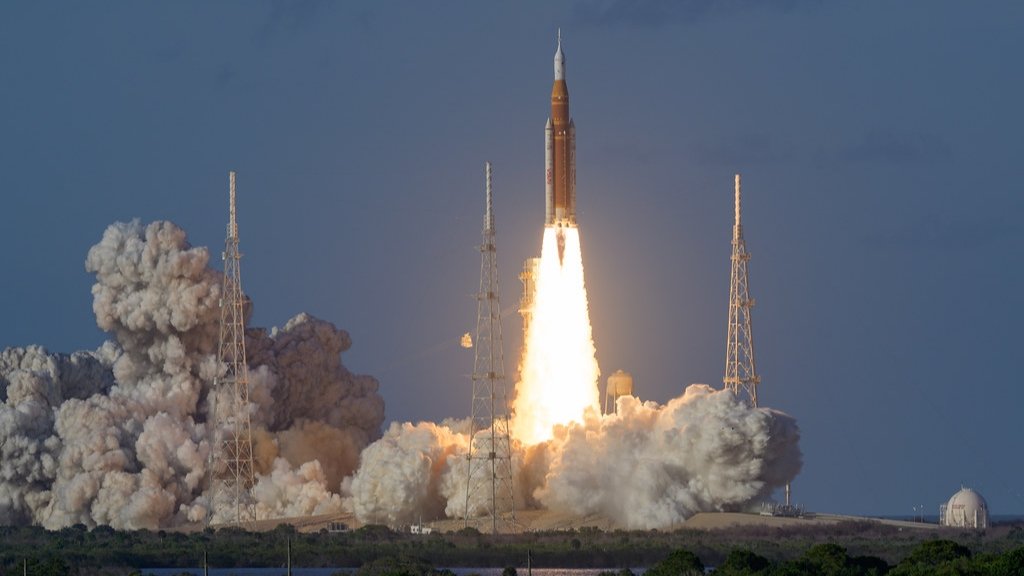

NASA’s Space Launch System rocket lifted off from Launch Pad 39B at Kennedy Space Center in Florida at 6:35 p.m. EDT on April 1, carrying four astronauts aboard the Orion spacecraft. The successful departure kicked off the first crewed flight of the Artemis program and the first crewed lunar flyby in more than 50 years.
Spurred by American ingenuity, the crew is already deep into flight operations. Reid Wiseman, Victor Glover, Christina Koch and Canadian Space Agency astronaut Jeremy Hansen named their spacecraft Integrity. They are putting the vehicle through its paces on what NASA describes as a planned 10-day test mission.
Immediately after clearing the pad the Orion deployed its solar array wings to draw power from the Sun. Ground teams and the astronauts then shifted the spacecraft from launch configuration to cruise mode, running initial checks on critical systems. About 49 minutes into the flight the rocket’s upper stage completed its first burn, placing Orion into an elliptical orbit around Earth.
A second planned burn followed, sending the spacecraft into a high Earth orbit that reaches roughly 46,000 miles beyond the planet. Once that maneuver finished, Orion separated cleanly from the upper stage and began flying under its own power. The crew has spent the past hours methodically verifying every major system while Mission Control in Houston monitors data in real time.
Engineers on the ground still have several hours before the upper stage, now a safe distance away, releases four small CubeSats built by Argentina’s space agency, Germany’s aerospace center, South Korea’s space administration and Saudi Arabia’s space agency. Those satellites will carry their own science payloads and technology demonstrations.
For the remainder of today the crew will stay in that high Earth orbit. They plan a manual pilot demonstration to test how Orion handles under direct crew control. Every switch, display and thruster response is being logged. If all systems continue to perform as expected, controllers will command the European-built service module to fire its main engine later today in a six-minute translunar injection burn.
That burn will sling the spacecraft out of Earth orbit and onto a trajectory that loops around the Moon. The flyby itself is scheduled for Monday, April 6. During the multi-hour pass the astronauts will photograph sections of the lunar surface, including areas on the far side never seen up close by previous crews. The lighting conditions at that moment should cast long shadows across ridges and crater rims, giving sharper relief than full sunlight usually allows.
The mission also includes human-health experiments such as the AVATAR study, which will gather data on how crews cope with deep-space conditions. Those results will shape planning for later Artemis landings and eventual flights to Mars. NASA has described the flight as a pure test, designed to prove the rocket, spacecraft and ground systems before committing crews to surface operations.
Back at Kennedy, the launch marked the latest use of infrastructure built for the Apollo era and upgraded over decades for the new generation of exploration. The four astronauts represent a mix of NASA veterans and international partners, chosen specifically for their experience with long-duration flight and complex spacecraft operations.
NASA Administrator Jared Isaacman called the launch a defining moment. “Artemis II builds on the vision set by President Donald J. Trump, returning humanity to the Moon for the first time in more than 50 years and opening the next chapter of lunar exploration beyond Apollo,” he said. “Aboard Orion are four remarkable explorers preparing for the first crewed flight of this rocket and spacecraft.”
Associate Administrator Amit Kshatriya added that the real work is only beginning. “Over the next 10 days, Reid, Victor, Christina, and Jeremy will put Orion through its paces so the crews who follow them can go to the Moon’s surface with confidence,” he noted. “We are one mission into a long campaign, and the work ahead of us is greater than the work behind us.”
After the lunar flyby the crew will ride the Moon’s gravity back toward Earth and splash down in the Pacific Ocean. The data gathered during every hour of this flight will feed directly into preparations for Artemis III and the first crewed landing since Apollo 17.
NASA has invited the public to follow live updates, additional imagery and telemetry at the agency’s Artemis II mission page.
Comments (0)
Leave a Comment
No comments yet. Be the first to share your thoughts!