
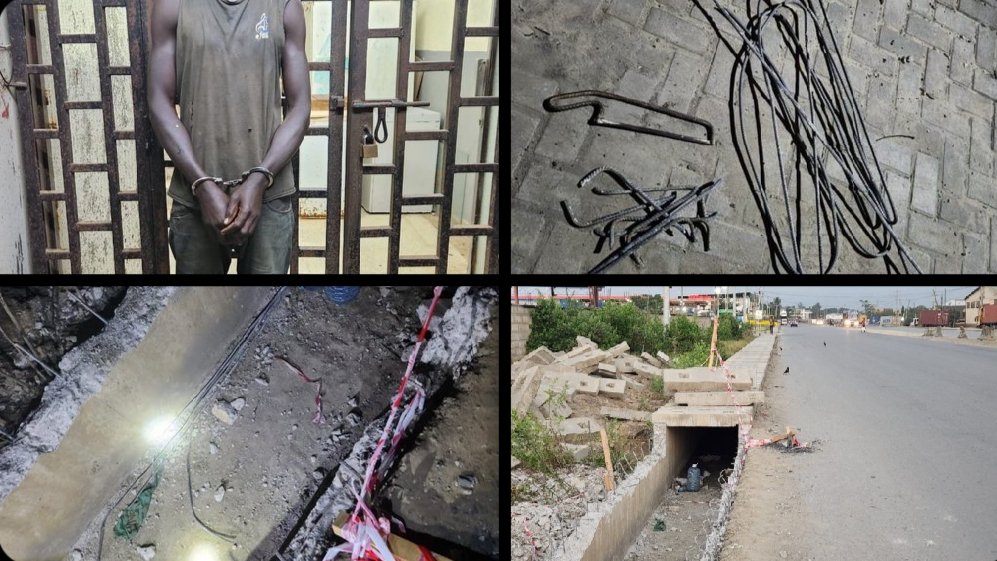

The Kenya National Highways Authority has welcomed a court decision that sentenced a man to two years in prison for vandalising road infrastructure. Fredrick Rakoro was arrested by the Axle Load Enforcement Highway Unit in the Coast Region and arraigned before the Mombasa Law Courts.
He pleaded guilty to an offence under Section 24 of the Scrap Metal Act, 2015. The court sentenced him to two years’ imprisonment at Shimo La Tewa Prison without the option of a fine. Rakoro had been found vandalising drainage structures and removing reinforcement bars from a newly constructed section of the Mombasa–Mariakani (A8) Highway near Jomvu.
KeNHA condemned acts of vandalism and theft that undermine public investment, endanger road users and compromise the integrity of the national road network. The Authority urged members of the public to protect infrastructure and report incidents involving road signs, guardrails, drainage structures, manhole covers, road studs, reinforcement bars, streetlights and other assets.
Reports can be made to the nearest KeNHA office, a police station or through the Authority’s toll-free line 0800-211244. Protecting roads is described as a shared responsibility.
Vandalism of road assets remains a persistent challenge on several corridors. Removal of reinforcement bars weakens structural integrity and can lead to premature failure of pavement and drainage systems. Damage to newly completed sections forces authorities to divert maintenance budgets that could otherwise extend the life of older roads.
The Scrap Metal Act provides specific offences for unauthorised removal of materials from public infrastructure. Courts have increasingly applied custodial sentences in cases involving deliberate damage to roads and bridges. The absence of a fine option in this instance reflects the seriousness attached to the offence.
Coast Region has recorded multiple incidents of infrastructure interference in recent years. Enforcement units combining highway police and axle-load teams have improved detection rates. Collaboration between KeNHA and security agencies is essential for rapid response and successful prosecution.
Public cooperation remains critical. Many acts of vandalism occur at night or in remote sections where surveillance is limited. Timely reports from road users and nearby communities increase the chances of interception before significant damage occurs.
The conviction is expected to serve as a deterrent. KeNHA continues to monitor vulnerable sections of the trunk network and to strengthen physical protection of high-value components such as reinforcement and drainage covers. Sustained enforcement and community vigilance will determine whether similar cases decline.
Investment in new highways represents a major public commitment. Protecting those assets after construction is equally important if the expected economic and safety benefits are to be realised over the design life of the roads.
Comments (0)
Leave a Comment
No comments yet. Be the first to share your thoughts!