
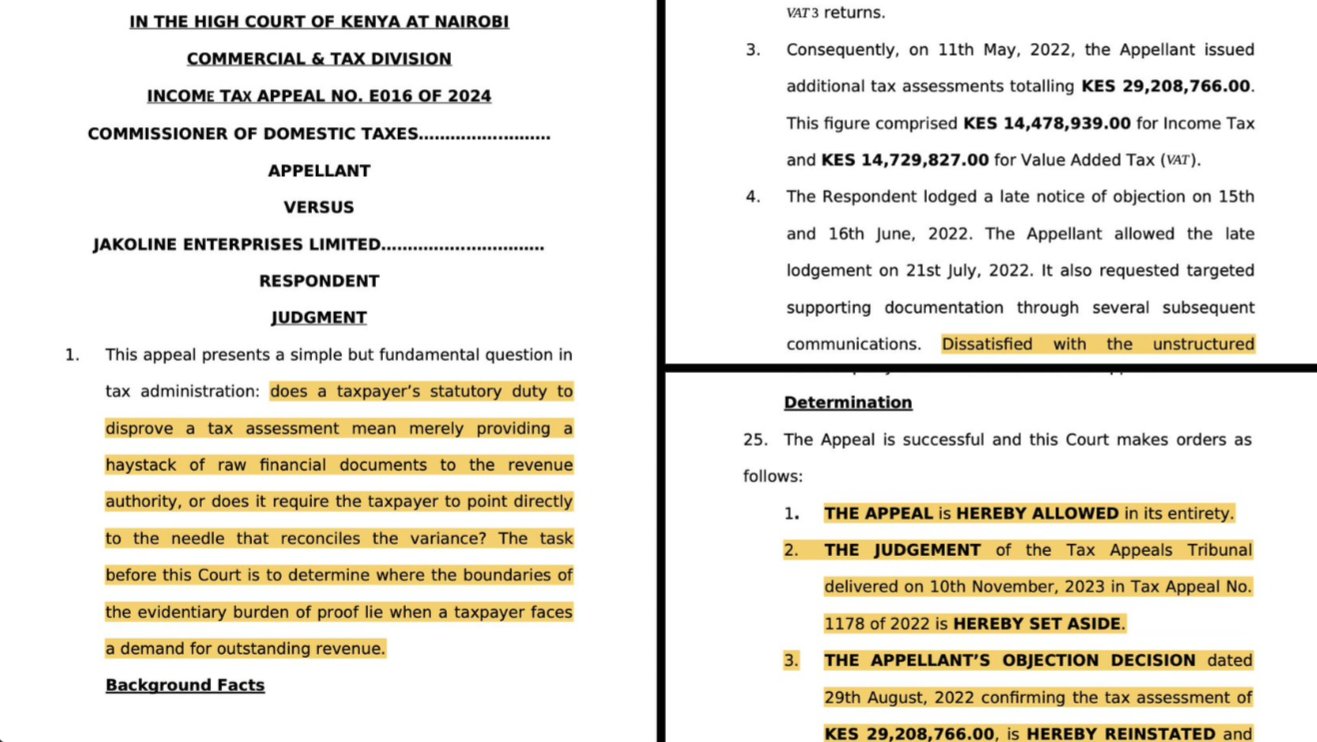

The High Court of Kenya at Nairobi Commercial and Tax Division has issued a judgment addressing the scope of a taxpayer's evidentiary burden when challenging revenue assessments.
In Income Tax Appeal No. E016 of 2024, the Commissioner of Domestic Taxes (CDT) brought an appeal against Jakoline Enterprises Limited (JEL).
The case centers on whether submitting raw financial documentation satisfies a taxpayer's statutory duty, or whether specific reconciliation is required.
Judges evaluated the boundaries of proof necessary when corporate entities face demands for outstanding revenue, establishing parameters for document presentation during tax audits.
Legal representatives presented arguments regarding how financial records must be organized, reconciled, and submitted to the Kenya Revenue Authority (KRA).
The dispute highlights ongoing scrutiny over how businesses handle tax assessments, reconciliations, and supporting documentation during legal appeals.
Tax law experts note that disputes involving corporate revenue demands frequently hinge on the clarity of financial submissions.
The High Court ruling sets clear expectations for enterprise tax appeals across commercial and industrial sectors.
In tax dispute proceedings, the burden of proof rests on the taxpayer seeking to disprove revised tax liability assessments.
Providing unstructured financial files does not automatically discharge statutory obligations during tax verification exercises.
Revenue authorities maintain powers to issue assessments where reconciliation between filed returns and raw financial data remains absent.
Corporate entities operating in construction, infrastructure, and commercial property developments frequently navigate complex tax assessment structures.
Proper accounting entries, reconciliation reports, and clear audit trails remain essential during statutory tax assessment reviews.
The Commercial and Tax Division emphasized that taxpayers must directly reconcile variances identified by revenue officials during tax audits.
Failure to align financial documentation with declared income leaves corporate taxpayers vulnerable to upheld tax assessments.
Legal teams representing both sides appeared in court to argue the interpretation of statutory tax provisions governing evidence submission.
The decision provides procedural clarity for enterprises managing tax liabilities, compliance obligations, and formal appeal filings in Kenya.
Businesses facing revenue demands must ensure that supporting documents directly match financial entries under review by tax auditors.
The judgment reinforces standard evidentiary requirements in high-value tax litigation across commercial sectors in Kenya.
Comments (0)
Leave a Comment
No comments yet. Be the first to share your thoughts!