
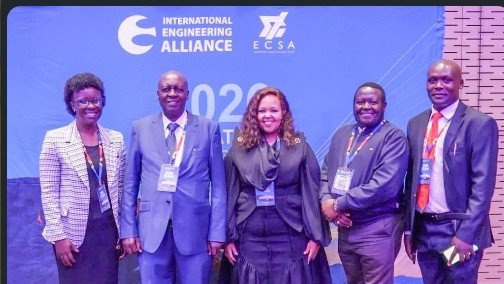

Kenya’s delegation participated in the International Engineering Alliance Meeting (IEAM) hosted by the Engineering Council of South Africa (ECSA), bringing together engineering regulators and professionals from different countries to discuss shared standards and cooperation in the sector.
The meeting focused on strengthening collaboration between member countries in the engineering field. It provided a platform for discussing how engineers can work across borders under common frameworks while maintaining quality, safety, and accountability in professional practice.
Kenya was represented by officials from engineering regulatory bodies and professional institutions. The delegation engaged with counterparts from other countries to share experiences on regulation, training and the development of engineering competencies.
A key area of discussion was the accreditation of engineering programmes. Delegates explored ways to align university curricula with international standards to ensure that graduates are well prepared for both local and global engineering demands.
The talks also addressed professional registration systems. Participants considered how different countries assess engineers and how mutual recognition can help qualified professionals practice in other jurisdictions more easily and fairly.
Another important issue was mobility of engineers across regions. The meeting highlighted the need for systems that support the movement of skilled professionals while maintaining trust in qualifications and ensuring public safety in engineering work.
Infrastructure development featured strongly in the discussions. Delegates noted that engineering plays a central role in roads, energy, housing, and water projects, and stressed the importance of shared knowledge to improve project delivery.
Climate change and environmental concerns were also raised. The participants discussed how engineers can contribute to sustainable development by designing projects that reduce environmental impact and improve resilience to changing weather patterns.
The meeting further looked at the role of technology in engineering practice. Digital tools, data systems, and modern design methods were highlighted as important areas that can improve efficiency and accuracy in engineering work.
Regional cooperation within Africa was another focus point. Delegates agreed that stronger collaboration between engineering bodies in African countries can help build capacity and support large-scale development projects across the continent.
For Kenya, the engagement provided an opportunity to benchmark its engineering systems against international practices. It also allowed Kenyan representatives to learn from other countries’ experiences in regulation and professional development.
The discussions are expected to support Kenyan engineers by improving recognition of qualifications and expanding opportunities for work and collaboration beyond national borders in the future.
The meeting concluded with a shared commitment to continue strengthening cooperation among member countries. Participants emphasized the importance of regular dialogue to support consistent growth and improvement in the engineering sector globally.
Comments (0)
Leave a Comment
No comments yet. Be the first to share your thoughts!