
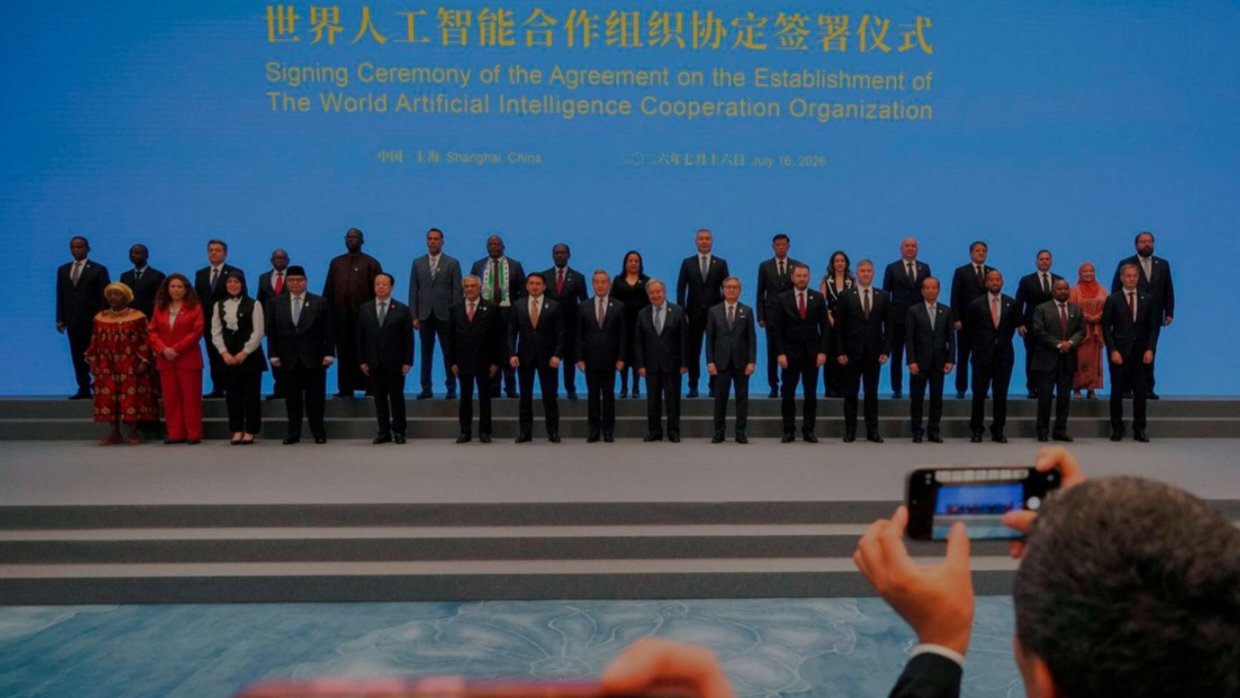

Kenya joined twenty-eight other founding nations in Shanghai to sign the agreement establishing the World Artificial Intelligence Cooperation Organization (WAICO). The international body aims to foster global digital collaboration, while ensuring equitable technological access for developing nations across the Global South.
By taking a founding seat, Kenya secures direct representation in global policy discussions that affect technology standards across the African continent. The initiative comes at a time when digital infrastructure investments, such as next-generation data centers and fiber optic networks, are expanding rapidly across developing regions.
Delegates from participating governments gathered alongside representatives from the United Nations (UN) during the official signing ceremony in China. The new organization will maintain its primary operational headquarters in Shanghai to coordinate international research, safety standards, and administrative functions.
Chinese Foreign Minister Wang Yi signed the treaty alongside representatives from member nations spanning Africa, Asia, and Latin America. The foundational charter focuses on creating open technical frameworks, which support technical development and public infrastructure modernization across emerging economies.
African representation in global technology governance has historically remained limited, when international standards were drafted primarily by wealthier industrial nations. Kenya now positions itself to influence how emerging software systems are deployed in public sectors and critical regional infrastructure projects.
The establishment of WAICO addresses long-standing concerns regarding concentrated computing power and software monopolies held by major corporate tech entities. Without balanced international oversight, smaller nations risk falling behind in adopting automated systems for public services, energy distribution, and urban development.
Under the strategic direction of President Ruto, Kenya continues to build international partnerships that support local digital master plans. The national government seeks to expand high-speed data connectivity, green computing hubs, and specialized technology training programs for local professionals nationwide.
Domestic integration of high-performance computing requires clear guidelines to protect citizen data, while encouraging private enterprise. Joining the Shanghai initiative provides Kenyan officials access to joint technical frameworks, which reduce the overall cost of building custom regulatory systems from scratch.
The agreement outlines commitments to shared research initiatives, ethical deployment standards, and mutual technology transfers among participating states. Emerging markets expect these shared mechanisms to lower entry barriers for local software developers, civil engineers, and municipal infrastructure planners.
Global technology analysts note that coordinated governance will prove critical, as automation enters core civil sectors like logistics, power grids, and transport networks. Direct involvement in drafting rules gives regional economies a stronger voice in international trade and technology agreements.
Kenya joins fellow African founding members, including South Africa, Ethiopia, Cameroon, and Senegal, in supporting the intergovernmental framework. The participating states plan to convene regular ministerial sessions to refine multilateral guidelines, while supporting joint digital projects across member borders.
Beyond multilateral diplomacy, the partnership offers technical assistance for public sector digitalization projects across East Africa. Local agencies hope to leverage these global agreements to accelerate smart infrastructure projects, including automated traffic management and digital land registries.
As implementation begins, Kenyan government agencies will align local regulations with the broader international charter. Country representatives expect these diplomatic efforts to attract hardware investment, while safeguarding national sovereignty in an increasingly automated global economy.
Future summits will outline concrete technical standards for data protection, cross-border data flows, and sovereign digital infrastructure. Kenya remains positioned to help shape those frameworks, ensuring African priorities remain central in global technology policy discussions.
Comments (0)
Leave a Comment
No comments yet. Be the first to share your thoughts!