
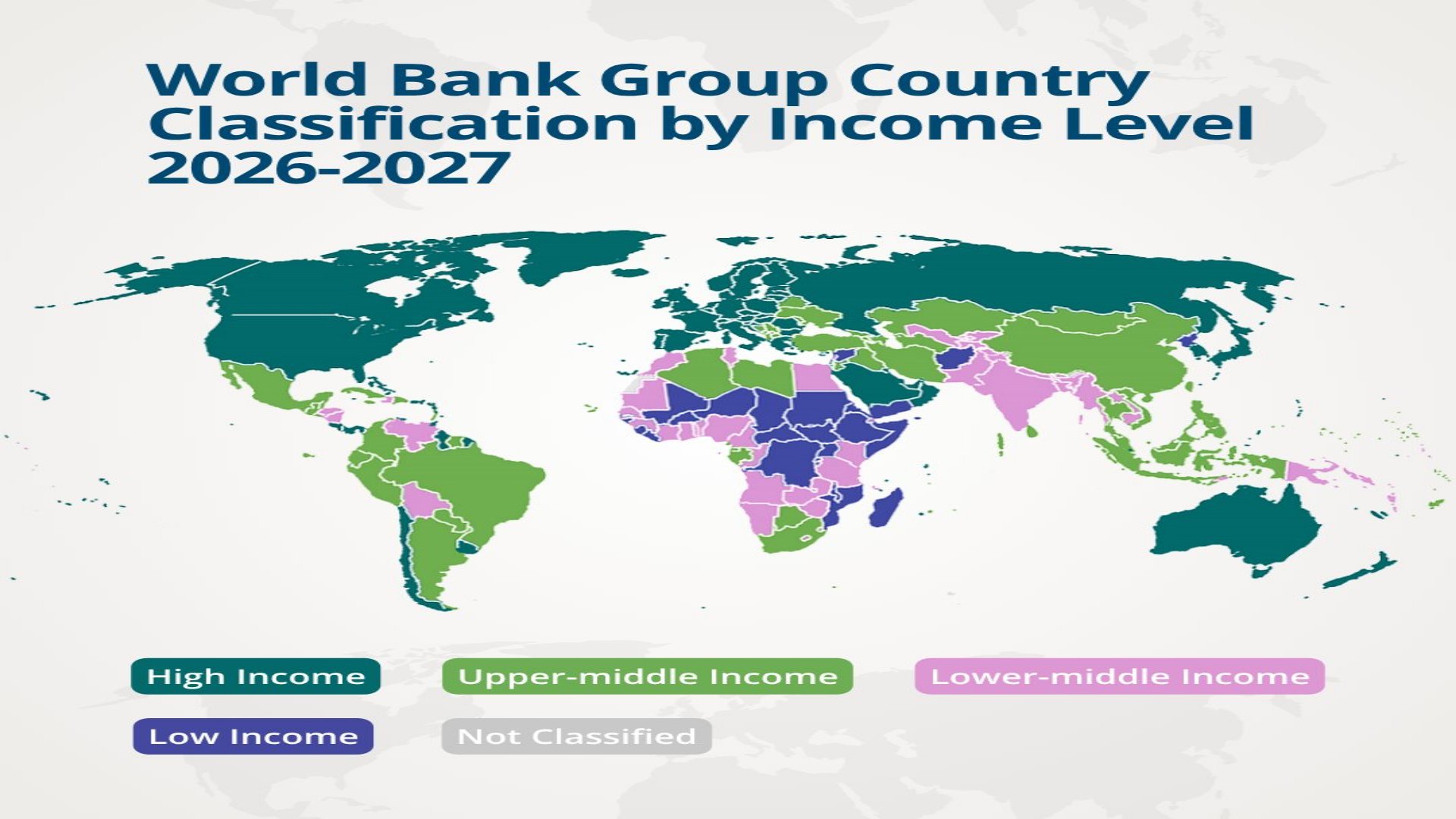

The World Bank Group (WBG) has released its 2026-2027 country income classifications, confirming that six nations moved to a higher income category during the latest annual review.
No countries shifted downward in the updated standings. The multilateral lender updates its four economic tiers every year on July 1 based on the Gross National Income (GNI) per capita from the previous calendar year.
The classification system divides global economies into four primary tiers: low income, lower-middle income, upper-middle income, and high income. The calculations use the Atlas methodology, which smooths out short-term foreign exchange rate volatility to allow consistent international comparisons.
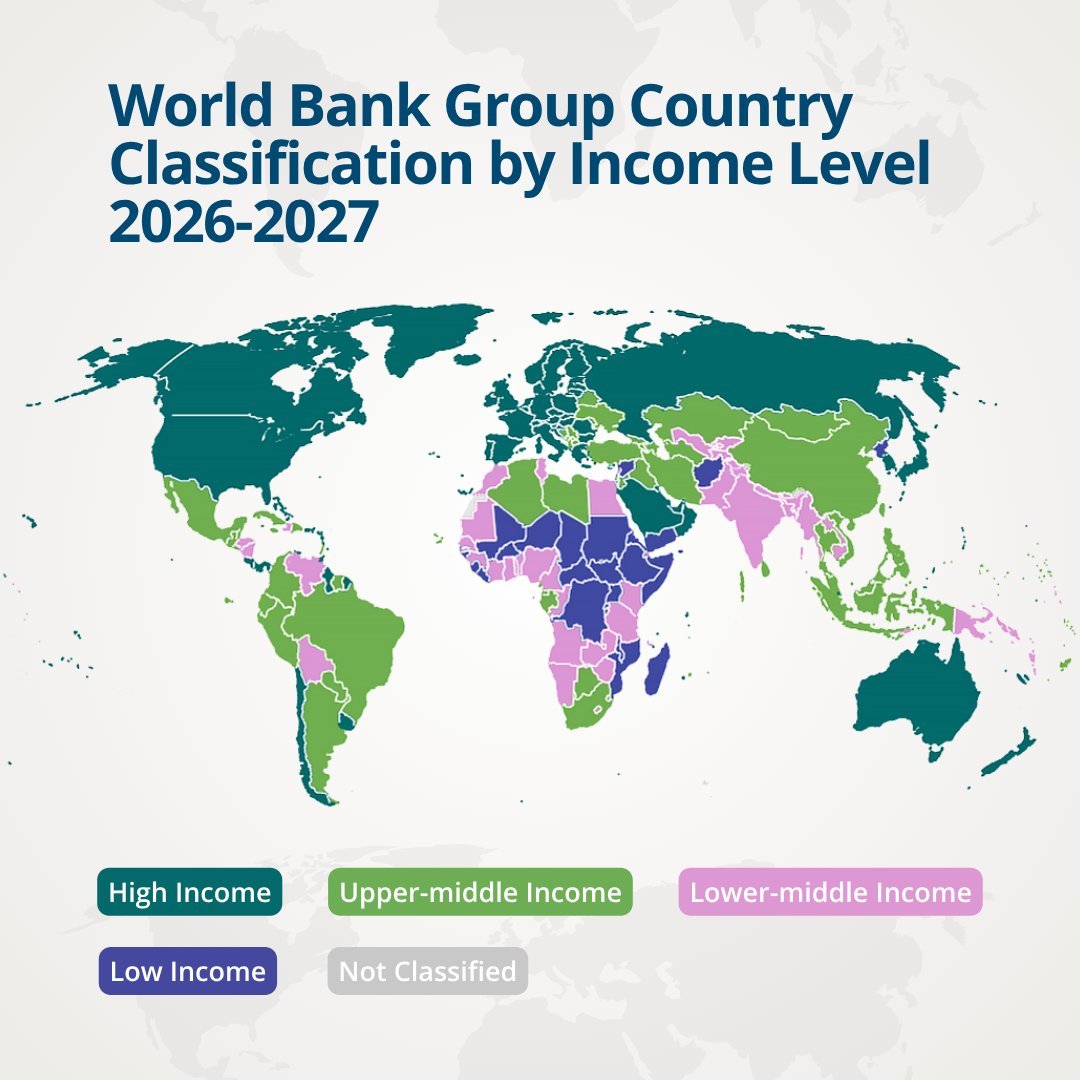
The world bank group's economic ranking of nations. Photo: World Bank Group/ X
For the 2026-2027 period, the Gross National Income (GNI) per capita thresholds stand at USD 1,175 or less for low income, USD 1,176 to USD 4,635 for lower-middle income, USD 4,636 to USD 14,375 for upper-middle income, and above USD 14,375 for high income.
Five nations moved from lower-middle income status to upper-middle income status. These include Jordan, the Federated States of Micronesia, the Philippines, Sri Lanka, and Viet Nam.
Togo was the sole nation to shift out of the low-income tier, advancing into the lower-middle income category.
The underlying factors driving each reclassification varied significantly across the six nations. Some upgrades stemmed from sustained export-led manufacturing growth, while others resulted from statistical revisions to national accounts, broad-based domestic expansion, or post-crisis economic recoveries.
In the case of Togo, the movement reflected a combination of domestic GDP growth and a population census revision that adjusted per capita figures upward.
The World Bank Group (WBG) updates these classifications to reflect underlying economic capacities and long-term development trends across 218 tracked economies. The thresholds are adjusted annually to account for global inflation using the Special Drawing Rights (SDR) deflator.
These annual classifications carry practical implications for borrowing governments worldwide. They determine eligibility for concessional financing, official development assistance, and specific lending windows managed by international institutions.
Comments (0)
Leave a Comment
No comments yet. Be the first to share your thoughts!