
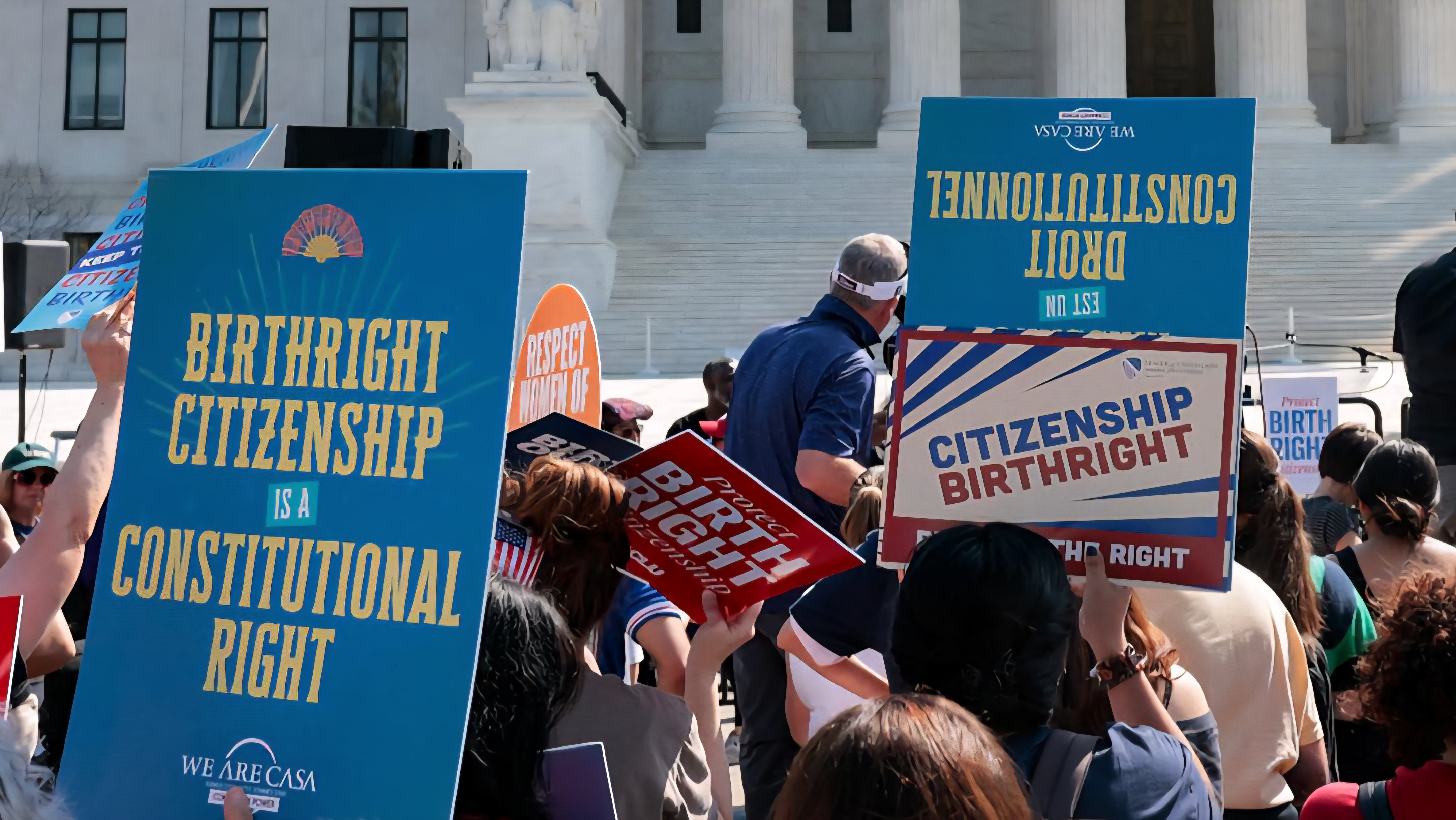

The United States (US) Supreme Court rejected an executive order by President Donald Trump, who sought to end automatic citizenship for children born on American soil to undocumented immigrants or temporary visa holders.
The 6-3 ruling on the final day of the judicial term invalidates a core pillar of the current administration’s immigration platform, which attempted to rewrite citizenship rules.
Chief Justice John Roberts authored the majority opinion, affirming a legal principle that has stood for over a century and a half.
The decision maintains that nearly everyone born within the country is a citizen under the Citizenship Clause of the 14th Amendment, although the administration argued otherwise.
"Citizenship, then and now, was the right to have rights to freely participate in our political community," Roberts wrote in the opinion.
He added that the framers of the amendment extended that promise to every free-born person, and the court kept that promise today.
President Trump signed the controversial order on January 20, 2025, when he returned to the Oval Office for his second term.
The directive immediately drew fierce legal opposition from a broad coalition of civil rights groups, but the American Civil Liberties Union (ACLU) led the legal challenge.
Lower courts quickly blocked the policy, if temporary injunctions were applied across the country, pushing the constitutional battle to the highest court.
In an unusual move for a sitting American leader, President Trump personally attended the oral arguments for the case in April.
The administration argued that the phrase "subject to the jurisdiction" in the amendment did not apply to children of non-citizens, if the parents lacked permanent legal status.
US Solicitor General John Sauer argued the post-Civil War amendment was intended exclusively to secure the status of formerly enslaved people.
The high court rejected that narrow interpretation, finding that the text and historical public meaning supported broad birthright citizenship.
Justice Amy Coney Barrett joined the liberal bloc and the Chief Justice to form the five-member constitutional majority, who supported the long-held precedent.
Justice Brett Kavanaugh agreed with the final outcome, but he noted that the order violated federal statutes rather than the constitution itself.
Three conservative justices dissented from the ruling.
Justice Clarence Thomas, who was joined by Justice Neil Gorsuch, argued that the decision devalues the true meaning of American citizenship.
Justice Samuel Alito wrote a separate dissent, calling the judicial decision a serious mistake, which preserves a powerful incentive for unlawful entry.
Reacting to the defeat, President Trump expressed his disappointment on his Truth Social platform, but he insisted the fight would continue.
He urged lawmakers in the legislature to begin working immediately on new legislation, if they wish to restrict birthright citizenship through statutory changes.
Following the ruling, the Department of Justice (DOJ) issued a memo announcing plans to prioritize investigations into organized birth tourism schemes.
Opponents of the order celebrated the decision as a decisive legal victory for thousands of immigrant families, who faced uncertain futures under the policy.
ACLU National Legal Director Cecillia Wang, who argued the case, stated that a president cannot rewrite the constitution by executive decree.
The judicial ruling follows another major legal setback for the administration, after the high court dismissed sweeping import tariffs in February.
The legal challenge, titled Trump v. Barbara, brought together regional civil rights organizations from New Hampshire, Maine, and Massachusetts.
Legal scholars noted that the administration relied heavily on a previous case, United States v. Wong Kim Ark, to argue for a domicile requirement.
However, the majority found that the word domicile does not appear anywhere within the text of the 14th Amendment.
Political leaders also responded quickly to the development.
House Minority Leader Hakeem Jeffries called the administration's policy an assault on the American way of life, but conservative lawmakers promised legislative countermeasures.
The decision brings to a close a highly watched legal term, which drew intense international interest.
Comments (0)
Leave a Comment
No comments yet. Be the first to share your thoughts!