
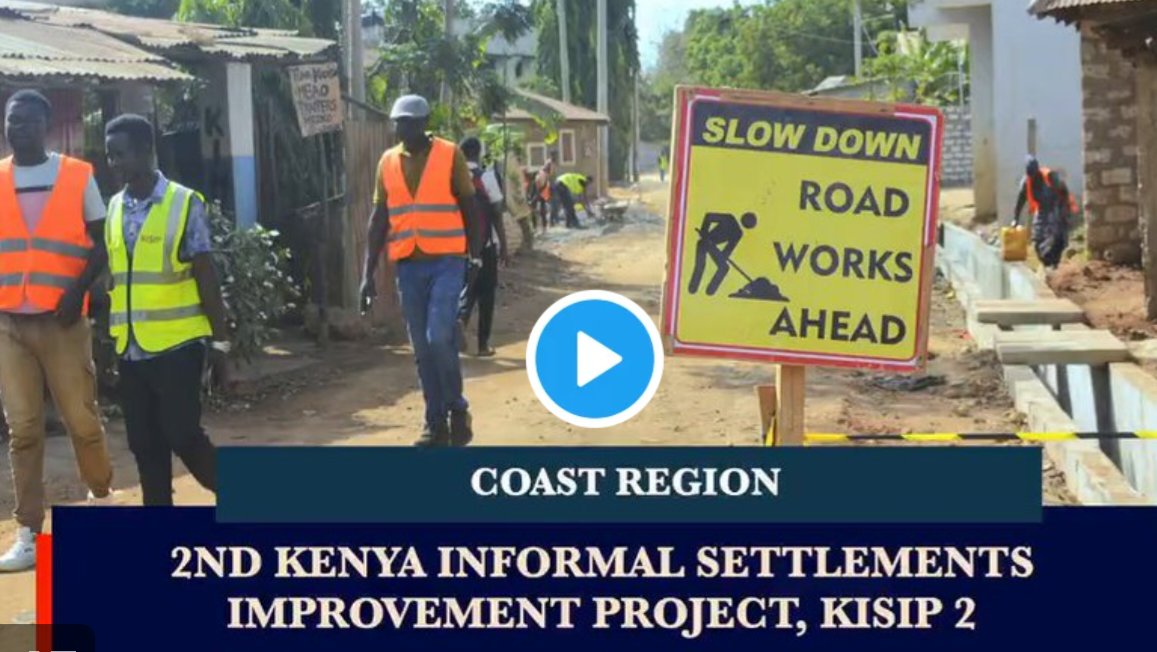

President Ruto shared updates showing the progress of infrastructure works under the Second Kenya Informal Settlements Improvement Project (KISIP 2) within the Coast region. The update emphasizes the ongoing local engineering interventions designed to improve basic living conditions in long-neglected urban settlements.
The presentation highlighted intensive civil works, including drainage development and road paving, currently underway in coastal neighborhoods. This initiative forms part of a broader countrywide effort targeting poorly serviced urban areas, with Kilifi County emerging as a focal point for these upgrades.
Local residents in Kilifi reported that several informal settlements are seeing infrastructural upgrades for the first time in decades. Local leaders previously noted that the verification of safeguards and land use plans had to be completed before contractors could safely deploy heavy machinery.
The civil works across the region involve a combination of basic service provision and structural regularisation. According to official project briefs, the national scope of KISIP 2 involves upgrading roads, installing reliable water supply lines, and establishing proper sanitation networks across dozens of settlements.
Financially, the institutional framework for KISIP 2 relies heavily on multilateral support. The global initiative operates as an Investment Project Financing development valued at 165 million US dollars in total funding.
The International Development Association (IDA) provided a credit facility worth 150 million US dollars to support the project. The Government of Kenya (GoK) committed an additional 15 million US dollars in counterpart funding to ensure domestic execution.
With the project timeline scheduled to close within the calendar year of 2026, work on the ground has intensified. Engineers and contractors are racing against tight deadlines to hand over completed roads and drainage systems to the respective county governments.
In Kilifi County alone, the infrastructure investments under this multi-million dollar arrangement are valued at approximately 1.2 billion shillings. These funds cover extensive structural upgrades in specific settlements such as Mtaani, Kisumu Ndogo, Kalolo, Kibaoni, and Bayamagonzi.
Similar interventions extend to Malindi town, where neighborhoods like Muyeye and Kibokoni have historically grappled with poor access and flooding. The installation of lined open drains and stable base layers for roads aims to mitigate these chronic environmental issues.
The implementation architecture divides responsibilities between the national administration and the participating decentralized units. While the national team coordinates procurement and overall design, the Kilifi County project coordination unit manages daily site oversight and engineering verification.
Community involvement remains central to preventing local disputes during construction. Settlement Executive Committees (SEC) were formed in each target area to handle community mobilization, and ensure residents understand the boundaries of the public works.
Additionally, Grievance Redress Committees (GRC) operate on site to receive and resolve complaints regarding property alignment or temporary disruptions. Unresolved issues can escalate through formal institutional channels up to the World Bank.
The civil works also integrate social programs alongside physical infrastructure. The project incorporates labor-intensive community works, which offer short-term employment to local youth through cash-for-work initiatives.
This approach provides immediate income to vulnerable households while the physical improvements are built. Contractors are utilizing local labor for manual excavation and block paving, keeping project expenditures within the immediate community.
The ultimate objective of these coastal interventions remains the formalization of living spaces. By aligning infrastructure with proper land surveys, the state intends to facilitate secure land tenure for thousands of families currently residing on uncontested public lands.
Comments (0)
Leave a Comment
No comments yet. Be the first to share your thoughts!