
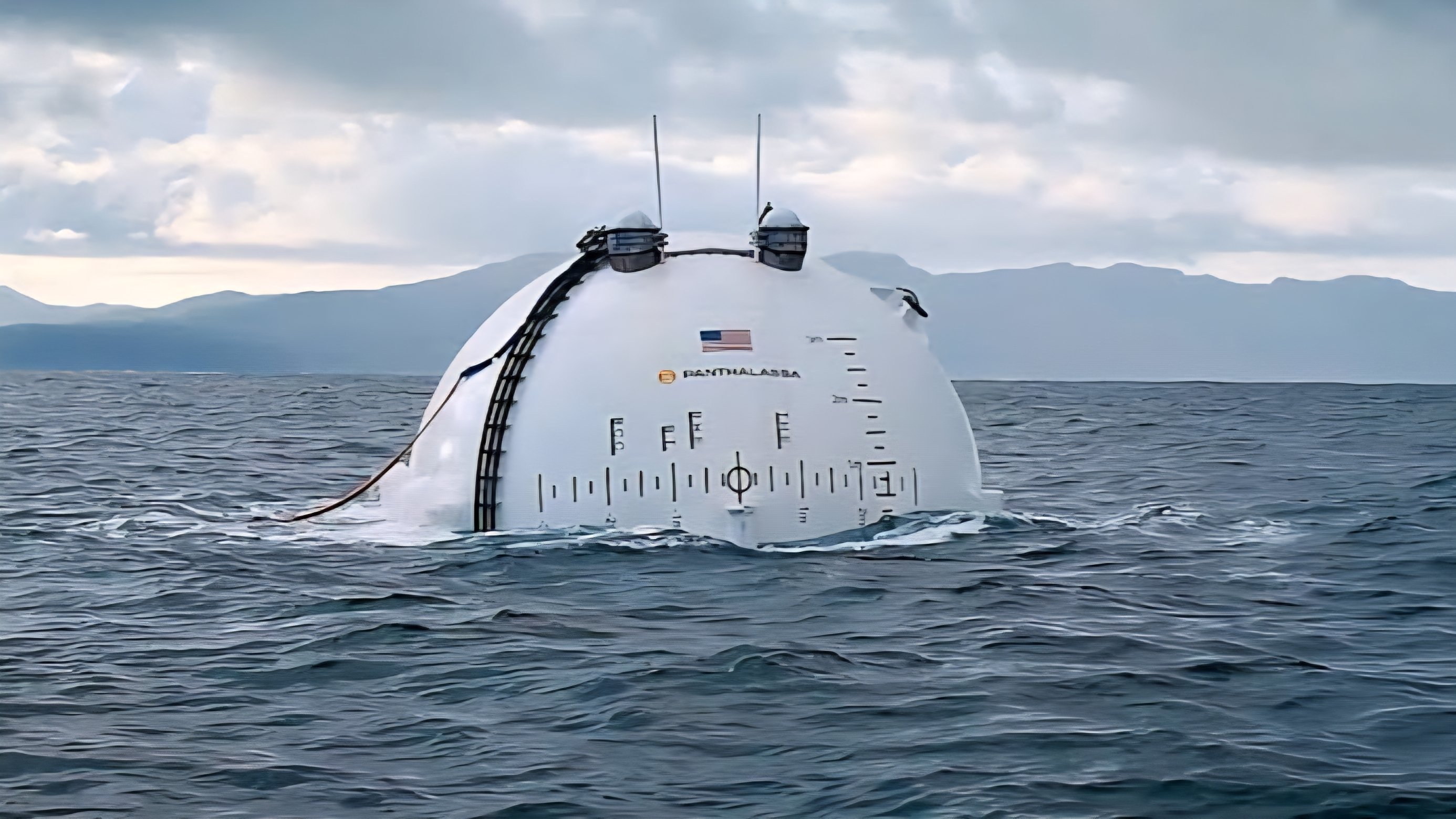

Energy demands from Artificial Intelligence (AI) systems are pushing infrastructure developers far beyond conventional land sites. Rising power needs have driven one engineering startup to move compute hardware directly into open ocean waters.
Portland, Oregon based firm Panthalassa has raised $140 million in Series B funding to deploy floating data infrastructure. The investment round was led by venture capitalist Peter Thiel, pushing the company valuation close to $1 billion.
Other prominent backers include Marc Benioff, Max Levchin, and John Doerr. Investors are backing the concept because it circumvents land availability issues, long permitting processes, and crowded electrical grids on shore.
The core design relies on floating offshore units called nodes. Each node measures 85 meters in length, which is roughly equivalent to the height of Big Ben in London.
These heavy steel structures operate mostly submerged beneath the surface of the sea. As ocean waves move the hull up and down, water forces through internal turbines to generate electrical power continuously without direct fuel consumption.
That electricity feeds directly into high-performance processors housed within a sealed internal compartment. Seawater surrounding the submerged steel vessel cools the computing hardware naturally, which resolves a major operational challenge for heavy compute clusters.
Engineering on the structure remains intentionally simple and robust. The mechanical design eliminates hinges, flaps, and gearboxes, which reduces maintenance demands and mechanical failure risks in corrosive salt water environments.
Nodes require no fossil fuel engines for propulsion during deployment. Once tugboats tow the hull horizontally into deep ocean waters, the unit flips upright and navigates using its specialized hydrodynamic shape.
Data transmission relies entirely on satellite connections provided by SpaceX through Starlink networks. Processing queries at sea eliminates the need for subsea power cables, optical fibers, or seabed transmission lines back to terrestrial grid networks.
Chief Executive Officer (CEO) Garth Sheldon-Coulson noted that open ocean waves offer abundant energy, while capturing power directly at the site eliminates costly energy transport. He emphasized that ocean waves act like a continuous battery for sunlight, operating around the clock.
International Energy Agency (IEA) projections indicate data center energy usage could grow 30 percent annually through 2030. High growth expectations have encouraged operators to explore nuclear restarts, orbital solar arrays, and now floating marine installations.
Manufacturing of the initial commercial nodes utilizes common earth-abundant materials, primarily structural steel. Using standard steel helps mitigate supply chain bottlenecks tied to rare earth minerals required in other renewable energy technologies.
Earlier ocean trials in the Strait of Juan de Fuca and Puget Sound tested smaller prototypes, generating tens of kilowatts in working conditions. The company plans pilot deployments of larger units later this year, with commercial operations planned for 2027.
Uncrewed ocean nodes walk out to target wave locations independently, remaining untethered while performing long-duration compute tasks. Remote operation introduces maintenance questions, but developers maintain that eliminating land grid connections reduces overall project delivery risks.
Offshore compute nodes represent a distinct shift in infrastructure planning, moving raw processing power directly to natural energy sources rather than building heavy transmission networks back to land-based facilities. Industry observers are watching closely as offshore tests progress.
Comments (0)
Leave a Comment
No comments yet. Be the first to share your thoughts!