
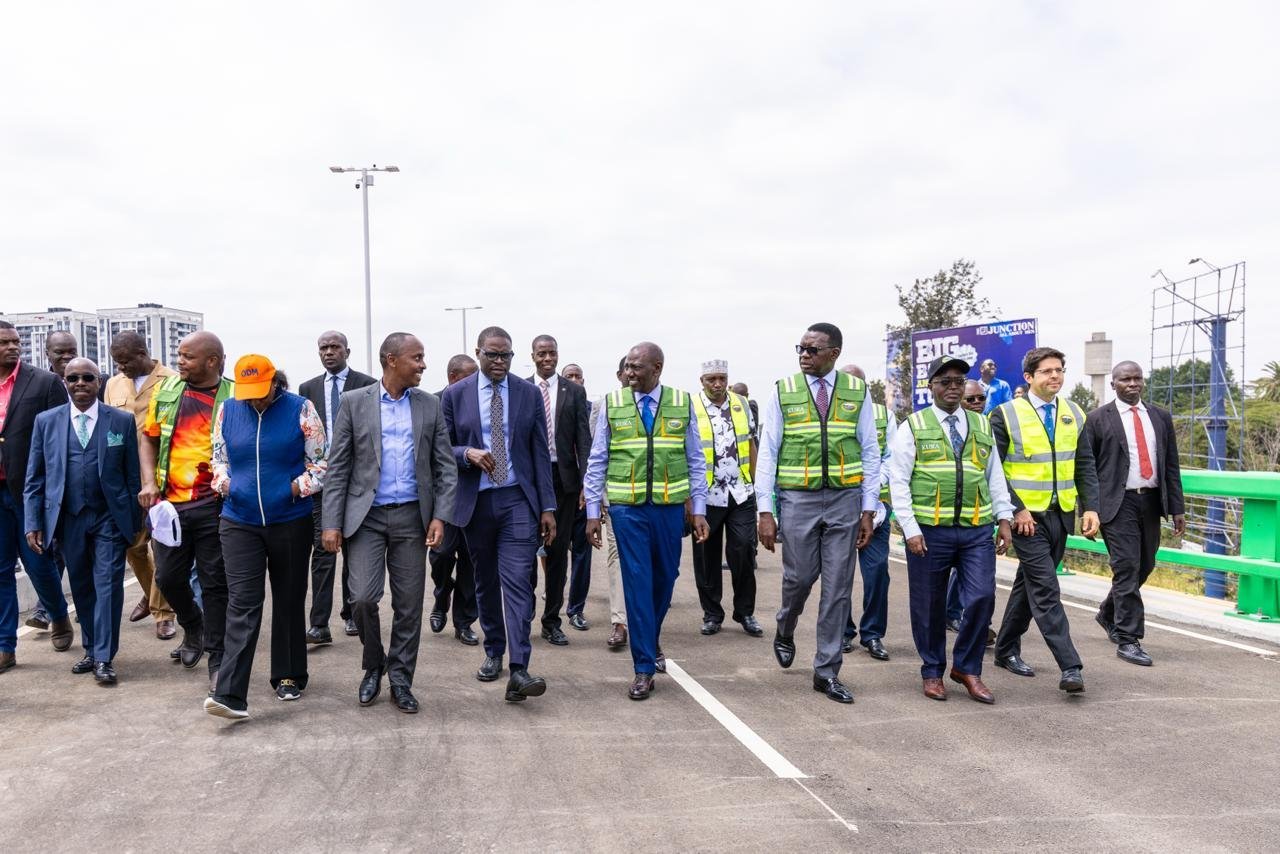

President William Ruto has announced the rollout of an Intelligent Transport System (ITS) covering more than 210 signalised junctions across Nairobi, to be delivered in three phases at a combined cost of KSh 45 billion (approximately USD 348 million).
The announcement came during the launch of the Ngong Flyover on 29 June 2026, where Ruto described the ITS as a coordinated push to bring real-time traffic management to a city that has long struggled with gridlock.
Nairobi currently operates a fragmented traffic control setup. Most signalised junctions function independently, with no central oversight, meaning signal timing cannot respond to conditions elsewhere in the network in real time.
An ITS links traffic signals, cameras, sensors, and control centres into a single managed system. Operators can monitor flow across the entire city and adjust signal behaviour dynamically, reducing bottlenecks before they cascade into wider congestion.
At over 210 junctions, Nairobi's planned network would represent one of the larger ITS deployments on the continent. Cities including Johannesburg and Cairo have implemented similar systems, with long-term outcomes tied closely to maintenance capacity after installation.
Nairobi's congestion problem is well-documented. The city consistently ranks among the most gridlocked in Africa, with commuters on key corridors losing several hours daily. The economic cost in lost productivity and fuel runs into billions of shillings each year.
Road safety is an equally stated objective. Kenya loses thousands of lives to road crashes annually, and poorly managed junctions account for a significant share of that toll. Coordinated signal control is known to reduce side-impact collisions at intersections.
The three-phase structure points to a staged rollout rather than simultaneous deployment across all junctions. No breakdown of which junctions fall under which phase has been publicly detailed at this stage.
At KSh 45 billion, the project represents a substantial public expenditure. Financing arrangements and contractor procurement details had not been disclosed at the time of the announcement.
The Ngong Flyover launch itself marked the completion of a key interchange in Nairobi's road network, with the ITS announcement framing the event within a broader government narrative on urban transport investment.
The push comes as Nairobi continues to absorb rapid urbanisation and a vehicle population that has grown well beyond what the city's road network was originally built to handle. Incremental road upgrades have not kept pace with demand.
Whether the ITS delivers on its stated objectives will depend on how the phased rollout is managed, who operates the central control infrastructure, and whether operational budgets hold beyond the initial commissioning period.
Formal procurement notices linked to the project had not been issued by the Kenya National Highways Authority (KeNHA) or Nairobi city authorities at the time of the President's announcement.
Comments (0)
Leave a Comment
No comments yet. Be the first to share your thoughts!